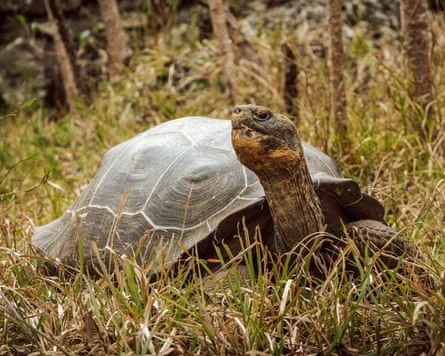
Conservationists and park rangers have successfully returned 158 juvenile giant tortoises to the Galápagos island of Floreana, ending a 180-year absence of the species from its native habitat. The release represents the culmination of decades of genetic research and a massive logistical effort to restore the ecological balance of the sixth-largest island in the archipelago.
The Floreana giant tortoise, scientifically known as Chelonoidis niger niger, was driven to extinction in the mid-19th century by human activity. For nearly two centuries, the island’s unique ecosystem suffered from the loss of its primary herbivore, leading to overgrown landscapes and the decline of other endemic species. This week’s reintroduction is the centerpiece of the Floreana Ecological Restoration Project, a collaborative venture between the Galápagos National Park Directorate and several international conservation organizations.
The return of these "ecosystem engineers" follows a complex scientific journey that began with a surprising discovery on a distant volcano. While the original Floreana lineage was thought to be lost forever, genetic remnants were found in a hybrid population hundreds of miles away, providing a biological blueprint for the species’ revival.
The Historical Collapse of the Floreana Population
The tragedy of the Floreana giant tortoise began during the era of Pacific whaling and exploration. In the 1800s, sailors and whalers frequently stopped at the Galápagos Islands to stock up on fresh meat for long voyages. Giant tortoises were particularly prized because they could survive for up to a year without food or water, providing a "living larder" for crews at sea.
Historical records indicate that whalers removed tens of thousands of tortoises from Floreana, which was more accessible than many of the other islands. When Charles Darwin visited the island aboard the HMS Beagle in 1835, he observed that the tortoise population was already in its final stages of decline. By the 1840s, the species was officially declared extinct on its home island.
The damage was compounded by the arrival of permanent settlers, who brought with them invasive species such as rats, feral cats, goats, and pigs. These animals preyed on tortoise eggs and hatchlings while competing with adults for limited vegetation. Without the tortoises to maintain open clearings and disperse seeds, the island’s native flora began to change, further threatening the survival of other endemic wildlife like the Floreana mockingbird and the racer snake.
Scientific Breakthrough on Wolf Volcano
The path to reintroducing the Floreana giant tortoise was cleared by an unexpected discovery in 2008. Researchers conducting a genetic survey of tortoises on Wolf Volcano, located on the northern tip of Isabela Island, found individuals with DNA that did not match the local Isabela populations. Instead, these tortoises possessed genetic markers identical to the extinct Floreana subspecies.
Experts believe that whalers, needing to lighten their cargo or simply moving animals between islands, deposited tortoises from Floreana onto the slopes of Wolf Volcano nearly two centuries ago. Over generations, these displaced tortoises bred with the local Isabela populations, preserving the Floreana genetic lineage within a hybrid group.
In 2017, a specialized captive breeding program was launched to isolate these genetic traits. Scientists selected 23 hybrid tortoises with the highest percentage of Floreana DNA to serve as the foundation for a "back-breeding" initiative. The goal was to produce offspring that closely resembled the original saddleback-shaped tortoises that once roamed the volcanic plains of Floreana.
Preparing the Island for the Return of the Floreana Giant Tortoise
Before the tortoises could be safely returned, the island of Floreana had to undergo a radical transformation. The presence of invasive predators made it impossible for juvenile tortoises to survive in the wild. In 2023, authorities launched one of the most comprehensive invasive species eradication programs in history, targeting the rats and feral cats that had dominated the island for decades.
This eradication effort was not just for the benefit of the tortoises. It paved the way for a broader resurgence of biodiversity. Following the removal of most invasive predators, local researchers have already documented the return of the Galápagos rail, a bird that had not been recorded on the island since Darwin’s era. Native geckos, snails, and lizards have also seen a significant population increase.

The 158 tortoises released this week were raised in a controlled environment until they reached a size that would make them resilient to natural environmental pressures. The group includes both males and females, with the largest males expected to eventually reach lengths of nearly five feet. Their release was a coordinated effort involving helicopters, boats, and teams of rangers who carried the tortoises into the island’s interior.
The Role of the Tortoise as an Ecosystem Engineer
The reintroduction of the Floreana giant tortoise is expected to trigger a "trophic cascade" of positive environmental effects. As keystone species, giant tortoises play a role similar to that of elephants in Africa or bison in North America. Their heavy frames and grazing habits prevent the landscape from becoming overgrown with dense brush, which maintains the open habitats required by other reptiles and birds.
One of the most critical functions of the tortoise is seed dispersal. Many native Galápagos plants have seeds that require passage through a tortoise’s digestive tract to germinate effectively. By moving across the island, the tortoises act as mobile gardeners, planting the next generation of native forests.
"Habitats are the foundation for biodiversity, the home that allows species to move, live, and evolve naturally over time," said Rakan Zahawi, executive director of the Charles Darwin Foundation. He noted that the tortoises influence how landscapes regenerate by creating micro-habitats, such as wallows, which provide water sources for smaller animals and insects.
Community Involvement and Economic Impact
Unlike many uninhabited islands in the Galápagos, Floreana is home to a small community of approximately 160 residents. The success of the restoration project depended heavily on the cooperation of these locals, who have transitioned their livelihoods to support conservation-based tourism and sustainable agriculture.
Verónica Mora, a representative of the Floreana community, emphasized that the health of the island is directly tied to the economic well-being of its people. "This moment marks an important step toward a future where conservation and community wellbeing go hand in hand," Mora said. She noted that farmers on the island have already seen improved harvests following the reduction of the rat population, and the return of the tortoises is expected to draw high-value eco-tourism to the region.
The project also serves as a global model for how human populations can coexist with large-scale rewilding efforts. By integrating the local community into the planning and execution of the restoration, the Galápagos National Park has ensured that the project has long-term social and political support.
Future Phases of the Floreana Ecological Restoration Project
The release of the Floreana giant tortoise is only the beginning of a multi-decade plan to restore the island to its pre-human state. With the tortoises back on the land, conservationists are now turning their attention to other species that were lost or pushed to the brink of extinction.
The next phase of the project involves the reintroduction of the Floreana mockingbird and the Floreana racer snake. These species currently survive only on small, predator-free offshore islets. Additionally, researchers hope to bolster the populations of the vegetarian finch and the little vermilion flycatcher, both of which have struggled due to habitat loss and invasive insects.
Monitoring the newly released tortoises will be a continuous task for the Galápagos National Park rangers. Each tortoise is equipped with tracking technology to allow scientists to study their movement patterns, health, and adaptation to the wild. This data will be vital for future releases, as the breeding program continues to produce hundreds of new hatchlings each year.
The reintroduction of the Floreana giant tortoise stands as a testament to the power of modern genetics and the persistence of conservationists. After 180 years of silence on the volcanic slopes of Floreana, the slow, steady thud of tortoise footsteps has returned, signaling a new chapter for one of the world’s most famous natural laboratories.