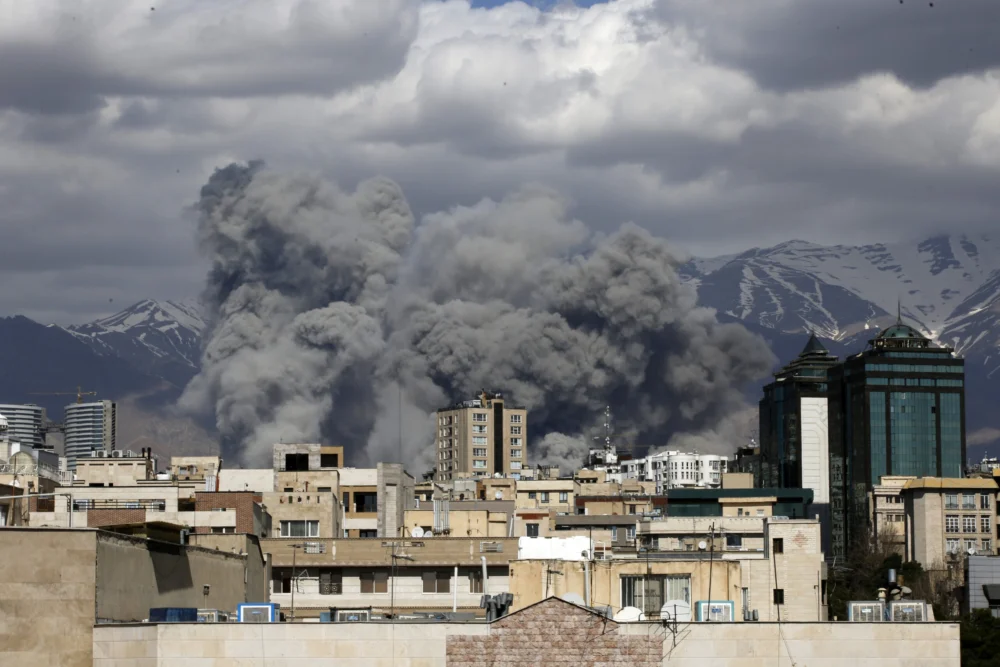
Explosions reverberated across Iran, Israel, and several Middle Eastern nations Saturday as the United States and Israel launched a significant wave of retaliatory attacks against Iranian targets, igniting a rapidly escalating regional conflict. Tehran swiftly responded with a barrage of missiles and drones aimed at Israel and U.S. military installations across the Middle East, fulfilling earlier warnings of severe repercussions should its territory be attacked. This coordinated offensive marks a dramatic escalation in the long-simmering tensions between the three powers, drawing multiple regional actors into the fray.
The scale of the initial Israeli and U.S. strikes was substantial. The Israeli Air Force reported deploying over 1,200 munitions across 24 of Iran’s 31 provinces in the joint operation. In response, Iran’s Islamic Revolutionary Guard Corps (IRGC) claimed to have targeted 27 bases hosting U.S. troops and numerous Israeli military facilities. The Iranian strikes extended across eight countries in the region, including Bahrain, Iraq, Jordan, Kuwait, Oman, Qatar, Saudi Arabia, and the United Arab Emirates, though most of these projectiles were reportedly intercepted.
Unfolding Crisis: Countries Under Attack and Initial Responses

The tit-for-tat exchanges have left a growing trail of destruction and casualties. As of Sunday, 15:00 GMT, preliminary reports indicate a grim toll across the ten affected nations. The situation remains fluid, with casualty figures expected to change as rescue and assessment operations continue.
Iran Faces Widespread Damage and Significant Casualties
Iran has borne the brunt of the initial retaliatory strikes, with the Iranian Red Crescent Society and state-linked media reporting approximately 201 fatalities and at least 747 injuries. Rescue efforts are ongoing amidst continued reports of explosions across the country. The deadliest single incident occurred in Minab, southeastern Iran, where an elementary girls’ school was reportedly struck, resulting in at least 148 deaths and 95 injuries, with the toll climbing. Israel stated it had carried out a major aerial assault on the "heart of the capital," indicating a broad operational scope.
Israel Under Barrage: Civilian Infrastructure and Military Sites Targeted

Israel has also sustained direct attacks from Iran. On Sunday afternoon, an Iranian ballistic missile strike on Beit Shemesh killed eight people and injured approximately 20, with rescue workers still sifting through the debris. A woman in the Tel Aviv area was killed by falling shrapnel late Saturday. In total, 121 individuals have been reported injured, with at least one in serious condition. The city of Tel Aviv experienced significant damage, with at least 40 buildings reportedly damaged by Iranian strikes, according to local reports.
U.S. Military Engaged: Casualties and Strategic Installations
U.S. forces operating in the region have not been spared. U.S. Central Command confirmed that three American soldiers were killed in action and five seriously wounded by Iranian attacks. Several others sustained minor injuries and are expected to return to duty. The statement emphasized that major combat operations are ongoing. Iran had previously declared U.S. military facilities across the region as legitimate targets in the event of an attack.
Regional Spillover: Attacks Across the Middle East

The conflict has rapidly drawn in neighboring countries, primarily through Iranian missile and drone strikes targeting bases and infrastructure associated with U.S. and Israeli operations.
-
Bahrain: The headquarters of the U.S. Navy’s 5th Fleet in Juffair and the country’s international airport were targeted by Iranian drones and missiles. While the airport sustained material damage, there were no fatalities. However, several residential buildings in the capital, Manama, were hit, resulting in four people treated for shrapnel injuries.
-
Iraq: The Jurf al-Sakher base in southern Iraq, housing the Popular Mobilization Forces and the Iran-backed Kataib Hezbollah, was reportedly targeted. Iraqi state media and Kataib Hezbollah sources confirmed two fighters killed and five wounded. In the northern Kurdish region, near the U.S. consulate and international airport in Erbil, powerful explosions were reported, though air defenses reportedly intercepted drone attacks.
-
Jordan: The Jordanian armed forces reported intercepting a significant number of drones and ballistic missiles that entered their airspace. While fragments caused localized property damage, no deaths or injuries were reported within the kingdom.

-
Kuwait: Ali al-Salem Air Base came under attack from ballistic missiles, which Kuwaiti air defense systems successfully intercepted. A drone strike on Kuwait International Airport caused minor injuries to employees and limited damage. The Ministry of Health reported one fatality and 32 injuries across the country.
-
Oman: Two drones reportedly targeted the Duqm port, injuring one foreign worker. Later, a Palau-flagged oil tanker was attacked approximately five nautical miles off the Musandam governorate, injuring four people.
-
Qatar: The Qatari Ministry of Interior confirmed 16 injuries, primarily from falling shrapnel and debris, with one person seriously hurt. Two ballistic missiles struck the Al Udeid military base, a key hub for U.S. forces, and a drone targeted a radar installation. Qatari air defense systems, in coordination with regional partners, intercepted a large number of missiles and drones. The Qatar Civil Aviation Authority suspended all air navigation indefinitely, and Qatar Airways grounded flights.
-
Saudi Arabia: The capital, Riyadh, and the Eastern Province, home to significant oil infrastructure and the King Abdulaziz Air Base, were reportedly targeted by Iranian attacks. The kingdom has officially reported no casualties.

-
United Arab Emirates: The UAE reported three fatalities and 58 injuries. A Pakistani national was killed and seven injured in Abu Dhabi when debris from intercepted projectiles fell on a residential area near Zayed International Airport. Another individual was killed by falling shrapnel in a residential district of the capital. Four airport staff in Dubai and four people at Palm Jumeirah sustained injuries. The UAE’s Defense Ministry reported detecting and destroying a large number of ballistic and cruise missiles.
U.S. Military Presence: A Decades-Long Strategic Footprint
The U.S. military has maintained a substantial presence in the Middle East for decades, operating a complex network of permanent and temporary military sites across at least 19 locations. Eight of these are permanent bases in Bahrain, Egypt, Iraq, Jordan, Kuwait, Qatar, Saudi Arabia, and the UAE. As of mid-2025, an estimated 40,000 to 50,000 U.S. soldiers were stationed in the region, supporting critical air and naval operations, regional logistics, intelligence gathering, and force projection. Countries like Qatar, Bahrain, Kuwait, the UAE, and Saudi Arabia host some of the largest concentrations of U.S. personnel and infrastructure.
Broader Implications and Future Trajectory

The current conflict marks a critical juncture in Middle Eastern geopolitics, with the potential for wider regional destabilization. The involvement of multiple state and non-state actors, coupled with the direct engagement of major global powers, raises concerns about the conflict’s scope and duration. The attacks highlight the vulnerability of key energy infrastructure and civilian populations in the region. International efforts to de-escalate the situation are likely to intensify, though the immediate focus remains on the unfolding military operations and humanitarian impact. The long-term consequences for regional security alliances, global energy markets, and international diplomacy are significant and will continue to develop in the coming days and weeks. The immediate aftermath is characterized by a heightened state of alert across the region, with diplomatic channels working to contain the escalating crisis.