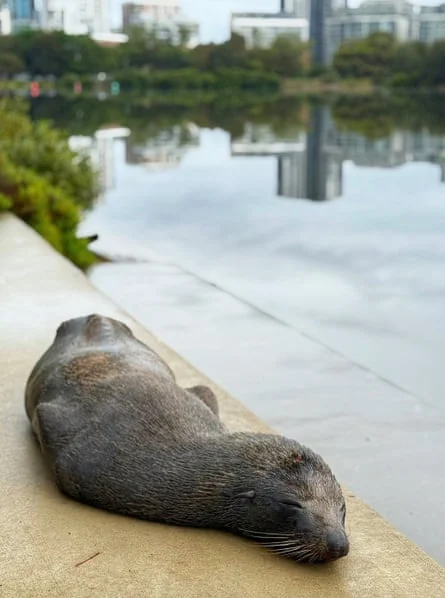
Wildlife rescue teams and state authorities are closely monitoring a New Zealand fur seal that has navigated deep into the urban waterways of Sydney’s inner west, sparking a debate over the animal’s physical condition and the safety of the polluted river environment. The marine mammal was most recently photographed resting on a concrete embankment along the Cooks River in Marrickville, a significant distance from its typical saltwater habitat. While local residents have expressed excitement at the rare sighting, experts from the Organisation for the Rescue and Research of Cetaceans in Australia (ORRCA) have raised alarms, suggesting the animal appears to be in a state of physiological decline.
The National Parks and Wildlife Service (NPWS) confirmed that they are aware of the seal’s presence and have been tracking its movements since it was first spotted near the Kyeemagh boat ramp on February 22. Despite the concerns voiced by volunteer rescuers, NPWS officials stated that the seal currently shows no obvious signs of injury or acute distress. The conflicting assessments between volunteer rescuers and government biologists have highlighted the complexities of managing marine wildlife that wanders into heavily populated metropolitan areas.
Chronology of Sightings in the Cooks River System
The seal’s journey began more than a week ago at the mouth of the river in Kyeemagh, located adjacent to Sydney’s international airport. From there, the animal moved inland, navigating through a series of tributaries and creeks that feed into the main artery of the Cooks River. Reports placed the seal in Muddy Creek and later in Wolli Creek near Earlwood before it was documented on a concrete slab in Marrickville on Saturday.
Tim Gillard, a local resident who photographed the seal, noted the rarity of such an encounter in the inner-western suburbs. After documenting the animal, Gillard contacted ORRCA, which immediately dispatched a team to assess the situation. The Cooks River flows through some of Sydney’s most densely populated industrial and residential zones before emptying into Botany Bay, known traditionally as Gamay.
ORRCA spokesperson Craig Ryan stated that the organization has been maintaining a vigil over the animal as it explores these unusual locations. According to Ryan, the seal has moved between several small creeks, a behavior that, while not unheard of, is often a sign that a marine mammal is seeking a reprieve from the harsher conditions of the open ocean or avoiding predators.
Conflicting Reports on Health and Condition
The primary point of contention remains the seal’s physical health. Craig Ryan characterized the animal’s state as a "declining condition," noting that it appeared lethargic and potentially undernourished. He suggested that the seal might be utilizing the calmer river waters to rest away from the pressures of the coast, where predators and heavy surf can tax an exhausted animal’s energy reserves.
"Normally seals stray closer to the coast; they’re not regularly viewed in these locations," Ryan said. He emphasized that the further an animal moves into a river system, the more likely it is that it is struggling to find adequate food sources or is suffering from an underlying ailment.
Conversely, the NPWS spokesperson provided a more optimistic, albeit cautious, update. While acknowledging that the fur seal is "lean," the agency reported that the animal remains active and alert. "Although the animal is lean, it is active and has no obvious sign of injuries or other health concerns," the NPWS statement read. The agency confirmed it would continue to collaborate with ORRCA to monitor the seal’s movements but indicated that no immediate intervention or relocation was planned.
Expert Analysis and Environmental Risks
Dr. Vanessa Pirotta, a prominent marine scientist at Macquarie University, weighed in on the visual evidence provided by social media and local residents. Dr. Pirotta noted that when compared to the robust fur seals frequently seen sunning themselves on the steps of the Sydney Opera House, this specific individual appears to be in significantly poorer shape.
"You only have to look at the individuals that hop on the Sydney Opera House steps of what a good condition-looking fur seal should be looking like," Pirotta said. She explained that a healthy fur seal should have a thick, insulated layer of blubber and a sleek appearance. The "lean" description provided by authorities often indicates that an animal has not fed successfully for an extended period.

Pirotta warned that if the seal’s condition continues to deteriorate, authorities may be forced to make a difficult decision regarding its future. "From time to time, unfortunately, we see individuals that do present with poor condition," she said. "As a result, this animal will likely be assessed by authorities to work out if this animal needs to be euthanised or not."
Beyond the seal’s internal health, the environment of the Cooks River itself poses a risk. Historically one of the most polluted river systems in Australia, the Cooks River has seen gradual improvements in water quality, but it remains a challenging habitat for marine life. The NSW Department of Planning and Environment’s most recent sampling from the 2022–23 summer period graded the estuary’s water quality as "fair." This was an improvement from a "poor" rating in 2011, but other indicators are trending downward. Specifically, the "algae abundance" grade has plummeted from "poor" to "very poor" over the last decade, suggesting an ecosystem still struggling with nutrient runoff and urban pollution.
Understanding Fur Seal Population Recovery
Despite the concerns for this specific individual, Dr. Pirotta emphasized that the broader population of New Zealand fur seals is currently in a phase of recovery. Following decades of commercial sealing that pushed the species to the brink of extinction in the 19th and early 20th centuries, legal protections have allowed their numbers to rebound across the Southern Hemisphere.
As populations grow, it is becoming increasingly common for these animals to enter "human-centric" environments. Sydney’s waterways, including Botany Bay and Sydney Harbour, serve as a "blue backyard" where humans and marine mammals must learn to coexist. However, the presence of a seal in an inner-west river like the Cooks is still considered an outlier. The last significant sighting of an adult fur seal in this specific river occurred in 2012.
The New Zealand fur seal (Arctocephalus forsteri) is known for its ability to travel vast distances. While they prefer rocky coastlines and islands for breeding and hauling out, younger or weaker individuals often explore estuaries and river mouths. Experts suggest that as the population expands, competition for prime coastal real estate increases, potentially pushing less dominant individuals into marginal habitats like urban rivers.
Public Safety and Exclusion Zones
Authorities have issued a stern reminder to the public regarding the legal and safety requirements when encountering marine mammals. Under New South Wales law, a mandatory 40-meter (approximately 130-foot) exclusion zone must be maintained around seals when they are "hauled out" on land.
Dr. Pirotta warned that despite their seemingly docile or sleepy appearance while resting, fur seals are wild predators with powerful jaws. "They can not only have a nasty bite, but a bite can come with infection as well," she cautioned. Seals carry a variety of bacteria in their mouths that can cause "seal finger" or other serious zoonotic infections in humans.
Furthermore, getting too close to a resting seal can cause the animal significant stress, forcing it to return to the water before it has sufficiently rested. For an animal already suspected of being in a "declining condition," this unnecessary expenditure of energy could be fatal. ORRCA has urged the public to keep dogs on leashes and to prevent children from approaching the animal for photographs.
Future Outlook and Reporting
The situation remains fluid as ORRCA and the NPWS continue their joint monitoring effort. The seal was last reported on Sunday morning, and rescue teams remain "ready to respond" should the animal show signs of acute physical trauma or become stranded in a location that poses an immediate threat to its life.
The appearance of the seal has reignited discussions regarding the health of Sydney’s river systems and the necessity of maintaining wildlife corridors in urban planning. While the Cooks River has moved away from its industrial past, the presence of a "declining" seal serves as a reminder of the delicate balance required to support marine life in a city of five million people.
ORRCA has requested that any further sightings of the seal, or any other marine mammals in distress, be reported immediately to their 24-hour rescue hotline. Authorities stress that public cooperation is essential in ensuring the animal is given the best possible chance of recovery without human interference. As the seal continues its journey through the inner west, the community remains on high alert, hoping for a positive outcome for the wandering visitor.