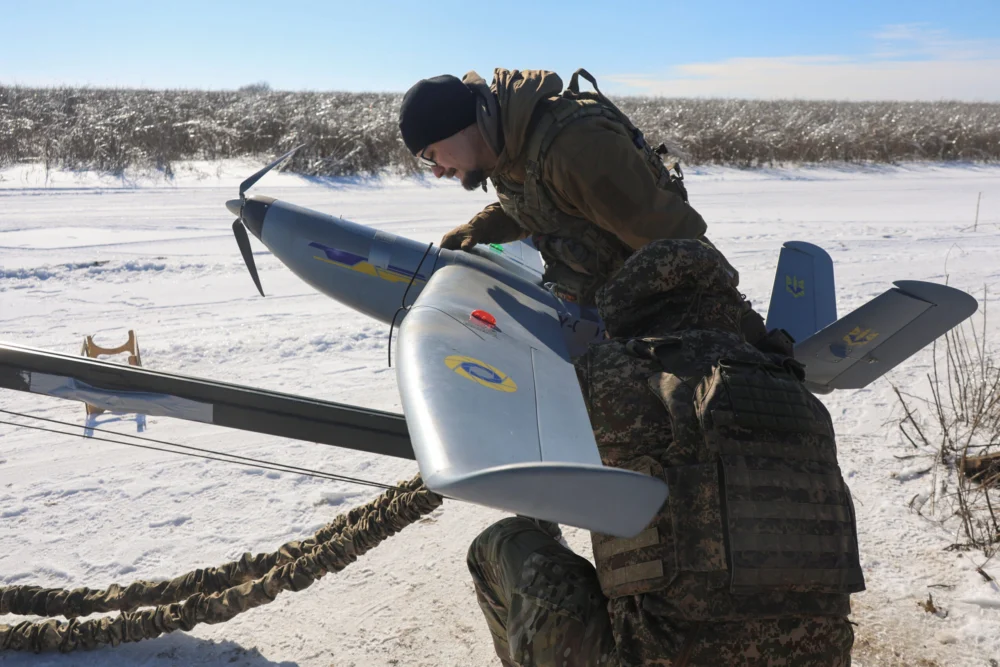
Ukraine, a nation that has endured tens of thousands of Iranian-made drones raining death since 2022, is now poised to share its hard-won expertise in downing these unmanned aerial vehicles with Gulf nations, British Prime Minister Keir Starmer announced Sunday. This strategic shift underscores how Russia’s full-scale invasion has profoundly reshaped global military doctrines, forcing a rapid re-evaluation of technological advancements and tactical approaches on battlefields worldwide.
The burgeoning role of Ukrainian expertise in combating drone threats highlights a dramatic evolution in modern warfare, moving far beyond initial Western predictions of a clash between two ex-Soviet armies relying on outdated strategies. The conflict has become a crucible for innovation, compelling global powers like China, the United States, and European nations to scrutinize its technological and tactical breakthroughs. These advancements represent a potent blend of unorthodox, high-tech solutions and ingenious, often improvised, fixes that are making warfare more cost-effective while accelerating the pace and lethality of arms manufacturing.
The Crucible of Ukrainian Ingenuity
The front lines in Ukraine have become a testing ground for a new generation of warfare, where adaptability and rapid innovation are paramount. Ukrainian servicemen have been likened to the fictional secret agent MacGyver, a testament to their ability to improvise and overcome overwhelming odds with limited resources. "Outmanned and outgunned, Ukrainians ‘have MacGyver-ed and come up with whatever they have to do to get to an outcome they need,’" U.S. Army Secretary Dan Driscoll stated in November, emphasizing a results-oriented approach where traditional rules are secondary.
This spirit of ingenuity is exemplified by companies like Army SOS, a Kyiv-based startup that began by providing essential equipment like flak jackets. Volunteers soon found themselves responding to a pervasive need for accurate battlefield intelligence, specifically requesting maps. Instead of conventional paper maps, Army SOS developed sophisticated software transforming inexpensive tablets and smartphones into precision guidance systems. These devices acquire and transmit coordinates for artillery fire correction, calculating target distances, directing shots, and even incorporating meteorological data that can influence ballistics.
Russia’s Counter-Innovation and Adaptation
However, the conflict is not a one-sided display of innovation. Russia has demonstrated a capacity to "mirror and scale up" Ukraine’s findings, according to Andrey Pronin, a pioneer in Ukrainian drone warfare. This process of adaptation, while often taking weeks, has led to significant shifts on the battlefield.

A notable example of this tit-for-tat innovation occurred in early 2023 when Ukrainian engineers pioneered the attachment of nearly invisible optical fiber to drones, rendering them resistant to radio jamming. Despite initial reluctance from some commanders, the effectiveness of this modification was undeniable. Russia quickly mimicked and expanded upon this concept. Consequently, forests in front-line areas are now often adorned with the glistening threads of optical fiber, a visual testament to this technological arms race, described by some as resembling post-apocalyptic Christmas decorations.
These enhanced Russian drones, equipped with optical fiber, have been deployed against key Ukrainian cities, including Kharkiv, located a mere 40 kilometers from the Russian border, and Zaporizhzhia. The skies over the front lines are now a constant theater of operations, with drones of all sizes operating 24/7, a stark contrast to the earlier stages of the invasion.
From Columns to Infiltration: Evolving Russian Tactics
The early days of Russia’s full-scale invasion saw attempts to utilize large columns of soldiers, a tactic that proved disastrous in the failed assault on Kyiv in 2022. Serviceman Bohdan Yavorsky recounted his experience on the third day of the invasion, where he and a small group of lightly armed volunteers ambushed and immobilized a convoy of three dozen Russian tanks and armored vehicles near Bucha. Their successful ambush, followed by their escape in civilian vehicles, allowed them to relay the column’s coordinates to the Ukrainian Air Force, which subsequently destroyed the convoy within 30 minutes.
By 2026, Russia has largely abandoned the strategy of massing troops in large formations, recognizing the vulnerability of such deployments to drone and air attacks. Instead, Russian forces have adopted a strategy of infiltration, deploying soldiers in small teams of two or three. These units are tasked with advancing to the front lines to carry ammunition and jamming equipment, operating in a decentralized manner, waiting for subsequent small teams to join them.
These dispersed units often rely on inexpensive smartphones equipped with applications like Alpine Quest. This topographic app enables navigation using coded coordinates, circumventing the need for internet access or global positioning systems (GPS). A former Russian soldier, a Tajik labor migrant who was captured in eastern Ukraine, spoke to Al Jazeera under the condition of anonymity, stating, "We didn’t know the names of villages we were told to go to," highlighting the reliance on such covert navigation methods.
Adapting to Drone Dominance: Anti-Thermal Camouflage and Evasive Maneuvers
Both sides of the conflict are employing sophisticated countermeasures to evade detection by increasingly advanced drone surveillance. Soldiers are utilizing anti-thermal camouflage to mask their heat signatures from thermal imaging devices. Additionally, improvised tactics such as hanging fishnets over roads and mounting electric scooters or snowmobiles are being employed to evade first-person-view drones equipped with explosive payloads. This constant cat-and-mouse game underscores the pervasive influence of drone technology on ground operations.

Naval Innovations: Ukraine’s Unmanned Maritime Revolution
Ukraine’s military ingenuity extends beyond aerial and land-based operations to the maritime domain. In 2022, the nation’s navy, comprised of a modest fleet of aging vessels, was largely decimated by Russia’s Black Sea Fleet, which subsequently gained control of Ukraine’s territorial waters. However, by mid-2023, Ukraine had developed and deployed effective sea drones. These unmanned surface vessels have been instrumental in inflicting significant damage on Russia’s largest warships.
Furthermore, Ukrainian aerial drones launched a precise attack on a dry dock in Sevastopol, a critical naval repair facility in annexed Crimea that had been operational for decades. The strategic impact of this strike, as noted by Kyiv-based analyst Ihar Tyshkevich, was not merely the damage to vessels but the disruption of the shipyard’s infrastructure. This attack proved so damaging that it prompted Russia to relocate a substantial portion of its Black Sea Fleet eastward to the port of Novorossiysk.
China’s Keen Observation of Global Military Shifts
The strategic implications of the war in Ukraine are being closely monitored by global powers, particularly China. Beijing is reportedly "especially eager to study and adopt the innovations of war" emerging from the conflict. Temur Umarov, a Sinologist and China expert with the Carnegie Endowment for International Peace, confirmed that Chinese military, scientific, economic, and historical communities are meticulously observing all developments. This keen interest stems from a long-standing relationship, dating back to the 1950s, when the Soviet Union played a pivotal role in shaping China’s nascent armed forces and military industrial complex.
However, another military analyst suggests China faces significant challenges in fully integrating these battlefield lessons. Pavel Luzin, a senior fellow at the Jamestown Foundation, points to the difficulty authoritarian or totalitarian regimes have in adopting "horizontal algorithms"—the rapid, real-time sharing of battlefield data for faster intelligence processing—coupled with decentralized decision-making. Luzin emphasizes that the core challenges of modern warfare lie in "organizational principles such as coordination building, delegation of decision making, logistics and so on," areas where China’s state-controlled structures may prove a hindrance.
The conflict in Ukraine has undeniably become a catalyst for a global redefinition of military strategy and technological application. The lessons learned on its battlefields are not confined to the immediate participants but are rippling outwards, influencing defense doctrines and technological development across the international stage, with profound implications for future global security.