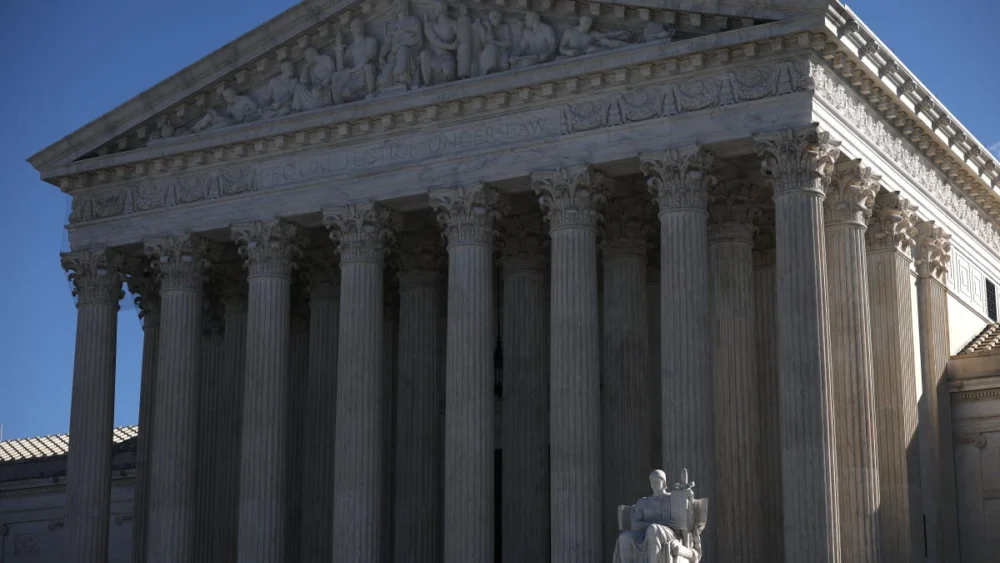
The United States Supreme Court on Monday declined to hear an appeal regarding whether artwork generated by artificial intelligence can be protected under federal copyright law, effectively upholding lower court decisions that reserve such protections exclusively for human creators. The petition was filed by computer scientist Stephen Thaler, who has spent years challenging the legal boundaries of machine-led creativity after the U.S. Copyright Office rejected his application for a visual work titled "A Recent Entrance to Paradise." By refusing to grant a writ of certiorari, the high court has signaled a reluctance to intervene in the rapidly evolving intersection of intellectual property and generative technology, leaving the "human authorship" requirement as the definitive standard for the foreseeable future.
The legal dispute began in 2018 when Thaler attempted to register a copyright for a piece of digital art created by his "Creativity Machine," an AI software he developed. Unlike many modern AI users who claim authorship over their prompts, Thaler explicitly listed the AI system itself as the author, arguing that the work should be eligible for protection under the "work-for-hire" doctrine. The U.S. Copyright Office issued a final rejection in 2022, stating that the Nexus between the human mind and creative expression is a prerequisite for copyright eligibility. This decision was subsequently upheld by a federal district court and a federal appeals court, leading to the final, unsuccessful petition to the nation’s highest judicial body.
Legal Precedent and the Supreme Court Refuses to Challenge Ruling That Denied Copyright for AI Art
The Supreme Court’s decision to bypass the case reinforces decades of legal precedent that links copyright protection to the physical and mental labor of human beings. For over a century, the U.S. court system has interpreted the Copyright Act of 1976 and its predecessors through a lens of human-centric creativity. In its rejection of Thaler’s claims, the Copyright Office cited the "human authorship" requirement, a standard that has been tested by various non-human entities in the past.
Legal experts point to the 1884 case Burrow-Giles Lithographic Co. v. Sarony as a foundational moment for this interpretation. In that case, the Supreme Court ruled that photographs were copyrightable because they were "representatives of original intellectual conceptions of the author." More recently, the Ninth Circuit Court of Appeals ruled in the famous "monkey selfie" case that animals cannot hold copyrights, further narrowing the definition of an "author" to a human person. The current refusal to hear Thaler’s appeal suggests the Supreme Court sees no immediate reason to expand this definition to include algorithms or autonomous software.
The U.S. Copyright Office and the 2025 Interpretation of Generative Tools
The landscape of digital creation shifted significantly following a comprehensive 2025 report issued by the U.S. Copyright Office. This report sought to clarify the "grey areas" created by the explosion of generative AI tools like Midjourney, DALL-E, and Stable Diffusion. The office established a clear boundary: unedited outputs generated solely by AI tools are not eligible for copyright protection. However, the report did provide a pathway for artists who use AI as a tool rather than a substitute for creativity.
Under the 2025 guidelines, works that incorporate AI-generated elements may still be eligible for copyright if a human author can demonstrate "sufficient human creativity." This usually involves significant modification, arrangement, or selection of the AI output by the human user. The office emphasized that the "centrality of human creativity" must remain intact. Thaler’s case, however, was unique because he did not claim to be the author; he insisted the machine was the creator, a stance that the government argued made the work legally ineligible for any form of intellectual property shelter.
Implications for the Tech Industry and the Supreme Court Refuses to Challenge Ruling That Denied Copyright for AI Art
The refusal of the Supreme Court to take up the case has sent ripples through the technology and creative sectors. Major tech firms that have invested billions into generative AI systems are watching these legal developments closely to determine how their products can be monetized and protected. If AI-generated content cannot be copyrighted, it effectively falls into the public domain the moment it is created, which could complicate the business models of companies that rely on exclusive digital assets.
Attorneys representing Thaler expressed deep concern over the court’s inaction, suggesting that the U.S. is falling behind in the global race to define the future of digital economy laws. In a statement following the announcement, Thaler’s legal team argued that the Copyright Office’s current stance would "irreversibly and negatively impact AI development" during a critical window of innovation. They contend that without the incentive of copyright protection, companies may be less likely to invest in the creation of highly sophisticated AI systems capable of producing valuable expressive works.
Political Pressure and the Solicitor General’s Involvement
The case also carried significant political weight, with the executive branch weighing in on the side of the Copyright Office. Reports indicate that the Trump administration, through the Solicitor General’s office, had urged the Supreme Court to deny Thaler’s petition. The government’s argument centered on the idea that copyright is designed to incentivize human labor and that granting rights to machines would serve no constitutional purpose.
The Solicitor General’s brief argued that the law is clear: "authors" must be persons. By maintaining this strict interpretation, the administration sought to prevent a flood of automated copyright applications that could overwhelm the federal registration system. This alignment between the executive and judicial branches suggests a unified government front against the personhood or creative autonomy of artificial intelligence in the legal sphere.
The Parallel Battle Over AI Patents and Intellectual Property
Thaler’s fight is not limited to the realm of art and copyright. He has also been involved in a high-stakes legal battle with the U.S. Patent and Trademark Office (USPTO) over inventions created by his AI software. Thaler has argued that AI systems should be recognized as "inventors" on patent applications, a claim that has been consistently rejected by both the USPTO and federal courts.
The Supreme Court’s refusal to hear the copyright case is seen by many as a precursor to how it might handle patent disputes involving AI. In both instances, the central question is whether the "inventor" or "author" must be a natural person. The current legal consensus in the United States remains firmly rooted in the belief that intellectual property rights are a human-only privilege, intended to reward human ingenuity and provide a framework for human economic activity.
Impact on the Creative Industry and Independent Artists
For independent artists, the Supreme Court’s refusal to challenge the lower court’s ruling provides a temporary sense of security. Many in the creative community have feared that if AI-generated works were granted copyright, the market would be flooded with machine-made content that would devalue human-made art. The current ruling ensures that while AI can be used as a tool, it cannot replace the legal status of the human artist.
However, the debate is far from over. As AI tools become more integrated into professional workflows—from graphic design to filmmaking—the line between "human-assisted" and "machine-generated" becomes increasingly blurred. The Copyright Office is expected to face a growing number of applications that test the limits of its 2025 report. Future litigation will likely focus on exactly how much "human intervention" is required to transform a machine output into a copyrightable work of art.
Future Outlook and Potential Legislative Intervention
With the Supreme Court refusing to challenge the ruling that denied copyright for AI art, the focus may now shift from the judicial branch to the legislative branch. Some legal scholars argue that the 1976 Copyright Act is ill-equipped to handle the nuances of the 21st-century digital landscape. There have been calls for Congress to amend the law to create a new category of "AI-assisted works" that offers a shorter term of protection or different ownership structures.
Without legislative changes, the United States will continue to operate under a framework where the human element is the sole gatekeeper of intellectual property. This puts the U.S. in a complex position internationally, as other nations experiment with different models. For example, some jurisdictions have explored "sui generis" rights for computer-generated databases or works, which could create a competitive disadvantage or advantage depending on how global markets react.
The Evolving Landscape of Digital Authorship
The Supreme Court’s decision marks a definitive chapter in the first wave of AI legal challenges, but it does not resolve the broader cultural and economic questions posed by generative technology. As algorithms become more capable of mimicking human expression, the legal definition of "originality" will continue to be under scrutiny. For now, the "human mind" remains the essential ingredient for legal protection in the American creative economy.
The rejection of Stephen Thaler’s appeal confirms that, in the eyes of the law, a machine is a tool of the creator, not a creator itself. While the "Creativity Machine" may produce visually stunning or technically complex outputs, those outputs remain outside the circle of copyright protection unless a human can claim the expressive elements as their own. As the creative industry navigates these critically important years of AI development, the legal boundaries established today will shape the distribution and ownership of digital content for decades to come.