Filmmaker Maggie Gyllenhaal has offered insights into her creative process behind her highly anticipated second feature, The Bride!, detailing her distinctive approach to reimagining the iconic characters portrayed by Jessie Buckley and Christian Bale. The director emphasized her commitment to grounding the fantastical elements of the classic horror narrative in a palpable reality, diverging significantly from previous cinematic interpretations. Her vision aims to imbue the monstrous figures with a raw, human authenticity, a decision that informed every aspect of the film’s aesthetic, particularly the detailed costume and makeup design for its lead performers.
Reimagining a Cinematic Icon
Gyllenhaal’s journey to direct The Bride! began with a pivotal re-examination of James Whale’s 1935 horror masterpiece, The Bride of Frankenstein. She observed a striking detail that sparked her curiosity: the titular character, famously portrayed by Elsa Lanchester, appears on screen for a mere two minutes and utters no dialogue. This brief, silent presence prompted Gyllenhaal to delve deeper into the unexpressed inner world of the Bride. "I didn’t know, but she’s only in it for two minutes and she doesn’t say one word," Gyllenhaal recounted. "And it made me start to wonder, made me curious what is she thinking, after having been dug up from a grave and told she’s supposed to be marrying somebody that she doesn’t recognize? What’s on her mind?"
This profound question became the genesis for The Bride!, which seeks to grant agency and a voice to a character historically defined by her brief, tragic existence. Gyllenhaal’s directorial debut, The Lost Daughter (2021), garnered critical acclaim, including an Academy Award nomination for Best Adapted Screenplay, establishing her as a formidable voice behind the camera. Her transition from a celebrated acting career to filmmaking has been marked by a focus on complex female narratives and psychological depth, themes that appear to be central to her latest project.
The Bride! transports the narrative to 1930s Chicago, a setting that provides a gritty, period-appropriate backdrop for its gothic romance. The story centers on Frankenstein’s monster, who now goes by "Frank" and is played by Christian Bale, as he enlists the help of Dr. Euphronius, portrayed by Annette Bening, to create a companion. Together, they resurrect a murdered young woman, who becomes the film’s titular Bride. This modernized premise allows for an exploration of identity, companionship, and the societal pressures placed upon beings who are inherently different.
Crafting the Characters: A Vision for The Bride!
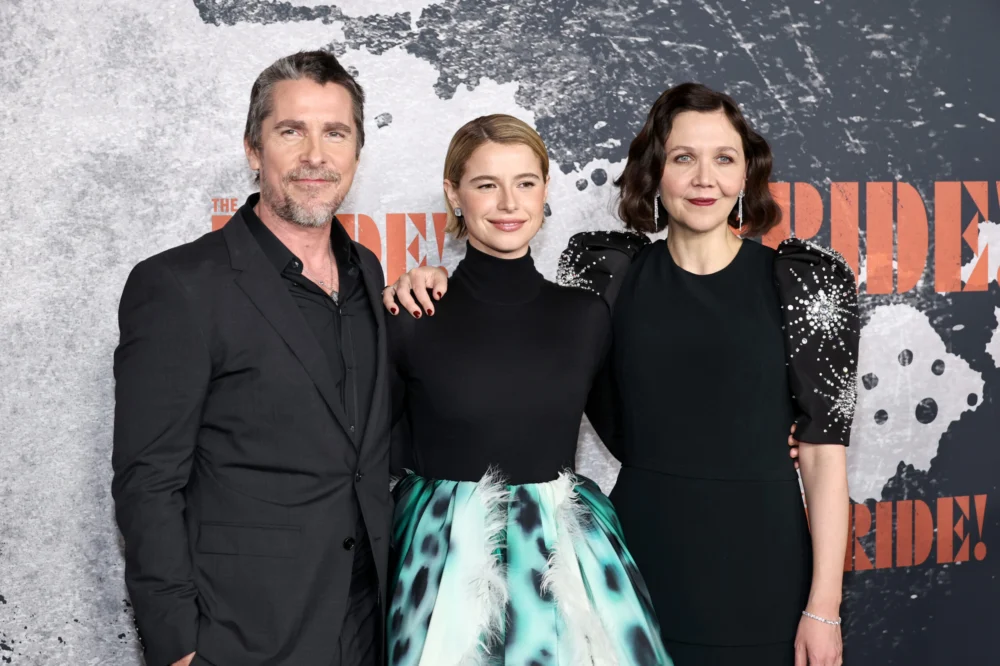
The casting of Jessie Buckley as The Bride was a natural choice for Gyllenhaal, building on their successful collaboration in The Lost Daughter. Buckley, who is currently generating Oscar buzz for her performance in Hamnet, shares a deep artistic connection with the director. Gyllenhaal praised Buckley at the film’s New York premiere, stating, "She was so wonderful and also spoke my language in a way that I’ve never encountered in quite the same way." She elaborated on their bond, adding, "Jessie and I are real soul sisters and artistic sisters, and have been for a long time." This established rapport was crucial for developing a character as nuanced and physically demanding as The Bride.
-
Jessie Buckley as The Bride
For Buckley’s portrayal, Gyllenhaal aimed for a look that was both instantly recognizable and profoundly human. The iconic visual of the Bride from the 1935 film, with her towering white streaked hair and gauze-wrapped costume, is deeply ingrained in cinematic history. However, Gyllenhaal sought to infuse her version with a sense of lived experience. "We knew that it had to be iconic, and at the same time I wanted it to be very real and very human," Gyllenhaal explained. A key element of this realism was the decision for Buckley’s character to wear a single dress throughout the entire movie. This choice presented a unique challenge for the costume department, requiring the garment to evolve with the character’s journey. Gyllenhaal envisioned the dress accumulating the wear and tear of a tumultuous existence—sweat, stains, rips, and tears—making it a dynamic part of the character’s physical narrative rather than a static costume piece. This commitment to verisimilitude pushes beyond mere aesthetics, aiming to reflect the character’s internal and external struggles. -
Christian Bale’s Monstrous Transformation
Christian Bale, known for his transformative roles and a previous collaborator with Gyllenhaal in Christopher Nolan’s The Dark Knight, steps into the formidable shoes of Frankenstein’s monster. Gyllenhaal’s directive for Bale’s appearance mirrored her approach for Buckley: "The same was true for Christian, I wanted him to be scary like a monster but very real." This meant moving away from the more theatrical or overtly prosthetic-heavy designs seen in many monster films. Instead, Gyllenhaal sought a look that suggested a horrifying, yet plausible, construction. "I think it’s more upsetting to see a face that looks like it actually could have been sewn together — the neck sewn onto the face and then something that looks like a Halloween mask," she articulated. The goal was to blend a "graphic novel iconic vibe" with a raw, visceral realism, making the monster’s appearance genuinely unsettling by hinting at its cobbled-together origins. This emphasis on believable physical trauma rather than cartoonish horror underscores the film’s grounded approach to its fantastical premise.
A Grounded Aesthetic: Redefining Horror Iconography
Gyllenhaal’s aesthetic choices for The Bride! represent a deliberate departure from traditional horror iconography, particularly within the Universal Monsters canon. While acknowledging the historical significance of the original designs, she is carving out a distinct visual language that prioritizes emotional resonance and psychological depth over conventional frights. By insisting on realism for both the Bride’s evolving dress and the Monster’s ‘stitched-together’ visage, Gyllenhaal invites audiences to engage with these characters not just as symbols of terror, but as sentient beings grappling with their existence.
The 1930s Chicago setting further supports this grounded approach. It places the supernatural events within a tangible historical context, allowing the film to explore themes of alienation and otherness against a backdrop of societal change and urban grit. This historical specificity can add layers of meaning to the characters’ struggles, reflecting anxieties about identity, societal acceptance, and the boundaries of scientific endeavor that were prevalent in that era. The juxtaposition of classic monster lore with a detailed period setting and Gyllenhaal’s modern, character-driven perspective promises a fresh take on a beloved, if underexplored, story.
Studio Support and the Future of Theatrical Release
Christian Bale expressed profound admiration for Gyllenhaal’s script and the studio’s willingness to back such an audacious project. Upon receiving the script, Bale remarked that he thought "she’d written one of the best, most radical, bold and just naughty scripts I’d read in so long." His surprise extended to the financial commitment, stating, "I couldn’t believe that a studio was going to put the amount of money into it." This sentiment highlights a common challenge in Hollywood, where studios often favor established intellectual property or safer, more formulaic projects.
Bale specifically lauded Warner Bros. executives Mike De Luca and Pam Abdy for their courageous decision to support The Bride!. He contrasted their approach with what he perceives as a pervasive fear-driven mentality in the industry. "They’re making choices based on bravery, based on genuine love of cinema, based on love of filmmakers as well and it’s really paying off for them," Bale asserted. He believes such leadership is crucial for the survival and resurgence of theatrical releases, particularly in a landscape increasingly dominated by streaming platforms. Bale concluded by expressing pride in being part of such a venture, praising Gyllenhaal’s directorial prowess: "Maggie’s just hit it out of the box, she’s a really fantastic director." His comments underscore a broader industry conversation about the balance between commercial viability and artistic integrity, and the vital role that studio executives can play in fostering innovative filmmaking.
Anticipation and an All-Star Ensemble
The anticipation for The Bride! is considerable, fueled by Gyllenhaal’s established artistic credibility, the star power of its lead actors, and the promise of a distinctive horror reimagining. The film’s narrative depth, combined with Gyllenhaal’s commitment to a visceral, humanistic aesthetic, sets it apart from typical genre fare. Early reactions from premieres and industry insiders suggest that Gyllenhaal has indeed crafted a bold and compelling vision that challenges expectations.
In addition to Buckley, Bale, and Bening, The Bride! boasts an impressive ensemble cast, further elevating its profile. Gyllenhaal’s husband, Peter Sarsgaard, and her brother, Jake Gyllenhaal, are part of the cast, alongside acclaimed actors Penélope Cruz, Julianne Hough, and John Magaro. This collection of talent suggests a film rich in character performance and dramatic weight, promising an experience that transcends a simple horror narrative. As The Bride! prepares for its theatrical release on Friday, it stands as a testament to Maggie Gyllenhaal’s evolving artistic vision and her determination to bring complex, human stories to the forefront of cinematic storytelling, even within the most fantastical of genres.