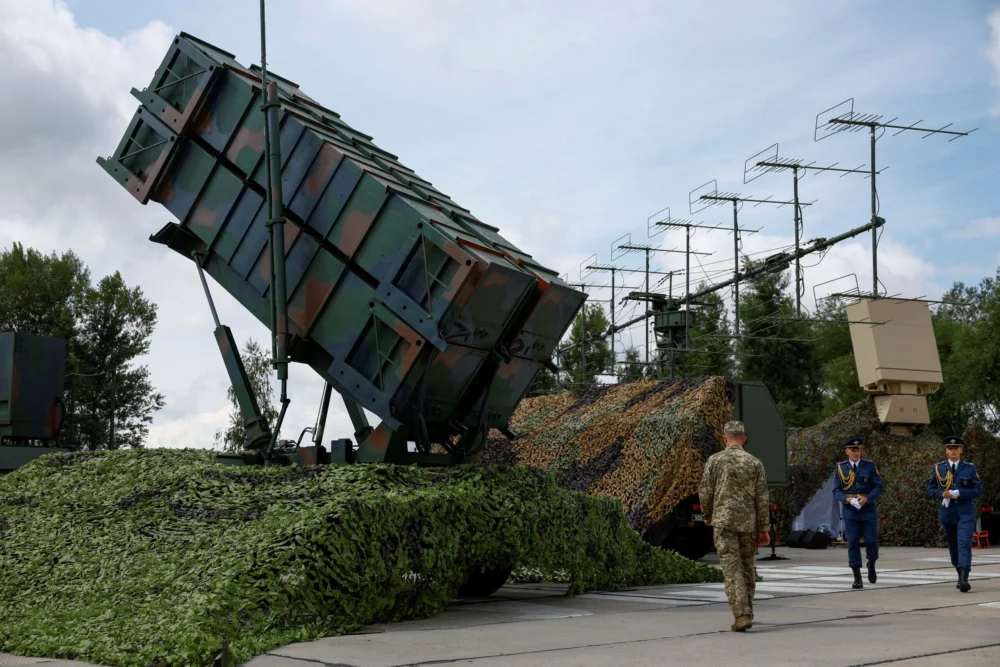
Ukraine is confronting a looming crisis regarding its Patriot air defense missile supply, a critical vulnerability that experts warn Russia is poised to exploit, especially as Middle Eastern allies increasingly rely on these same U.S.-made systems to counter Iranian aerial threats. The dwindling ammunition for the sophisticated Patriot batteries, designed to intercept high-speed ballistic and cruise missiles, presents a significant challenge for Kyiv as it continues to fend off relentless Russian assaults.
The Patriot system, a cornerstone of modern air defense, was originally developed in the 1970s to counter Soviet missile threats, a legacy that directly impacts Ukraine today as Russia employs modernized versions of those very weapons. Its deployment to Ukraine began in 2023, with initial systems strategically positioned around the capital, Kyiv, and their locations frequently shifted to evade Russian detection and attack. The system’s advanced radar can detect targets traveling at supersonic speeds, launching its interceptor missiles with a rapid cadence, capable of firing up to 32 rounds per minute.
For Ukrainians, the distinctive sonic boom and subsequent bright explosions of Patriot intercepts have become a symbol of safety amidst prolonged and often devastating Russian air raids, which frequently target civilian areas with barrages of drones and missiles. Within weeks of their deployment, Patriot systems successfully intercepted Russia’s formidable Kinzhal (Dagger) ballistic missiles, a weapon system Moscow had touted as virtually unstoppable and capable of evading all Western air defenses. These successful interceptions directly challenged President Vladimir Putin’s earlier assertions of the Kinzhal’s invincibility.
However, the immense defensive capability of the Patriot system comes at a substantial cost. Each guided interceptor missile carries a price tag in the millions of dollars, and global production capacity is limited, with annual manufacturing numbers reportedly not exceeding 900 units. This scarcity is now being acutely felt by Ukraine, especially as demand surges from multiple fronts.
The Escalating Missile Demand
President Volodymyr Zelenskyy recently highlighted the severe strain on Ukraine’s missile reserves, noting that approximately 800 guided missiles were expended in just three days to repel Iranian aerial attacks. This surge in usage, directly linked to Tehran’s intensified missile and drone campaigns against multiple nations in the Middle East, has exacerbated Ukraine’s existing supply challenges. Zelenskyy reiterated Ukraine’s willingness to assist allied nations in intercepting these threats, underscoring the interconnectedness of global security.
While the immediate depletion of Patriot missiles is not yet a critical issue, analysts predict a dire shortage within weeks. "This is not today’s problem, this is tomorrow’s problem," stated Volodymyr Fesenko, head of the Kyiv-based Center for Applied Political Studies (Penta) think tank. He warned that the situation could evolve into a catastrophic scenario for Ukraine.
Fesenko observed that Russia has recently reduced its drone and missile attacks on Ukraine, a tactic he interprets as a prelude to amassing forces for more substantial offensives. "Russia’s most obvious actions would be to bleed Ukraine’s stock of Patriot missiles dry to inflict maximal damage on us through massive missile attacks," he explained. This strategic approach aims to deplete Ukraine’s most advanced air defense capabilities, thereby paving the way for more destructive Russian strikes.
Broader Ammunition Shortages
Beyond the Patriot system, Ukraine is also grappling with a less critical but equally vital shortage of missiles for Western-supplied F-16 fighter jets. These aircraft have proven effective in downing Russian missiles, but their operational capacity is directly tied to the availability of compatible munitions. The dual challenges of depleted Patriot missile stocks and a looming F-16 missile deficit underscore a systemic issue of ammunition supply for Ukraine’s Western-backed defense.
Ukraine has experienced Patriot missile shortages previously. Last summer, during periods when the U.S. and Israel engaged in strikes on Iranian nuclear sites, the Pentagon temporarily suspended Patriot missile shipments to Ukraine as it conducted an audit of its own stockpiles. This suspension left Ukrainian civilian infrastructure, including vital power plants and transportation hubs, more vulnerable to Russian attacks.
Russia’s Evolving Air War Tactics
Russia’s strategy of indiscriminate aerial bombardment has been honed over years of conflict. A common tactic involves initiating an air raid with drones and decoy drones, designed to compel Ukrainian air defense units to expend valuable Patriot missiles. This is often followed by subsequent waves of attack drones and ballistic or cruise missiles, exploiting any gaps created by the initial defensive expenditures.
"The question is that this time, it won’t be energy infrastructure, but whatever other targets the Kremlin will want to choose," noted Igar Tyshkevych, a Kyiv-based analyst. He alluded to the devastating attacks on energy and heating facilities that plunged millions of Ukrainians into darkness and cold during the previous winter, leading to health crises and fatalities from hypothermia. The potential for Russia to target other critical civilian infrastructure, or even military assets, with less air defense cover is a significant concern.
International Hesitation and Technological Arms Race
Meanwhile, Israel and several European nations that had previously pledged to transfer their Patriot missile stocks to Ukraine are now reportedly hesitant to do so. "Considering the general instability, I don’t think that many nations will open up their stock and pass it on to us," Tyshkevich commented, reflecting a broader trend of nations prioritizing their own defense needs amidst global uncertainties.
Since the initial deployment of Patriot systems to Ukraine, a continuous technological arms race has been underway between Russia and the U.S., alongside Ukrainian forces. Lieutenant-General Ihor Romanenko, former deputy head of Ukraine’s General Staff of Armed Forces and an air defense specialist, described this as a "confrontation in engineering." He elaborated, "Russians change something, Americans together with our experts change something else, because remaining on the old [technological] level means losing the battle before it begins."
Russian engineers have reportedly modified software for their Iskander-M missiles, enabling mid-air maneuvers that significantly complicate the task of Patriot systems in intercepting them. This constant adaptation highlights the dynamic nature of modern air warfare, where technological parity is fleeting.
Limited Ukrainian Air Defense Coverage
The Patriot systems, while potent, have not provided comprehensive air defense coverage across all of Ukraine. Ukraine operates fewer than a dozen Patriot batteries, a number far short of the at least 25 that Kyiv has indicated it needs to effectively defend its airspace. This limited deployment means that significant areas remain vulnerable.
"They already know that we have but a few Patriot batteries against their ballistic missiles, so they were hitting the sites that had not been covered by the Patriots, or where they had not been deployed," Romanenko stated, referring to Russian targeting strategies. This indicates a calculated approach by Moscow to exploit known defensive weaknesses.
Alternative Air Defense Systems
Fortunately for Ukraine, alternative air defense solutions are being deployed. A handful of French-Italian SAMP/T systems, equipped with solid-fuel anti-aircraft missiles, have been stationed in Ukraine since 2023. These systems have demonstrated advantages in their radar capabilities and "engagement logic" when dealing with high-speed targets.
While a Patriot battery requires a substantial crew of up to 90 servicemen and considerable time to deploy, SAMP/T systems are more compact, requiring around a dozen personnel and quicker setup. Their effectiveness against Russia’s modified missiles will be crucial, but their ability to neutralize these advanced threats is still undergoing rigorous battlefield testing.
Ukraine’s Offensive Capabilities
In parallel with its defensive struggles, Ukraine continues to employ increasingly sophisticated drone and missile strikes deep inside Russian territory. These operations have successfully targeted Russian arm depots and manufacturing facilities that produce drones and missiles, disrupting Moscow’s logistical and production capabilities. Recent Ukrainian strikes have reportedly hit the Admiral Essen, a Russian frigate capable of launching Kalibr cruise missiles, as well as nine air defense systems in Russian-occupied Donetsk and Crimea. Furthermore, Ukraine claims to have struck Russia’s sole plant producing fiber-optic cable essential for drone technology. These offensive actions aim to degrade Russia’s ability to wage war and replenish its own arsenal.