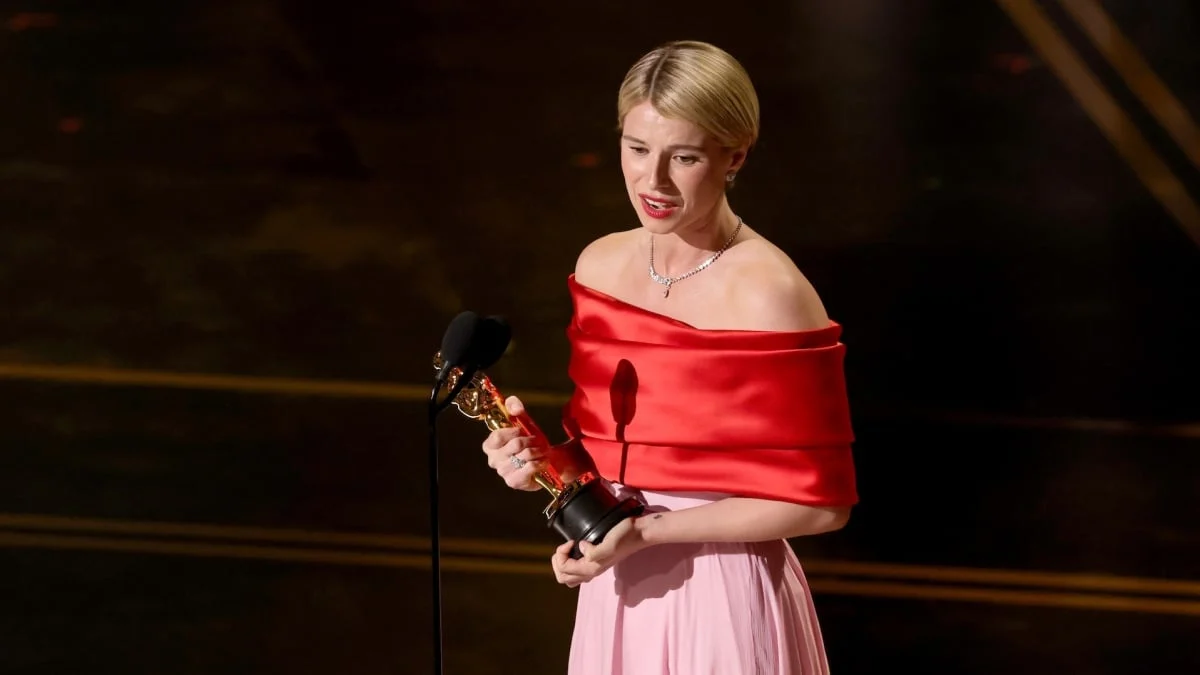
Jessie Buckley secured the Academy Award for Best Actress on Sunday night, delivering a powerful acceptance speech that resonated through the Dolby Theatre and emphasized the profound emotional complexities of motherhood. The Irish actress was recognized for her performance as Agnes in Chloé Zhao’s Hamnet, an adaptation of Maggie O’Farrell’s celebrated novel. Her victory at the 98th Academy Awards follows a sweeping awards season in which she also garnered top honors at the Golden Globes, the BAFTAs, and the Screen Actors Guild Awards.
Taking the stage after her name was announced, Buckley appeared visibly moved as she accepted the statuette from the previous year’s Best Actor winner. Her address began with a tribute to her fellow nominees, a group that represented one of the most competitive fields in recent cinematic history. Buckley’s win solidified her status as one of the preeminent dramatic talents of her generation, capping a multi-year rise from independent darling to an Academy Award-winning lead.
Oscars 2026: Watch Jessie Buckley’s moving speech and the tribute to motherhood
The centerpiece of Buckley’s address was a poignant dedication to mothers, specifically timed to coincide with Mother’s Day in the United Kingdom. Buckley described her role in Hamnet as a transformative journey that deepened her understanding of maternal love and the resilience of women throughout history. "I would like to dedicate this to the beautiful chaos of a mother’s heart," Buckley told the audience, a line that quickly became the defining quote of the evening.
She continued by acknowledging the lineage of women who have maintained their creative and emotional strength under duress. "We all come from a lineage of women who continue to create against all odds," she stated, linking her character’s 16th-century struggles to the modern experiences of women worldwide. The speech emphasized the "incandescent" nature of the collaborators she worked with, specifically naming director Chloé Zhao and author Maggie O’Farrell.
Buckley also took a moment to thank her family, including her husband, Freddie, and their daughter, Isla. The inclusion of her personal life served as a grounded contrast to the high-glamour environment of the Oscars. Industry analysts noted that the speech was characteristic of Buckley’s public persona—unfiltered, deeply intellectual, and rooted in a clear sense of identity.
The path to the 98th Academy Awards Best Actress victory
The win for Hamnet was the culmination of a rigorous promotional and awards circuit that began with the film’s premiere at the Venice Film Festival. Buckley’s portrayal of Agnes, the wife of William Shakespeare, was lauded by critics for its "raw, devastating, and sublime" quality. The role required a delicate balance of historical accuracy and modern emotional resonance, as the story focuses on the death of the couple’s young son, Hamnet, and the subsequent grief that informs the writing of the play Hamlet.
Critics pointed out that Buckley’s performance was the emotional anchor of Zhao’s film, which utilized the director’s signature naturalistic style. By the time the Oscars 2026: Watch Jessie Buckley’s moving speech became a viral moment, the actress had already built significant momentum. Her earlier wins at the Golden Globes and the BAFTAs had made her the statistical favorite, though the presence of Emma Stone and Kate Hudson in the category kept the outcome uncertain until the envelope was opened.
The 98th Academy Awards saw Hamnet compete in several major categories, including Best Director and Best Adapted Screenplay. However, it was Buckley’s performance that served as the film’s most decorated element. The actress, who first gained international attention in the film Wild Rose and later earned an Oscar nomination for The Lost Daughter, has been praised for her ability to inhabit "difficult" or emotionally porous characters.
Analyzing the competition in the Best Actress category
The 2026 Best Actress category was notable for its diversity of performances, ranging from experimental sci-fi to intimate indie dramas. Buckley’s fellow nominees included Rose Byrne for her role in If I Had Legs I’d Kick You, Kate Hudson in the musical drama Song Sung Blue, Renate Reinsve in the Norwegian production Sentimental Value, and Emma Stone for her work in Bugonia.
Buckley addressed these women directly during her speech, stating, "I am inspired by your art and your heart, and I want to work with every single one of you." The camaraderie among the nominees was a recurring theme during the 2026 season, with several joint interviews highlighting a shared commitment to female-led narratives.
Emma Stone’s nomination for Bugonia marked her continued collaboration with director Yorgos Lanthimos, while Kate Hudson’s turn in Song Sung Blue was widely seen as a major career comeback. Renate Reinsve, who previously gained fame for The Worst Person in the World, further established herself as a force in international cinema with Sentimental Value. Despite the strength of these performances, Buckley’s portrayal of maternal grief in Hamnet was viewed by the Academy as the most "sublime" achievement of the year.
Cultural significance of the Irish language on the global stage
In the final moments of the Oscars 2026: Watch Jessie Buckley’s moving speech, the actress transitioned from English to Irish (Gaelic). She concluded her remarks by saying, "Go raibh maith agaibh, slán," which translates to "Thank you all, goodbye." This gesture was seen as a significant cultural statement, reflecting the ongoing "Irish Wave" in Hollywood that has seen actors like Cillian Murphy, Paul Mescal, and Barry Keoghan achieve major success.
Buckley, who was raised in Killarney, County Kerry, has frequently spoken about her pride in her Irish roots. Her use of the native language at the Academy Awards follows a trend of international winners using their platform to highlight their heritage. For the Irish public and the global Irish diaspora, the moment was a point of national pride, occurring on a night where Irish talent was represented across several categories.
Paul Mescal, who starred alongside Buckley in Hamnet as William Shakespeare, was also present at the ceremony. The chemistry between the two actors was a major talking point for critics, who credited their partnership with giving the film its grounded, visceral feel. The success of Hamnet has further solidified the reputation of Irish actors as central figures in contemporary prestige cinema.
The impact of ‘Hamnet’ and the direction of Chloé Zhao
The success of Hamnet marks another milestone for director Chloé Zhao, who previously won Best Director for Nomadland. In Hamnet, Zhao moved away from the contemporary American West to 16th-century England, yet she maintained her focus on the relationship between human emotion and the natural world. The film was praised for its cinematography and its ability to turn a historical biography into a universal story of loss.
Collaborating with Maggie O’Farrell to adapt the novel, Zhao centered the narrative on Agnes rather than her famous husband. This shift in perspective allowed Buckley to explore a character who is often relegated to the margins of history. The film’s exploration of the "beautiful chaos" of the home and the medicinal power of nature provided Buckley with a rich tapestry for her performance.
The industry impact of Hamnet is expected to be long-lasting. By focusing on the domestic life of the Shakespeare family, the film challenged the traditional "great man" theory of history, instead positing that the world’s greatest literature was born out of domestic tragedy and the strength of a woman often misunderstood by historians.
Industry reactions and the future of Jessie Buckley’s career
Following the ceremony, social media and trade publications were flooded with praise for Buckley’s win. Industry veterans noted that her speech was a masterclass in humility and grace. The phrase "beautiful chaos of a mother’s heart" trended on various platforms, becoming a shorthand for the emotional depth the Academy Awards aims to celebrate.
With an Oscar now to her name, Buckley’s career trajectory is expected to ascend even further. Producers and directors have long noted her versatility, ranging from musical theater to psychological thrillers. This win likely grants her "green-light power," allowing her to pursue passion projects and continue advocating for complex female roles.
The 98th Academy Awards will be remembered for several standout moments, but the image of Jessie Buckley speaking Irish and honoring the lineage of creative women remains its most enduring image. As the film industry continues to evolve, the recognition of Hamnet and Buckley’s performance suggests a continued appetite for deeply felt, character-driven storytelling that bridges the gap between historical fact and emotional truth.