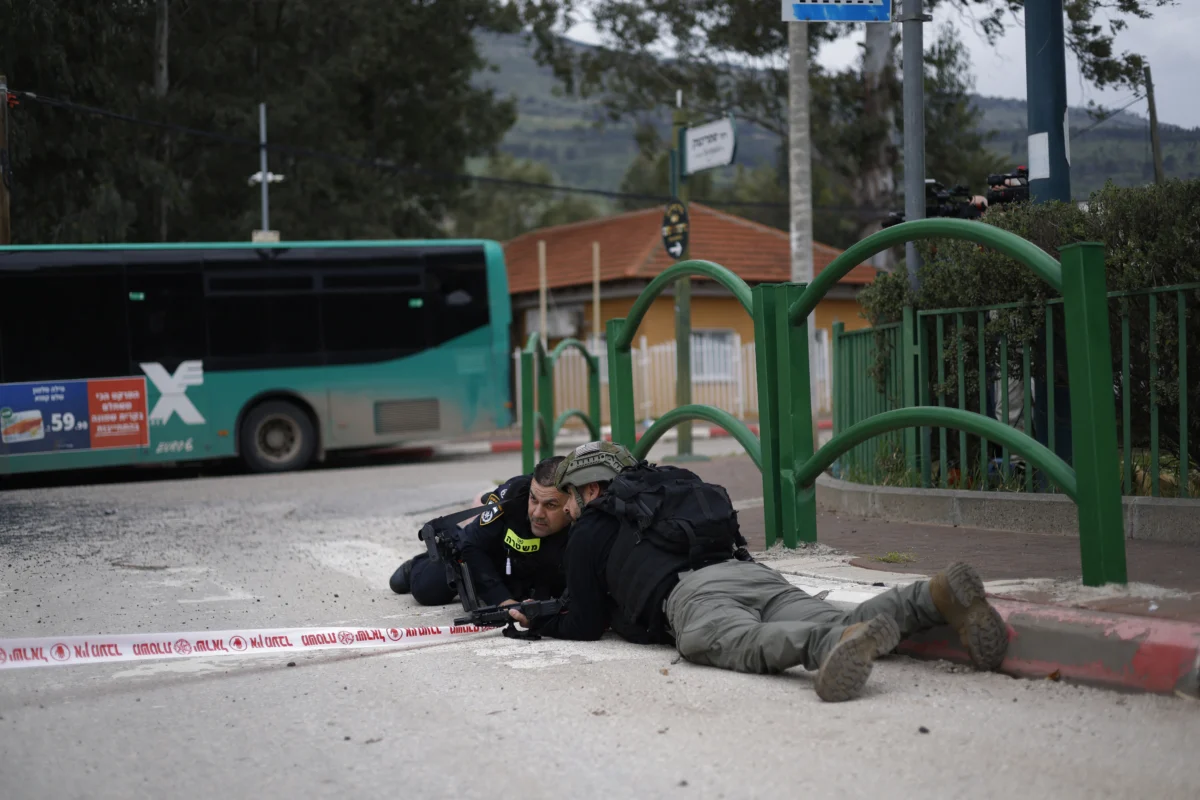
KIRYAT SHMONA, Israel – A missile impacted near the northern Israeli town of Kiryat Shmona on Monday, March 23, 2026, forcing President Isaac Herzog to seek immediate cover shortly after concluding a press conference. The incident occurred mere moments after Herzog delivered remarks emphasizing Israel’s stance against returning to a previous ceasefire and asserting the necessity of securing "strategic depth inside Lebanon." The strike underscores the volatile security situation along Israel’s northern border, a region that has experienced escalating tensions.
The presidential visit to Kiryat Shmona, a community frequently targeted by cross-border shelling, was intended to project an image of resilience and underscore the government’s commitment to the region’s security. However, the swift and proximate missile attack served as a stark reminder of the ongoing threats emanating from Lebanon. The proximity of the strike to the president’s location immediately raised concerns about the efficacy of security protocols and the reach of militant groups operating across the border.
Escalating Tensions on the Northern Front
The missile strike on Kiryat Shmona is the latest in a series of escalating incidents that have characterized the northern Israeli front. For months, the region has been a focal point of exchanges of fire, primarily involving the Lebanese militant group Hezbollah and Israeli forces. These exchanges have been largely attributed to the broader regional conflict ignited by the October 7th attacks and subsequent Israeli military operations in Gaza.
Hezbollah, an Iran-backed organization, has consistently stated its solidarity with Palestinian factions and has engaged in cross-border attacks as a means of diverting Israeli military resources and pressuring Israel. The group possesses a significant arsenal of rockets and missiles, capable of reaching various targets within Israel. The repeated targeting of northern Israeli communities, including Kiryat Shmona, has led to widespread evacuations and significant disruption to daily life.
President Herzog’s Stance on Strategic Depth
During his press conference, President Herzog articulated a firm position regarding Israel’s security strategy in the north. He explicitly rejected the idea of reverting to the status quo ante, referencing a previous ceasefire agreement that had largely held for years before the current escalation. His call for "strategic depth inside Lebanon" signals a potential shift in Israeli policy, suggesting a willingness to take more assertive actions to create a buffer zone or establish a security perimeter beyond Israel’s internationally recognized border.
This declaration reflects a growing sentiment within Israeli leadership and the security establishment that a passive defense is no longer sufficient. The perceived vulnerability of northern communities and the persistent threat of cross-border incursions necessitate a proactive approach, according to proponents of this strategy. The concept of "strategic depth" implies the potential for deeper military operations or the establishment of de facto security zones within Lebanese territory to deter attacks.
Immediate Aftermath and Security Response
Following the missile impact, security personnel swiftly moved President Herzog and his entourage to a secure location. Emergency services were immediately dispatched to assess the situation and provide any necessary assistance. Initial reports indicated that the missile struck an open area near the town, causing no immediate civilian casualties, though the psychological impact on residents was palpable.
The Israeli military immediately launched retaliatory strikes against targets in southern Lebanon, a customary response to rocket fire from Lebanese territory. These strikes are aimed at degrading the capabilities of militant groups and signaling Israel’s resolve to respond to attacks. The cycle of escalation, however, remains a persistent concern, with fears of a wider conflict always present.
Historical Context of the Northern Border
The Israeli-Lebanese border has long been a volatile frontier, marked by periods of intense conflict and uneasy calm. The 2006 Lebanon War, fought between Israel and Hezbollah, remains a significant historical marker, demonstrating the destructive potential of a full-scale conflict between the two. The war resulted in significant casualties on both sides and a UN Security Council resolution that aimed to stabilize the border.
Since that conflict, UN peacekeeping forces, known as UNIFIL, have been deployed along the southern Lebanese border. However, their effectiveness in preventing militant activity has been a subject of debate, particularly given the continued presence and capabilities of Hezbollah. The current escalation represents a significant departure from the relative quiet that characterized much of the period following the 2006 war.
Broader Implications for Regional Stability
The missile strike and President Herzog’s assertive remarks carry significant implications for regional stability. The call for "strategic depth" could be interpreted by Hezbollah and its allies as a prelude to expanded Israeli military operations within Lebanon, potentially leading to a dangerous escalation. Such actions could further destabilize an already fragile region, drawing in other actors and exacerbating existing tensions.
The involvement of Iran, a key supporter of Hezbollah, adds another layer of complexity. Iran views such actions as part of a broader confrontation with Israel and the United States. Any significant Israeli military action in Lebanon could draw a response from Iran or its proxies in other parts of the Middle East, creating a wider conflagration.
Impact on Northern Israeli Communities
For the residents of Kiryat Shmona and other northern Israeli towns, the missile strike is a deeply unsettling event. These communities have borne the brunt of the escalating conflict, with many residents forced to evacuate their homes and livelihoods. The constant threat of rocket attacks has created a pervasive sense of insecurity and anxiety, impacting mental health and economic activity.
The visit by the Israeli president was intended to offer reassurance and demonstrate solidarity. However, the subsequent attack has likely amplified fears and raised questions about the effectiveness of government protection. The long-term impact on these communities could include further population displacement and a lasting sense of vulnerability, requiring significant government support for recovery and rebuilding.
Public and Political Reactions
The incident has generated a predictable range of reactions within Israel and internationally. Political leaders across the spectrum have condemned the attack and expressed support for the president’s security. Opposition figures have used the incident to criticize the government’s handling of security matters, while government officials have reiterated their commitment to defending the nation.
Internationally, the United Nations and various global powers have called for de-escalation and restraint. However, the ongoing regional dynamics, particularly the Israel-Hamas conflict and its ripple effects, make diplomatic solutions increasingly challenging. The United States, a key ally of Israel, has reiterated its support for Israel’s right to self-defense while also urging caution to avoid a wider conflict.
Analysis of Hezbollah’s Strategy
Hezbollah’s continued engagement in cross-border attacks, even after President Herzog’s visit, suggests a deliberate strategy to maintain pressure on Israel. By targeting areas near presidential visits, Hezbollah may be aiming to demonstrate its reach and capabilities, signaling that no part of Israel is entirely safe from its arsenal. This tactic also serves to rally domestic support and project strength within the broader regional resistance narrative.
The group’s actions are closely coordinated with other Iran-aligned groups in the region, suggesting a unified front against Israel. This coordinated approach complicates any efforts by Israel to isolate or contain specific threats, as actions against one proxy may be met with responses from others.
The Path Forward: Deterrence and Diplomacy
The events of March 23, 2026, highlight the precarious balance on Israel’s northern border. The immediate aftermath saw a predictable cycle of retaliatory strikes, a tactic that has proven effective in the short term but does not address the underlying causes of the conflict. The longer-term challenge lies in finding a sustainable solution that can de-escalate tensions and prevent further bloodshed.
The concept of "strategic depth" introduced by President Herzog suggests a potential for a more aggressive Israeli posture. However, such a strategy carries significant risks of escalating the conflict into a full-blown war with devastating consequences for both Lebanon and Israel. Balancing the need for security with the imperative of avoiding wider regional conflagration will be a critical challenge for Israeli policymakers in the coming months.
The ongoing violence also underscores the urgent need for renewed diplomatic efforts. While the immediate focus remains on security and deterrence, a comprehensive political solution that addresses the root causes of the conflict, including the unresolved issues between Israel and Lebanon, will ultimately be necessary for lasting peace. The international community has a crucial role to play in facilitating such dialogue and providing the necessary support for de-escalation and stability. The missile strike served as a stark reminder that the path to peace remains fraught with peril.