
British Business Secretary Peter Kyle confirmed Thursday that the government has established comprehensive contingency plans to address potential food shortages and supply chain disruptions should the ongoing conflict in Iran persist through the summer. The announcement follows leaked internal documents suggesting that a "reasonable worst-case scenario" could lead to a significant depletion of essential supermarket goods, particularly poultry and pork products.
The government’s strategy focuses on mitigating the impact of a potential prolonged closure of the Strait of Hormuz, a critical maritime artery for global trade. Officials are specifically concerned that a blockade or continued instability in the region will sever the supply of materials necessary for the production of carbon dioxide (CO2), a gas that is indispensable to the United Kingdom’s food and beverage industry.
During a series of media appearances on Sky News and Times Radio, Kyle emphasized that while the current food supply remains stable, the government is proactively engaging in "resilience deep dives" to ensure the nation is prepared for any escalation. He stated that the prime minister has been personally overseeing these planning sessions to avoid the administrative delays seen during previous national crises.
The Strait of Hormuz and the Threat to Food Security
The strategic importance of the Strait of Hormuz cannot be overstated, as it serves as the primary transit point for a significant portion of the world’s energy and chemical exports. A disruption in this corridor has immediate repercussions for the British economy, particularly in the manufacturing of CO2.
In the UK, CO2 is not merely a byproduct for carbonated beverages; it is a vital component of the food supply chain. It is used extensively in the humane slaughtering of pigs and chickens, as well as in Modified Atmosphere Packaging (MAP), which extends the shelf life of salads, fresh meats, and baked goods. Without a steady supply of this gas, the logistics of food production and distribution face an immediate bottleneck.
Internal government analysis suggests that under the most severe projections, CO2 supplies could plummet to just 18 percent of their normal levels by June. Such a shortfall would hit the farming and hospitality sectors the hardest, potentially resulting in a reduced variety of products on supermarket shelves and shorter expiration dates for fresh produce.
Reasonable Worst-Case Scenario: Contingency Plans in Place for Possible Food Shortages if Iran War Continues
The "reasonable worst-case scenario" drafted by civil servants assumes that the Strait of Hormuz remains impassable through the mid-summer months without a permanent peace agreement in place. Under these conditions, the government is prepared to introduce emergency legislation that would compel domestic factories to maximize CO2 production at any cost.
To bolster current domestic resilience, Business Secretary Kyle noted that the government has already taken steps to secure local production. This includes reversing the mothballing of the Ensus bio-ethanol plant in Teesside. The facility, which was previously slated for closure, has been identified as a cornerstone of the UK’s strategy to maintain a strategic reserve of carbon dioxide.

"People should be reassured that we are doing this kind of action behind the scenes to keep resilience in our economy," Kyle told reporters. He added that while CO2 supplies are "not a concern" at this exact moment, the government is acting with "boldness and creativity" to ensure that the public can continue their daily lives without significant disruption to their grocery shopping habits.
Broader Economic Support and the British Industrial Competitiveness Scheme
As the conflict in the Middle East continues to exert upward pressure on global energy prices, the Department for Business and Trade announced an expansion of the British Industrial Competitiveness Scheme (BICS). This move is designed to protect energy-intensive industries from the volatility of fuel bills exacerbated by the war.
The expansion of BICS will increase the number of eligible businesses from 7,000 to more than 10,000. Sectors such as steel production, aerospace, automotive manufacturing, and pharmaceuticals are expected to benefit from a one-off additional payment in 2027 to compensate for high electricity costs.
Beginning in April 2027, eligible firms will see their electricity bills reduced by up to 25 percent. The government emphasized that this support—estimated to be worth £600 million ($748 million) per year—will be funded in a way that ensures household energy bills do not increase. By stabilizing these industries, the government hopes to prevent a "domino effect" where high industrial costs lead to higher consumer prices and further inflation.
Political Reactions and the SNP Manifesto Launch
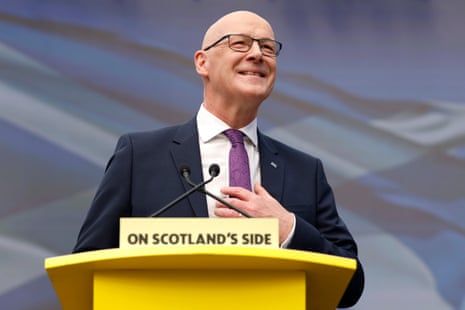
The confirmation of food security planning comes at a time of heightened political activity in the UK. In Scotland, First Minister and SNP leader John Swinney launched his party’s manifesto for the upcoming Holyrood election, framing his leadership as a stabilizing force amid global and domestic uncertainty.
Swinney highlighted his record over the past two years, citing progress in reducing hospital waiting times and abolishing peak rail fares. However, he also introduced new policy proposals, including a national ban on smartphones in Scottish classrooms. Swinney argued that mobile devices have become a "distraction from learning" and pledged that an SNP government would legislate a full ban to support teachers and improve literacy and numeracy rates.
The SNP’s manifesto launch was met with criticism from opposition parties, who argued that the focus on social issues distracts from the immediate economic pressures facing Scottish households due to the international conflict.
Reform UK Proposes Strict Liability for Asylum Fraud
Simultaneously, the Reform UK party has introduced a hardline policy targeting the "legal-industrial complex" involved in the asylum system. Home affairs spokesperson Zia Yusuf announced that a Reform UK government would create a new "strict liability" criminal offence for lawyers and advisers who facilitate bogus asylum claims.
The proposal follows a BBC investigation into fraudulent claims within the immigration system. Under the proposed law, prosecutors would not need to prove intent to secure a conviction, and the crime would be punishable by up to two years in prison. Yusuf also advocated for ending all taxpayer-funded legal aid for illegal arrivals and visa overstayers, arguing that those who enter the country unlawfully should not receive public funds to fight their removal.
Home Secretary Shabana Mahmood responded to the underlying fraud concerns by stating that sham lawyers facilitating abuse of the system would face the "full force of the law." However, the Reform UK proposals represent a significant escalation in the rhetoric surrounding immigration and legal accountability.
NHS Performance Data and Economic Momentum Before the Conflict
New data released by NHS England provided a rare glimmer of positive news, showing that the waiting list for routine hospital treatment has fallen for the fourth consecutive month. As of the end of February, an estimated 7.22 million treatments were pending, the lowest level in a year.
Economically, the UK also showed surprising strength prior to the escalation of the Iran war. Official figures indicate that the GDP expanded by 0.5 percent in February, surpassing analyst expectations. This growth suggested that the British economy was gaining significant momentum and emerging from a period of stagnation before the geopolitical crisis in the Middle East introduced new risks to the recovery.
Economists warn, however, that the gains made in early 2024 could be erased if the war leads to a sustained spike in energy prices or if the contingency plans for food shortages must be fully activated. The hospitality and retail sectors are particularly vulnerable to any shifts in consumer confidence or supply availability.
Critical Uses for CO2 Beyond the Food Industry
The government’s focus on CO2 is driven by its necessity in sectors far beyond the supermarket. Business Secretary Kyle noted that the gas is essential for MRI scanning in the healthcare sector and plays a vital role in water purification processes.
Furthermore, the UK’s civil nuclear power industry relies on CO2 for cooling and various safety protocols. The defense sector also utilizes the gas for specific applications. The multi-sector dependency on CO2 explains why the government is prioritizing the "resilience deep dives" and the reopening of domestic production facilities like the Teesside plant.
Kyle reiterated that the public should continue their normal shopping habits for now, emphasizing that "right now, people should go on as they are, enjoying beer, enjoying their meats, enjoying all the salads." He promised that the government would be "upfront with the public" well in advance if the supply situation deteriorates to the point where consumer-facing changes are required.
As the situation in the Middle East remains fluid, the UK government continues to coordinate with international partners and domestic industry leaders. The focus remains on maintaining a balance between preventing public panic and ensuring that the infrastructure is in place to handle a "reasonable worst-case scenario" should the war in Iran continue to disrupt the global supply chain.