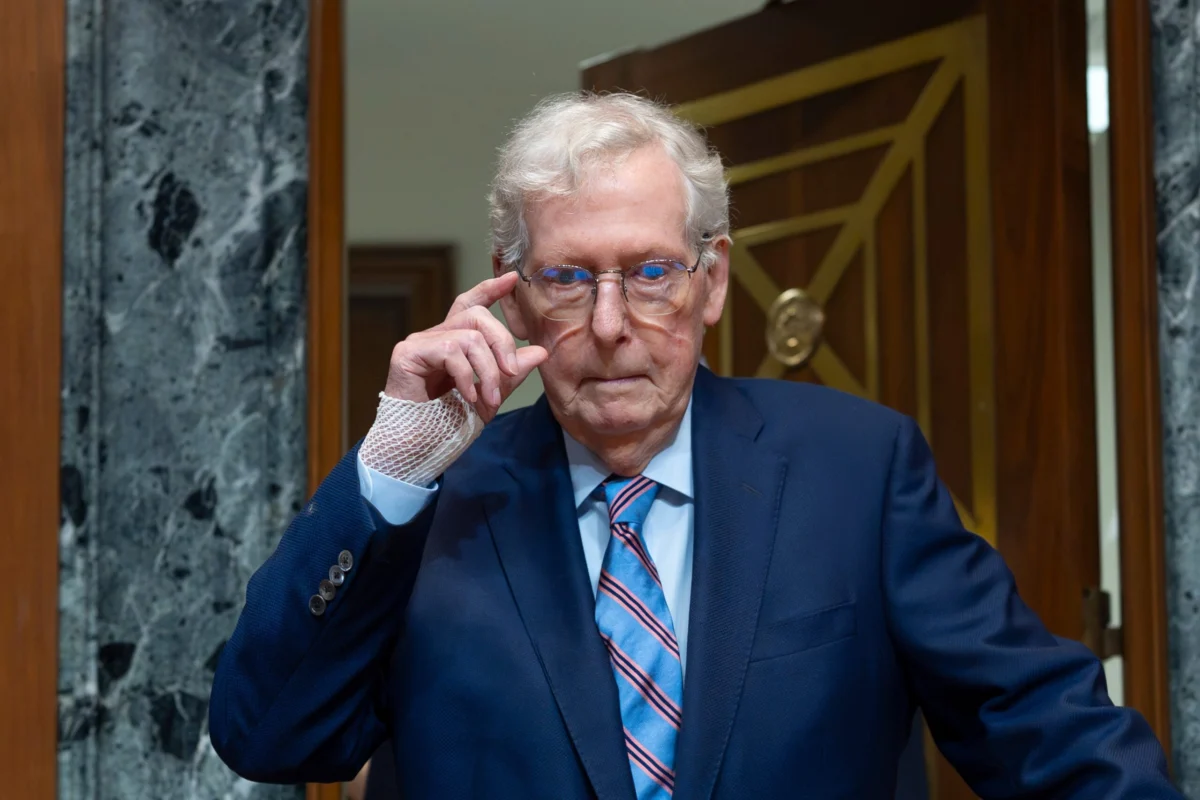
The prolonged absence and visible health concerns of Senate Minority Leader Mitch McConnell have amplified scrutiny over the procedures and political ramifications should he be unable to complete his current term. McConnell, a titan of Republican leadership in the Senate for decades, has recently experienced public health episodes that have raised questions about his fitness to serve and triggered discussions about the potential impact on the narrowly divided upper chamber of Congress. The intricacies of filling a sudden Senate vacancy in Kentucky, coupled with the delicate balance of power in Washington, underscore the gravity of these concerns.
McConnell’s Health and Recent Incidents
The 82-year-old senator, who has served as a Republican leader in the Senate for an unprecedented tenure, recently experienced a significant public health event. After a period of absence from public view, McConnell confirmed he was hospitalized on June 14 following a fall that rendered him "briefly unconscious." He also disclosed a mild case of pneumonia. This hospitalization followed weeks of speculation and online rumors, some of which baselessly suggested severe neurological issues.
Prior to this incident, McConnell had shown increasing signs of frailty. He has been observed freezing in place during public appearances and has navigated Capitol Hill with visible unsteadiness, at times requiring a wheelchair. These episodes have reignited concerns that have periodically surfaced in recent years. In February, McConnell was hospitalized for flu-like symptoms. He also suffered a fall in 2019 that resulted in a fractured shoulder. Reporting from the Louisville Courier Journal has detailed other instances, including three collapses in 2023 that led to a concussion and a broken rib, and subsequent public "freezing" episodes that fueled questions about his capacity to serve.
The Strategic Importance of McConnell’s Seat
McConnell’s position as the longest-serving party leader in Senate history is not merely a matter of personal achievement; it is intrinsically linked to the Republican Party’s control of the Senate. Republicans currently hold a slim majority, making each seat critically important for advancing their legislative agenda and confirming judicial and executive nominees.

His absence, even temporarily, shrinks the number of available Republican votes from 53 to 52 in the 100-seat chamber. This numerical shift can be pivotal in close votes on contentious legislation. For instance, McConnell’s absence was cited as a factor in the passage of a resolution opposing President Donald Trump’s war on Iran, which saw four Republicans cross party lines to vote with Democrats. Furthermore, McConnell’s role on the influential Senate Appropriations Committee, which dictates discretionary government spending, is crucial, especially with a looming government funding deadline. His continued incapacitation could complicate efforts to pass essential funding measures.
What Happens If McConnell Vacates His Seat?
The constitutional and statutory framework for filling a U.S. Senate vacancy is complex and varies by state. In the event Senator McConnell were unable to complete his term, the process in Kentucky is now governed by a law passed in 2024. This legislation significantly altered the procedure for filling Senate vacancies, shifting authority away from the governor.
Under the new state law, Kentucky governors do not have the authority to directly appoint a replacement for a U.S. Senate vacancy. Instead, the law mandates that any vacancy must be filled through a special election. This election must be called by the governor.
The Mechanics and Challenges of a Special Election
The timing and logistical complexities of a special election present significant hurdles. The 2024 Kentucky law specifies that the governor must provide 63 days’ notice before a special election can be held. Aspiring candidates would then have a limited window, needing to file their candidacy no later than 56 days prior to the vote.

Even if a vacancy were to occur immediately, the earliest a special election could realistically be scheduled would be in September. However, experts widely agree that initiating such a process would be impractical given that the November midterm elections are less than four months away. McConnell’s Senate seat is already on the ballot in that regularly scheduled election.
Political strategists and academics suggest that the expense and administrative effort of organizing a special election for a seat that will be decided in the general election just weeks later would be inefficient. The cost to the state, often referred to as the "commonwealth," of holding an additional election solely to fill a seat for a period of potentially only one month is deemed prohibitive by many. The logistical challenges of setting up the election framework, including candidate filing deadlines and ballot printing, would also lead to delays, making it unlikely a replacement would be seated before the November election.
Potential Legal Battles and Constitutional Questions
Beyond the procedural challenges, the 2024 Kentucky law is largely untested and is expected to face significant legal challenges. Election law experts anticipate that the validity of the new statute could be debated in the courts. A key point of contention may be a perceived conflict between the new state law and provisions within the U.S. Constitution and the Kentucky Constitution regarding Senate vacancies.
Specifically, the 17th Amendment to the U.S. Constitution states that state legislatures "may empower the Executive thereof to make temporary appointments until the people fill the vacancy by election as the Legislature may direct." Section 152 of the Kentucky Constitution historically granted the governor the power to appoint Senate replacements. The new law, which mandates a special election and removes the governor’s appointment power, could be challenged as unconstitutional.

These potential legal battles could further delay the filling of any vacancy. Lawyers specializing in election law could employ tactics to slow-walk the legal process, creating extended periods of uncertainty regarding representation in the Senate.
The Governor’s Veto and Legislative Power Shifts
The 2024 law that stripped the governor’s appointment power was a point of contention. Governor Andy Beshear, a Democrat, vetoed the bill. However, the Republican-controlled Kentucky legislature, possessing a supermajority, successfully overrode his veto. This action is seen as part of a broader trend by Republican lawmakers in the state to consolidate power within the legislative branch and diminish the authority of the executive, particularly since Beshear’s election in 2019.
This was not the first legislative attempt to curtail the governor’s role in filling Senate vacancies. In 2021, Republican lawmakers had passed a bill requiring the governor to select a temporary replacement from a list of three nominees provided by the former senator’s party’s executive committee. This was followed by a special election. The 2024 update, which completely removed the governor’s appointment authority, was reportedly enacted due to concerns about potential legal challenges to the earlier legislation.
Proponents of the 2024 law argue that it promotes a more democratic process and aligns with procedures for filling other state-level vacancies. However, Governor Beshear remains the only Democrat holding statewide office in Kentucky, a state that has not elected a Democrat to the U.S. Senate since 1992.

The Political Landscape and Republican Unity
The health of senior Republican figures like McConnell has also brought into focus the internal dynamics of the Republican Party. As the Republican majority in the Senate has thinned, the influence of moderate Republicans and individual "swing" votes has become more pronounced. These lawmakers, such as Senators Susan Collins and Lisa Murkowski, along with figures like Rand Paul, have demonstrated a willingness to diverge from party leadership on critical votes.
The increasing number of "lame-duck" Republicans who have lost re-election bids to rivals backed by former President Donald Trump may also contribute to a greater willingness to challenge party leadership. This fragmentation could make the Senate more susceptible to policy battles where McConnell’s unifying influence, or at least his strategic guidance, is crucial. His absence, whether due to health or a potential vacancy, could exacerbate these internal divisions and complicate the party’s ability to present a united front.
Reactions and Calls for Transparency
The extended period of McConnell’s absence from public view naturally prompted concern and calls for information. Republican leadership initially sought to reassure the public and the party faithful that the senator would return to his duties. However, as weeks turned into months, these reassurances were met with increasing skepticism, leading to mounting questions about his condition.
Kentucky Governor Andy Beshear formally requested an update on McConnell’s health status in early July, underscoring the public interest in the senator’s well-being. While Beshear acknowledged McConnell’s statement as a "step in the right direction," he continued to advocate for greater transparency, suggesting that a video update from the senator would be more reassuring.

Critics, including Democratic Senate candidate Charles Booker, have called for McConnell to step down, questioning his ability to continue serving. Conversely, some Republican strategists, like Tres Watson, have defended McConnell’s mental acuity, stating that while his body may be failing, his intellect and wit remain intact, which they believe was a factor in his decision not to seek re-election.
The 2024 Senate Race in Kentucky
The question of McConnell’s succession is already being addressed in the upcoming midterm elections. In the general election, Democrat Charles Booker, a former state legislator, is running against Republican Representative Andy Barr. They are vying for McConnell’s seat, which is up for election in November. The outcome of this race will be a critical factor in determining the balance of power in the U.S. Senate for the next six years.
The ongoing discussions surrounding Mitch McConnell’s health and the potential implications for his Senate seat highlight the critical juncture at which American politics finds itself. The interplay of health, political strategy, and constitutional law will continue to shape the narrative surrounding this pivotal Senate race and the broader landscape of the U.S. Congress.