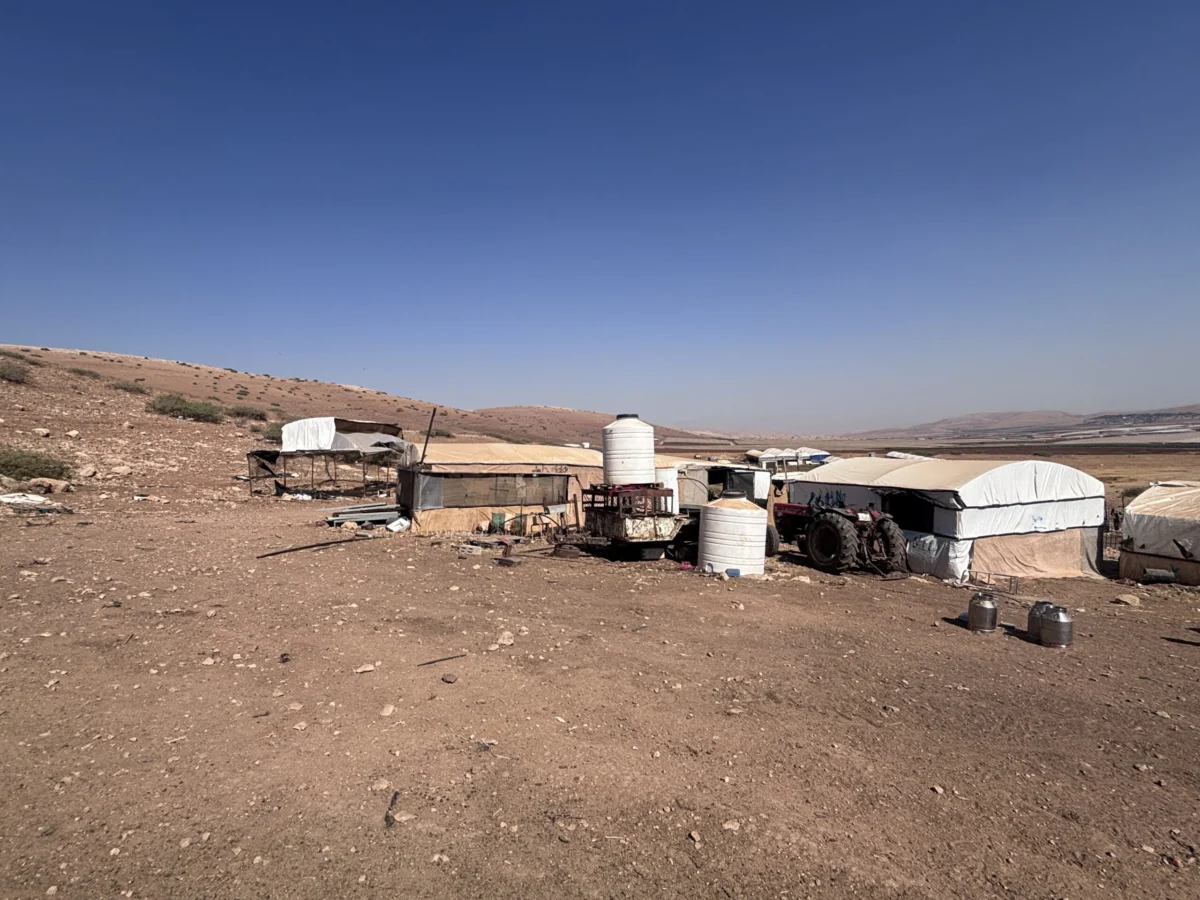
The journey to Thaer Bisharat’s home in Ras al-Ahmar, a Palestinian village nestled in the occupied West Bank’s Jordan Valley, once a mere ten-minute drive, now stretches into an arduous three-hour ordeal. This dramatic increase in travel time is a direct consequence of the escalating measures implemented by Israeli authorities, most notably the construction of the "Crimson Thread" military barrier, which is systematically isolating Palestinian communities and severing their access to vital lands and resources.
The village of Ras al-Ahmar, like many others in the northern Jordan Valley, finds itself under a suffocating blockade. Gates that once provided access to the main roads are now permanently shut, patrolled by Israeli soldiers and settlers whose distinct roles have become increasingly blurred on the ground. The sole remaining route to Bisharat’s home is a treacherous, winding dirt track, navigable only by four-wheel-drive vehicles and requiring constant vigilance to evade Israeli patrols. This deliberate constriction of movement is not an isolated incident but a systematic pattern of control aimed at displacing Palestinian residents and consolidating Israeli control over the territory.
This deliberate strangulation is amplified by recent Israeli military actions. During Bisharat’s lengthy journey home, Israeli forces intensified a lockdown in the area, undertaking the destruction of three water wells belonging to local Palestinians in the adjacent al-Buqaia plain. One of these wells was owned by a relative of Bisharat, highlighting the targeted nature of these demolitions. The fertile lands of the Jordan Valley, historically a breadbasket for Palestinian farmers cultivating crops such as bananas, grapes, olives, and potatoes, now bear the scars of this policy. Along the increasingly inaccessible dirt roads, farms stand partially abandoned, their greenhouses open and flapping in the wind, their crops wilting under a water supply that has been deliberately cut off by Israeli authorities for weeks.
Thaer Bisharat himself articulates the profound impact of these restrictions on daily life. "I can’t even run an errand," he stated, his voice heavy with frustration. "From Tamun, the village, it used to take me ten minutes. Now, with the current [dirt] road… it takes an hour, at best." The psychological toll is equally significant. Bisharat describes the pervasive fear of being isolated and vulnerable, especially when alone. He recounted a recent incident where individuals in military attire, described as "army-backed," visited nearby residents, collecting personal information and issuing chilling ultimatums: "You’ve got 24 hours to leave. Otherwise, we’re coming to confiscate everything you’ve got." This explicit threat underscores the coercive tactics employed to drive Palestinians from their ancestral lands.
The current phase of intensified pressure marks a stark escalation from previous policies. What were once characterized as "closed military zone" orders have now morphed into outright seizures of private land, accompanied by the systematic destruction of essential agricultural infrastructure, including irrigation pipes, water wells, and greenhouses. This aggressive advance is a clear manifestation of a dual strategy: the expansion of illegal Israeli settler outposts and the appropriation of Palestinian land, working in tandem to forcibly remove the Palestinian population. As Bisharat poignantly describes it, "They cage us in and suffocate us."

The ‘Crimson Thread’ Barrier: A New Phase of Control
The "Crimson Thread," Israel’s latest infrastructure project in the occupied West Bank, represents a significant new phase in its territorial control. Announced in 2025, the initial phase of this barrier involves the construction of a trench and a military road stretching approximately 22 kilometers between the Ein Shibli and Tayasir checkpoints. This corridor effectively severs the northern Jordan Valley from Tubas to the north and Nablus to the south, isolating a significant Palestinian agricultural heartland. While Israel claims the barrier is intended to prevent weapons smuggling from Jordan, its route lies several kilometers inside the occupied West Bank, deviating from the existing fenced Jordanian border.
The ultimate ambition for the "Crimson Thread" project is a sprawling 500-kilometer barrier, designed to physically divide Palestinian communities from thousands of hectares of their land. The strategic implications of this barrier are profound, echoing the disruptive impact of the separation wall constructed on the other side of the West Bank. This infrastructure project is not merely a physical barrier but a tool for demographic engineering, aimed at fragmenting Palestinian life and consolidating Israeli dominance.
The groundwork for the "Crimson Thread" was laid by a significant increase in Israeli military orders. On March 8, Israeli military commander Gilad Shriki visited several Palestinian communities, delivering thinly veiled warnings to residents about an impending "complete Israeli takeover of the area." This was followed by a crucial Israeli Supreme Court ruling last month, which cleared the path for the barrier’s construction. Since then, the Israeli Civil Administration has acted with unprecedented speed and aggression. Approximately three kilometers of trenches have already been dug, causing widespread destruction to Palestinian infrastructure. Irrigation pipes, fertile farmland, and greenhouses have been uprooted and obliterated, directly severing farmers from access to their land and livelihoods.
Land Seizures and Escalating Aggression
The routing of the "Crimson Thread" project was meticulously stitched together through nine land seizure orders. Dror Etkes, who meticulously tracks Israeli land policy for the Israeli NGO Kerem Navot, describes this as a "clear escalation" in a decades-long effort by Israeli authorities to dispossess Palestinians in the region. Etkes notes that this process has evolved from earlier tactics such as establishing checkpoints, building settlements, and designating Palestinian lands as military firing zones. In recent years, these methods have become "much more aggressive," involving settler attacks, military raids, property confiscations, and the denial of access to designated zones.
The current military land seizure orders empower Israeli authorities to "seize whatever land it deems necessary" for purported security purposes, according to Etkes. Official figures reveal a dramatic surge in these seizures. The Colonisation and Wall Resistance Commission reported that Israeli authorities issued 49 military land-seizure orders in the first half of the current year alone, already surpassing the 47 issued throughout the entirety of the previous year. This data starkly contradicts the official narrative of security necessity.
Thaer Bisharat dismisses the official rationale with cynicism. "It’s not a military road," he stated emphatically. "You don’t dig a trench two and a half, three meters deep for that." His observation points to the disproportionate and destructive nature of the barrier, suggesting ulterior motives beyond stated security concerns. The depth and scale of the trench suggest a permanent infrastructure of control rather than a temporary security measure.

Palestinians Trapped: ‘Effectively in a Prison’
Experts like Etkes highlight that the "Crimson Thread" barrier serves a dual purpose: it not only blocks Palestinians from accessing their agricultural lands east of the barrier but also facilitates the consolidation of existing illegal Israeli settlements. Furthermore, it directly links these settlements to a new outpost being constructed along the barrier’s route on Jabal Tamun. Etkes predicts this development will have a significant detrimental impact on an estimated 8,000 to 9,000 dunams (8 to 9 square kilometers) of Palestinian agricultural land, much of which is located in Area B under the Oslo Accords.
The process of displacement has been ongoing for years, with many communities already emptied. Etkes points to the abandonment of communities such as Khirbet Samra and Khirbet Yarza, noting that the departure of their residents created the perceived "right time for the next move" by Israeli authorities. A map provided by Kerem Navot illustrates the "Crimson Thread" route encircling Khirbet Yarza, but by the time construction reached the area, the village was already deserted, its inhabitants having been displaced by settlers months prior.
Mahdi Daraghmeh, the head of the al-Maleh village council, has witnessed this pattern of dispossession unfold across the hamlets under his purview. "Settler terror and fear have pushed many families to leave," he reported. "In the communities here, 130 families have been displaced – they’ve abandoned their structures, their homes, their land. And now they’ve lost their livelihoods – they have nothing left to live on."
Since the Supreme Court ruling in June, Israeli authorities have conducted near-daily operations in the area. These operations include the cutting of water supplies, the destruction of water tanks, and the confiscation of tractors and other essential farming equipment. Thaer Bisharat recounted his own experience: "They confiscated the tractors and water tanks from us here. So they claim these tractors and tanks are a threat to their security. A threat to your security, how?"
Concurrently, Israeli settlers have established a presence in the area east of Ras al-Ahmar, bringing caravans and positioning themselves within territory slated to be severed from Palestinian communities. The pattern of intimidation and violence is starkly illustrated by the case of Bilal Bani Oudeh, a friend of Bisharat’s. On June 16, bulldozers demolished livestock infrastructure at his home, and he was issued a 24-hour eviction notice. When Bani Oudeh refused to leave, settlers returned that night and subjected him to a brutal assault. "He nearly died," Bisharat stated grimly. "After they attacked him, they talked about tying him to a rope behind a vehicle. They took everything he owned."
Israeli authorities have actively sought to prevent observers from documenting or photographing the "Crimson Thread" operation. Despite these efforts, the excavation has led to the uprooting of hundreds of olive and grape trees and the repeated severing of irrigation pipelines that serve vast tracts of agricultural land. On the morning of July 14 alone, Israeli authorities destroyed three wells in al-Buqaia, including one belonging to Bisharat’s relative, and confiscated associated pumps and equipment. The Atuf village council, one of the communities directly impacted by the new barrier, estimated the damage from that single day’s operations at over four million shekels (approximately $1.3 million).

This systematic destruction has already decimated the local economy, wiping out the summer harvest. "There’s no agricultural season to speak of," Daraghmeh lamented. "Most of the land hasn’t been cultivated and what has been cultivated is for the settlers’ benefit." The completion of the trench, severing communities from each other and their farmland, is feared by residents to mark the definitive end of a Palestinian presence in the region. "Our communities will have no services, no infrastructure whatsoever," Daraghmeh warned. "No hospital, no emergency center, no schools; for all of that, people have to go to the neighboring town and that will be impossible." He concluded with a somber prediction: "Once this trench cuts people off, the people here will effectively be in a prison."
The Erosion of Livelihoods and the Plea for Basic Rights
With Israeli authorities having deliberately cut off water supplies to the area for weeks, the cost of a single water tank has surged to over 300 shekels ($100), more than triple its previous price. Even the transport of water has become a perilous endeavor. Bisharat’s brother was recently subjected to a violent encounter with settlers, who held him at gunpoint, stole his phone, and robbed him of his money.
Bisharat estimates that agricultural production in the area has collapsed by as much as 90 percent. Many families have already lost half their livestock due to their inability to access grazing lands. However, Bisharat has observed a familiar pattern in the fate of neighboring communities that have been erased from the map: once Palestinians are removed, settlers invariably take over their lands. "Then suddenly there’s no more ‘firing zone’," Bisharat stated, describing the transformation of these areas. "A road appears, water arrives, sheep arrive. Life comes back to the place, thank God!" He questions the official justifications for these actions: "So why do I get told it’s all a military zone?"
Looking out at the lush, green Israeli settlement farms in the distance, contrasted with the parched, equipment-strewn land around his own property, Bisharat expressed a profound sense of injustice. "Under their ‘law’, we are treated like animals," he remarked. He paused, reflecting on the discourse surrounding rights. "Israel always talks about ‘rights’, ‘rights’, ‘rights’," he said. "When someone hits a dog, suddenly, there’s animal rights advocates everywhere."
His voice carried a note of deep weariness and a desperate plea for basic dignity. "So actually, we don’t even want human rights," he concluded. "Just give us the animal rights they talk so much about. At this point, we’d settle for living under that." This statement underscores the profound dehumanization experienced by Palestinians in the face of escalating Israeli policies, where the fundamental rights afforded to animals are seen as a more attainable aspiration than their own human rights.