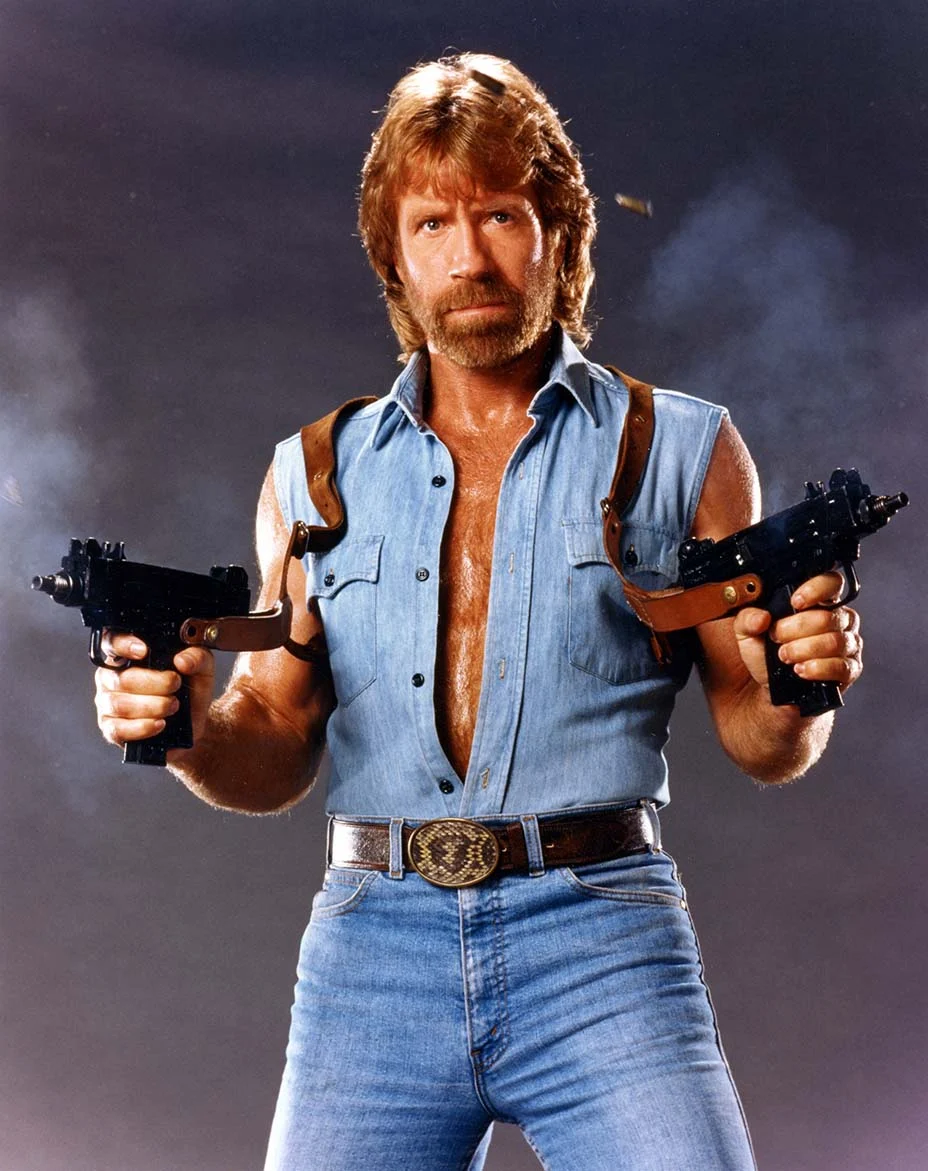
Chuck Norris, the iconic martial arts champion who transitioned into a formidable action star known for his roles in 1980s films like Missing in Action and the long-running CBS series Walker, Texas Ranger, has passed away at the age of 86. Norris’s family confirmed his death, stating he died suddenly on Thursday in Hawaii following a hospitalization.
In a public statement, Norris’s family expressed profound grief while celebrating his impactful life. "He lived his life with faith, purpose, and an unwavering commitment to the people he loved," the statement read. "Through his work, discipline, and kindness, he inspired millions around the world and left a lasting impact on so many lives." The family also conveyed their gratitude for the global outpouring of love and support, noting, "To him, you were not just fans, you were his friends." While the specific circumstances of his passing were requested to remain private, the family assured that he was surrounded by loved ones and was at peace.
Early Life and the Genesis of a Legend
Born Carlos Ray Norris on March 10, 1940, in Ryan, Oklahoma, near the Texas border, Norris’s early life was marked by humble beginnings. His father, Ray, worked as a mechanic and trucker, while his mother, Wilma, took on various jobs to support the family. Norris, who later identified his heritage as a blend of Irish and Native American, grew up with a father who struggled with alcoholism and was frequently absent. This environment led young Carlos to seek male role models in the Western heroes he admired on screen, such as John Wayne, Gene Autry, and Roy Rogers. He documented this formative influence in his 2004 memoir, Against All Odds: My Story, writing, "I determined that I would grow up one day to be like them. Their behavior in their films was governed by the ‘Code of the West’ — loyalty, friendship and integrity."
The family relocated frequently, eventually settling in Southern California in 1950. After graduating from North Torrance High School, Norris enlisted in the U.S. Air Force. It was during his military service, while stationed as a military policeman at Osan Air Base in South Korea, that he acquired the nickname "Chuck," which stuck with him for life. More significantly, his time in Korea ignited his lifelong passion for martial arts, where he began studying judo and Tang Soo Do, an "empty-hand" fighting style emphasizing kicks and punches.
A Champion in Martial Arts
Chuck Norris quickly distinguished himself in the martial arts world. He meticulously developed his skills, blending various forms to create his unique fighting style, Chun Kuk Do, which translates to "The Universal Way." Upon his military discharge in 1962, he held a first-degree black belt in Tang Soo Do and a third-degree brown belt in judo. While working as a file clerk for Northrop Corp. and preparing for a career in law enforcement, Norris began teaching karate lessons in his mother’s backyard. This modest start soon led him to secure a loan and open his first professional karate school in Torrance, California.
His competitive career was equally impressive, boasting a reported record of 65 wins against only 5 losses. He achieved widespread recognition by winning six world karate championships, solidifying his reputation as a legitimate and formidable martial artist. His expertise wasn’t just for competition; he opened numerous Chuck Norris Karate Schools across Los Angeles, which even received a credit in the 1975 film Dolemite. He also provided private lessons to a roster of celebrities, including Bob Barker, Priscilla Presley, and the legendary Steve McQueen, who would later play a pivotal role in Norris’s acting career.
From Dojo to Silver Screen: The Bruce Lee Connection
A significant turning point in Chuck Norris’s journey occurred in 1967 when he met Bruce Lee at a martial arts tournament in Madison Square Garden. The two martial arts titans quickly forged a friendship. Lee, then serving as an adviser on the 1968 Matt Helm movie The Wrecking Crew, cast Norris in a minor role as a bodyguard, marking one of Norris’s earliest forays into film. Although they lost touch when Lee moved to Hong Kong to pursue his burgeoning movie career, their paths spectacularly reconnected for an iconic cinematic moment.
In 1972, Norris and Lee famously squared off in an epic, no-holds-barred brawl within the ancient confines of the Roman Colosseum for Lee’s directorial debut, The Way of the Dragon. This fight sequence became a legendary benchmark in martial arts cinema, showcasing Norris’s authentic fighting prowess against Lee’s unparalleled agility.
Steve McQueen’s Encouragement and Hollywood Breakthrough
It was Steve McQueen, Norris’s karate student for several years, who ultimately encouraged him to seriously pursue acting. McQueen, recognizing a unique screen presence in Norris, famously advised him in 1974: "You either have a certain presence that comes across on the screen, or you don’t. I think you may have it. I strongly suggest that you give it a try." Taking McQueen’s counsel to heart, Norris embarked on an acting career that would define his public persona for decades.
His early roles included fight sequences in Slaughter in San Francisco (1974) and starring as a trucker in Breaker! Breaker! (1977), which notably featured some of his former black-belt students in the cast. His performance as CIA commando John T. Booker in Good Guys Wear Black (1978) surprised the industry by turning a significant profit. After showcasing his skills in A Force of One (1979), The Octagon (1980), and An Eye for an Eye (1981), Norris landed his first major studio release with Columbia Pictures’ Silent Rage (1982), playing a sheriff battling a mentally ill man with superhuman strength.

His true breakthrough came with the Sergio Leone-inspired Lone Wolf McQuade (1983), where he portrayed a Texas Ranger facing off against an arms merchant and martial arts master, played by David Carradine. This film established the rugged, honorable loner archetype that would become Norris’s signature.
The Cannon Era and Action Icon Status
Following Lone Wolf McQuade, Chuck Norris signed with the Cannon Group, led by producers Menahem Golan and Yoram Globus. This partnership proved incredibly lucrative, transforming Norris into a major box office draw for the mini-studio. He starred as Colonel James Braddock in Missing in Action (1984), a former POW returning to Vietnam to rescue captured soldiers. Despite being heavily criticized by reviewers, the film resonated deeply with audiences, spawning a prequel in 1985 and a sequel in 1988.
Norris famously recalled Steve McQueen’s advice regarding critical reception versus audience appeal: "Steve McQueen once said, ‘Look, the critics can praise you to the end of the world, but if your movie makes $2, you’re not going to work. So the thing is, as long as people come and see your movies, you’re going to keep working, no matter what the critics say.’" This philosophy allowed him to weather critical disdain and continue his hot streak with a string of successful action films, including Code of Silence (1985), Invasion U.S.A. (1985), Firewalker (1986), and The Delta Force (1986), which also led to a 1990 follow-up.
Walker, Texas Ranger and Television Stardom
While his film career solidified his action hero status, it was television that catapulted Chuck Norris into a household name for a generation. After reportedly declining numerous TV offers, Norris was approached with the concept for Walker, Texas Ranger. He embraced the idea, stating in a mid-1990s interview, "I liked the idea of a modern-day Western story. It had the action that I wanted, it had the inner relationships with the people that are necessary for a series, and it had the humor with the characters that I was involved with."
The series, created by Al Ruddy, Leslie Greif, Paul Haggis, and Christopher Canaan, debuted on CBS in April 1993. Norris starred as Cordell Walker, a soft-spoken U.S. Marine turned Texas Ranger, bringing a sense of moral rectitude and unparalleled physical prowess to the role. The show, often compared to classic Westerns like Gunsmoke for its Saturday night slot and thematic elements, ran for an impressive nine seasons, spanning approximately 200 episodes, and concluded with a 2005 telefilm. The enduring popularity of the Walker universe led to a new series starring Jared Padalecki, which premiered on The CW in December 2020 and ran for four seasons.
Cultural Icon and "Chuck Norris Facts"
Beyond his martial arts achievements and acting career, Chuck Norris achieved a unique form of cultural immortality through the widespread phenomenon of "Chuck Norris Facts." These hyperbolic, humorous statements celebrating his superhuman toughness and invincible nature became an internet sensation, cementing his status as a cultural icon. Examples included: "When the boogeyman goes to sleep, he checks his closet for Chuck Norris"; "When Chuck Norris crosses the street, the cars have to look both ways"; and "People wanted to add Chuck Norris to Mount Rushmore, but the granite was not tough enough for his beard." This phenomenon underscored his pervasive influence and the affectionate regard in which he was held by a global audience.
Later Career, Authorship, and Legacy
In his later career, Norris continued to make appearances in film and television, including a memorable cameo in Dodgeball: A True Underdog Story (2004) and a significant role in Expendables 2 (2012), joining an ensemble of action legends. He also ventured into authorship, penning several books such as The Secret of Inner Strength (1987), The Secret Power Within: Zen Solutions to Real Problems (1996), and Black Belt Patriotism (2008). In 2005, he founded the World Combat League, a team-based martial arts competition.
Norris’s family life was also intertwined with his career. His youngest brother, Aaron, a skilled stuntman and karate expert, directed and produced numerous episodes of Walker, Texas Ranger as well as several of Norris’s films. The family faced tragedy with the loss of their middle son, Wieland, who was killed in action during the Vietnam War.
In 2023, Norris made headlines when it was announced he had settled a lawsuit against CBS and Sony Pictures, alleging he was shortchanged at least $30 million in profits from Walker, Texas Ranger. He is survived by his second wife, Gena, whom he married in 1998, and his children: Mike, Dina, Eric (a stunt coordinator who also directed Walker episodes), Danilee, and Dakota.
Reflecting on his onscreen work in a 1990s interview, Norris acknowledged the violence in his projects but emphasized their underlying "moral structure." He stated, "When you are fighting good against evil, when the good guys are taking on the bad guys and winning, then I think that’s good. Unfortunately in our society, in reality, that’s not always the case… It’s nice to be able for do movies where people say, ‘This is what should happen, this is the way it should be in real life.’ That’s why I think I’m so successful." Chuck Norris leaves behind a legacy as a true martial arts pioneer and an action star who, through his discipline, unwavering moral compass, and a healthy dose of humor, carved out a unique and unforgettable place in American popular culture.