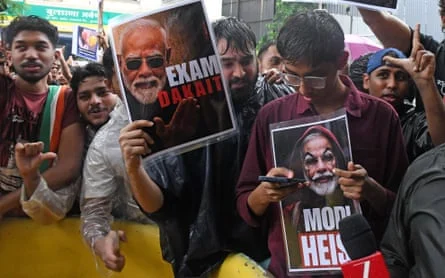
Prime Minister Narendra Modi announced the establishment of specialized "fast-track courts" intended to expedite the prosecution of officials involved in widespread examination leaks, a move designed to neutralize the youth-led ‘cockroach’ protests that have paralyzed parts of New Delhi and challenged the federal government’s authority. The Prime Minister’s intervention follows weeks of escalating civil unrest and a series of high-profile security failures involving national-level entrance exams, which have left millions of students in a state of professional limbo.
In his first direct public comments regarding the burgeoning movement, Modi utilized social media platform X to signal a zero-tolerance policy toward administrative corruption. "Nothing is more important than the welfare and future of our youth," Modi stated, emphasizing that those responsible for compromising the integrity of the education system would face severe consequences. The government’s pivot toward judicial speed is an attempt to address a primary grievance of the protesters: the notorious sluggishness of the Indian legal system, where cases involving official misconduct often languish for decades without resolution.
Despite the Prime Minister’s pledge of "fast-track" justice, the leadership of the Cockroach Janta Party (CJP)—the satirical name adopted by the protest movement—swiftly rejected the offer as insufficient. The movement’s nomenclature originated from a controversial remark made by a senior member of the Indian judiciary who reportedly referred to unemployed youth as "cockroaches," a term the protesters have since reclaimed as a symbol of resilience and numbers. The CJP has maintained that judicial promises are a distraction from their primary demand: the immediate resignation of Union Education Minister Dharmendra Pradhan and a total overhaul of the National Testing Agency (NTA).
The Genesis of the ‘Cockroach’ Protests and Judicial Frustration
The current wave of ‘cockroach’ protests was ignited by reports of systemic leaks in the National Eligibility cum Entrance Test (NEET) and the University Grants Commission-National Eligibility Test (UGC-NET). These examinations are the primary gateways for students seeking careers in medicine and academia, respectively. When evidence surfaced that question papers were being sold on the black market for significant sums, the resulting public outcry transformed from a localized student grievance into a national political crisis.
For many Indian youths, the exam leaks represent more than just administrative incompetence; they are seen as a betrayal of the meritocratic ideal. In a country where government jobs and professional degrees offer the only stable path out of poverty for millions, the perceived rigging of the system has created a volatile atmosphere. The CJP argues that the government’s reliance on fast-track courts is a "cosmetic fix" for a systemic rot that requires executive accountability rather than just judicial speed.
The judicial backlog in India is a central theme in the ‘cockroach’ protests. With over 40 million cases pending across various levels of the court system, the promise of a "fast-track" solution is often met with skepticism. Protesters point out that previous fast-track initiatives have frequently been hampered by a lack of judges and inadequate infrastructure, leading to the same delays they were intended to prevent. By focusing on the courts, the CJP claims, the Modi administration is attempting to shift the burden of responsibility away from the Ministry of Education.
Escalation at Jantar Mantar and the Police Crackdown
The heart of the ‘cockroach’ protests remains centered at Jantar Mantar, an 18th-century observatory in New Delhi that has long served as a designated site for democratic dissent. On Monday, an estimated 50,000 protesters converged on the site, attempting to march toward the Parliament House. The demonstration was met with a heavy security presence; police, having denied the CJP permission for the march, utilized baton charges and tear gas to disperse the crowds.
The violence of the crackdown has only served to harden the resolve of the demonstrators. Despite Delhi’s punishing summer heat and stifling humidity, over 1,000 core activists remain camped at the site in a permanent dharna (sit-in). The logistics of the protest have become a community effort, with supporters from across the city providing donations of water, glucose, and food. In a display of non-violent defiance, some protesters have even been observed handing out refreshments to the police officers tasked with containing them, while others focus on maintaining the cleanliness of the protest site to counter the "cockroach" label.
The movement has also seen a significant digital surge, with the ‘cockroach’ protests gaining traction on social media platforms. Videos of the police crackdown have been shared millions of times, drawing international attention to the plight of Indian students. This digital visibility has helped the CJP coordinate solidarity rallies in other major urban centers, including Mumbai, Bengaluru, and Kolkata, effectively nationalizing the movement and putting the ruling Bharatiya Janata Party (BJP) on the defensive in multiple states.

Political Deadlock and the Opposition’s Role
The political fallout of the ‘cockroach’ protests has reached the floor of the Indian Parliament, which was recently shut down by opposition parties in a show of solidarity with the students. Rahul Gandhi, the leader of the opposition and a prominent figure in the Indian National Congress, has taken a leading role in criticizing the government’s handling of the crisis. At a press conference held on Wednesday, Gandhi escalated his rhetoric, accusing the Modi administration of "destroying the most valuable asset of the country: its youth."
Gandhi highlighted a startling statistic to underscore the government’s failure: over the past decade, there have been 152 reported instances of examination paper leaks across various states and federal agencies, yet these have resulted in zero high-profile convictions. "Somebody, or a group of people, are destroying our education system," Gandhi said. "What does the government do? Zero convictions. They protect the corrupt while the students suffer."
The opposition’s demands mirror those of the CJP, specifically calling for the resignation of Dharmendra Pradhan. While some government ministers have indicated a willingness to engage in dialogue with the protesters, the administration has remained firm on its refusal to remove the Education Minister. This impasse has led to a stalemate, with the CJP’s founder, Abhijeet Dipke, stating that the movement will no longer seek private meetings with government officials. Instead, the CJP demands that any future negotiations take place in public at the protest site to ensure transparency.
Socio-Economic Implications and the Demographic Dividend
The ‘cockroach’ protests are occurring against a backdrop of broader economic anxiety among India’s youth. While India remains one of the world’s fastest-growing major economies, job creation has not kept pace with the number of graduates entering the workforce. For many, the "demographic dividend"—India’s large population of young people—is increasingly viewed as a "demographic time bomb" if the state cannot provide fair access to employment and education.
The competitive exam system is the cornerstone of social mobility in India. When that system is compromised by "paper leak mafias"—organized criminal syndicates that collude with corrupt officials to sell exam papers—it erodes public trust in the state. The intensity of the ‘cockroach’ protests reflects a deep-seated fear that the "Indian Dream" is being paywalled by corruption. The protesters argue that the government’s focus on "fast-track courts" fails to address the underlying economic desperation that makes these leaks so lucrative and damaging.
Furthermore, the protests have highlighted the divide between the government’s technological ambitions and its administrative realities. While the Modi administration has championed "Digital India," the NTA’s failure to secure digital and physical examination papers suggests a significant gap in the country’s cybersecurity and administrative oversight. The CJP has called for a transition to more secure, transparent testing protocols, including third-party audits of the NTA’s operations.
Future Outlook and Administrative Challenges
As the ‘cockroach’ protests enter their third week of sustained activity, the Modi government faces a difficult path forward. The promise of fast-track courts is a traditional political maneuver intended to signal action, but its success depends on the tangible results of those courts in the coming months. If the government fails to secure high-level convictions quickly, the skepticism of the CJP will likely be vindicated, potentially leading to even larger demonstrations.
The refusal to sacrifice Education Minister Dharmendra Pradhan suggests that the BJP is wary of appearing weak or bowing to street pressure, especially in the wake of a general election that saw the party’s majority narrowed. However, the persistence of the protesters at Jantar Mantar indicates that the ‘cockroach’ movement is not a fleeting burst of anger but a structured organization with significant public sympathy.
For now, the standoff continues. The CJP remains entrenched in the capital, the opposition remains vocal in Parliament, and the youth of India remain watchful. The outcome of the ‘cockroach’ protests may well determine the trajectory of administrative reform in India for the next decade, as the government grapples with the challenge of restoring integrity to an education system that serves as the lifeblood of the nation’s future. The world’s largest democracy is currently witnessing a fundamental clash between its youth and its bureaucracy, with the definition of justice hanging in the balance.