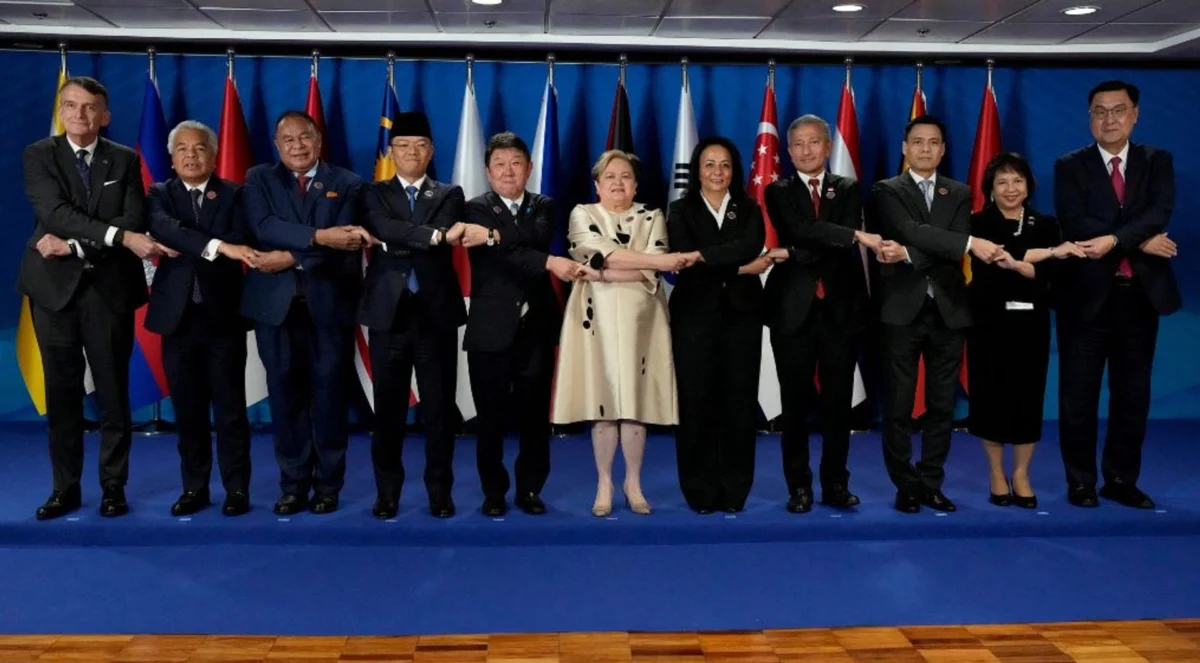
Renewed hostilities between the United States and Iran have cast a long shadow over the critical ASEAN foreign ministers’ gathering in Manila, raising significant questions about the bloc’s capacity to address pressing regional security and economic challenges. The high-stakes meeting, convened in the Philippine capital, was intended to foster dialogue and advance solutions for persistent disputes and conflicts that plague Southeast Asia. However, the escalating tensions in the Middle East have injected an unexpected and potentially destabilizing element into the proceedings, diverting attention and resources from the region’s internal concerns.
ASEAN’s Agenda Under Threat
The primary focus of the ASEAN summit was to confront deeply entrenched regional security issues. Among the most critical on the agenda were the protracted civil war in Myanmar, which has led to a severe humanitarian crisis and regional instability, and the complex territorial disputes in the South China Sea. These maritime rivalries, involving multiple ASEAN member states and China, have long been a source of friction and have significant implications for freedom of navigation and regional economic prosperity.
Ministers were poised to engage in substantive discussions aimed at de-escalating tensions in Myanmar, where a military junta’s crackdown on pro-democracy movements has resulted in widespread violence and displacement. Similarly, efforts to find a common path forward on the South China Sea, potentially through a Code of Conduct, were a priority. These are issues that require sustained diplomatic engagement and a united ASEAN front.
The Shadow of Middle Eastern Conflict
The sudden intensification of conflict between the U.S. and Iran has, however, inadvertently overshadowed the crucial deliberations in Manila. Reports from the summit indicate that while the primary regional agendas remain, the broader geopolitical shifts stemming from the Middle East are unavoidable talking points. The ministers present have, in unison, voiced calls for an immediate cessation of hostilities in the Persian Gulf.
The ripple effects of the conflict in the Middle East are already being felt across Asia, a continent heavily reliant on global supply chains and energy imports. The disruption to energy and food supplies is a palpable concern, threatening to exacerbate existing economic vulnerabilities. Furthermore, the specter of a global economic slowdown, fueled by escalating geopolitical instability, looms large. This economic uncertainty adds another layer of complexity to ASEAN’s efforts to promote regional stability and prosperity.
Geopolitical Repercussions for Southeast Asia
The question now is not just whether the war on Iran will affect ASEAN’s efforts, but to what extent. Experts are closely observing how this external crisis will impact the bloc’s internal dynamics and its ability to maintain a cohesive stance on regional matters. The interconnectedness of the global economy means that events on one side of the world can have profound and far-reaching consequences for regions seemingly distant.
Richard Heydarian, a political scientist and author of "Indo-Pacific: Trump, China and the New Struggle for Global Mastery," notes that major geopolitical disruptions often force a recalibration of priorities. "When a significant crisis erupts in a vital global hub like the Middle East, it invariably draws the attention of major powers and can redirect diplomatic bandwidth," Heydarian explained. "For ASEAN, this means that issues that were already challenging might become even more difficult to navigate if external powers become more preoccupied with the Middle East conflict."
Economic Vulnerabilities and Supply Chain Shocks
Asia’s economic architecture is particularly susceptible to the fallout from Middle Eastern conflicts. The region’s substantial reliance on oil imports from the Persian Gulf makes it acutely vulnerable to any disruption in supply. The Strait of Hormuz, a critical chokepoint for global oil trade, is located in the region, and any escalation of conflict there could lead to significant price volatility and potential shortages.
Phar Kim Ben, a professor in ASEAN studies at International Islamic University of Malaysia and former Director of Political & Security Community at ASEAN Secretariat, highlighted these economic interdependencies. "Southeast Asia’s economic growth is intricately linked to stable energy markets and unimpeded international commerce," Professor Kim Ben stated. "Any instability in the Middle East that impacts oil prices or shipping routes will directly affect our member states, potentially slowing down economic development and increasing inflationary pressures." This economic strain can, in turn, undermine social stability and create new political challenges within ASEAN nations.
Myanmar: A Test of ASEAN’s Resolve
The ongoing crisis in Myanmar presents a particularly acute test of ASEAN’s collective will and its efficacy as a diplomatic body. The bloc has adopted a "five-point consensus" aimed at resolving the crisis, but progress has been glacial, and the military junta has shown little inclination to implement the agreed-upon measures. The renewed focus on global conflicts could further dilute the international pressure on Myanmar’s military leaders.
Don McLain Gill, a lecturer at De La Salle University and Indo-Pacific Research Fellow with the Asia Pacific Foundation of Canada, argues that external distractions can embolden those who disregard international norms. "When major global powers are absorbed in a significant conflict, it can create a window of opportunity for regimes that are under international scrutiny," Gill observed. "This could make it even harder for ASEAN to exert meaningful pressure on the Myanmar junta to adhere to its commitments, as the international community’s attention is divided." The failure to resolve the Myanmar crisis not only perpetuates suffering but also erodes ASEAN’s credibility as a guarantor of regional peace and stability.
The South China Sea: Shifting Dynamics?
The territorial disputes in the South China Sea, a highly contested maritime area with significant economic and strategic importance, could also see their dynamics altered. While not directly linked to the U.S.-Iran tensions, the broader geopolitical realignment and the potential for shifting alliances and priorities among major powers could have indirect consequences.
Increased focus on the Middle East might lead to a temporary reduction in the overt naval presence or diplomatic attention from some global powers in the Indo-Pacific region. This could be interpreted differently by various stakeholders in the South China Sea. China, for instance, might see it as an opportunity to further solidify its claims, while other claimant states might look to ASEAN for stronger assurances of support and collective action. The challenge for ASEAN is to ensure that its own internal mechanisms for managing these disputes remain robust, even as global attention fluctuates.
Implications for ASEAN’s Centrality
ASEAN has long championed the concept of "ASEAN centrality," advocating for the bloc’s pivotal role in shaping the regional architecture. However, the current geopolitical climate, characterized by escalating global power competition and unforeseen crises, tests this principle. The ability of ASEAN to remain the primary driver of regional security and economic cooperation is contingent on its members’ capacity to present a united front and effectively manage both internal and external pressures.
The current situation underscores the inherent vulnerability of regional blocs to global shocks. While ASEAN has a well-established framework for dialogue and cooperation, the magnitude of external crises can overwhelm its deliberative processes if member states are not aligned or if external actors deliberately exploit divisions. The success of ASEAN in navigating these turbulent times will depend on its members’ commitment to multilateralism, their ability to prioritize regional interests, and their capacity to engage effectively with external powers without compromising their autonomy.
The Path Forward: Resilience and Adaptation
The foreign ministers in Manila are tasked with a formidable challenge: to maintain momentum on their critical regional agendas while acknowledging and adapting to the destabilizing influence of global events. This requires not only robust diplomatic engagement but also a strategic recalibration of priorities and a renewed emphasis on collective resilience.
The interconnectedness of the globalized world means that ASEAN cannot insulate itself from events in the Middle East. Instead, the bloc must develop strategies to mitigate the economic and security fallout, strengthen its internal cohesion, and continue to advocate for peaceful resolutions to both regional and global conflicts. The current geopolitical juncture demands a sophisticated and adaptable approach from ASEAN, one that can weather external storms while steadfastly pursuing its own vision for a stable and prosperous Southeast Asia. The decisions made in Manila, and in subsequent engagements, will be crucial in determining whether ASEAN can effectively steer through these complex times and maintain its relevance as a key player in the Indo-Pacific.