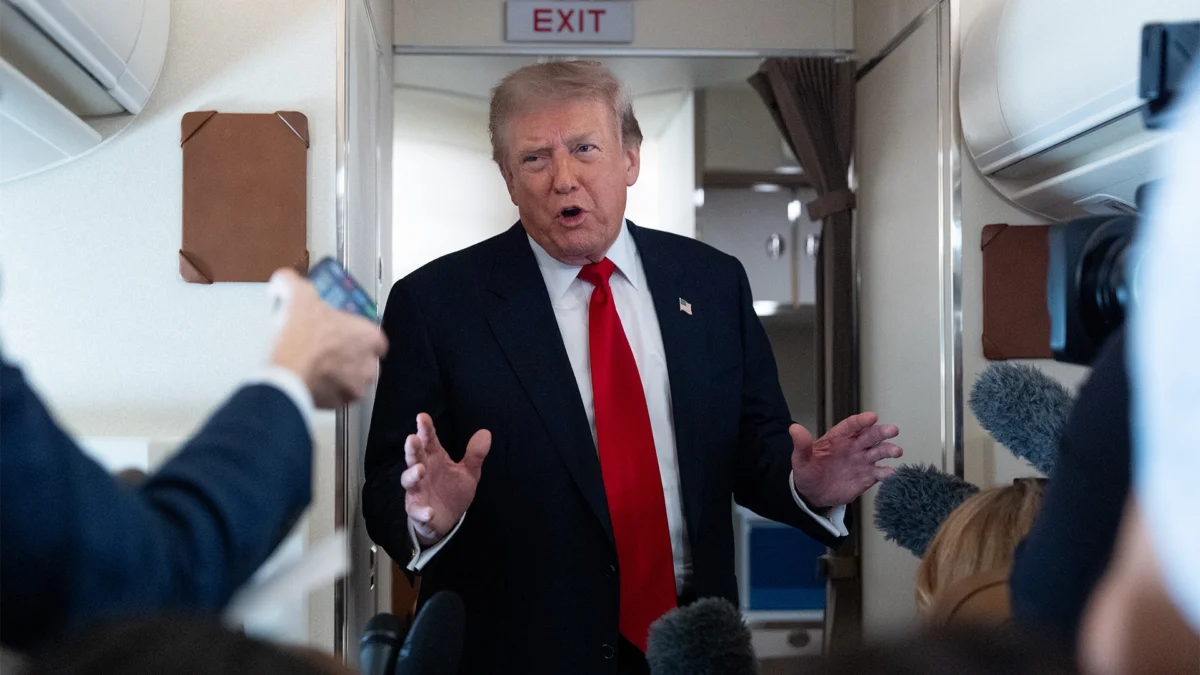
President Donald Trump highlighted his personal relationship with Turkish President Recep Tayyip Erdogan as a key factor in discussions surrounding the potential sale of advanced F-35 fighter jets to Ankara, a move that has drawn significant opposition from Israeli Prime Minister Benjamin Netanyahu. Trump’s remarks, made in the lead-up to a planned meeting with Netanyahu, underscore the complex geopolitical dynamics at play in the Middle East and NATO alliances. The potential sale of sophisticated military hardware to Turkey, a NATO member with increasingly divergent foreign policy interests, has become a flashpoint, illustrating the challenges of balancing security concerns, diplomatic ties, and established defense partnerships.
The F-35 Lightning II Joint Strike Fighter program, a cornerstone of modern air power for the United States and its allies, represents a significant technological and financial commitment. Turkey has been a partner in the F-35 program, contributing to its development and production, and had placed orders for the aircraft. However, Turkey’s acquisition of the Russian-made S-400 missile defense system, a decision viewed by the U.S. and NATO as incompatible with the F-35’s advanced stealth technology and operational security, has jeopardized its participation. The S-400’s radar systems, it is feared, could be used to glean intelligence on the F-35’s vulnerabilities, rendering the aircraft’s stealth capabilities obsolete.
Geopolitical Undercurrents and Strategic Partnerships
President Trump’s approach to foreign policy has often been characterized by a transactional style, emphasizing personal relationships and perceived advantages for the United States. His acknowledgment of a friendly rapport with President Erdogan suggests a willingness to leverage this connection in negotiations. This personal diplomacy, however, can create friction when it clashes with established policy frameworks and the security interests of allied nations. The United States finds itself navigating a delicate balance between maintaining a strategic partnership with Turkey, a vital NATO member bordering volatile regions, and addressing concerns raised by other key allies, such as Israel.
Israel, a close U.S. security partner with a significant F-35 fleet, has consistently voiced strong objections to the sale of advanced U.S. military hardware to Turkey, particularly in light of Ankara’s foreign policy actions. Jerusalem fears that any advanced U.S. weaponry supplied to Turkey could eventually be used in ways that threaten Israel’s security interests, especially given existing regional tensions and Turkey’s often critical stance on Israeli policies. The presence of both Erdogan and Netanyahu on the U.S. president’s diplomatic radar simultaneously amplifies the stakes, highlighting the administration’s efforts to manage competing demands from its regional partners.
The F-35 Program: A Pillar of Allied Air Power
The F-35 program is designed to provide a common advanced fighter jet capability across multiple branches of the U.S. military and a consortium of international partners. The aircraft, developed in three distinct variants (F-35A for conventional takeoff and landing, F-35B for short takeoff and vertical landing, and F-35C for carrier operations), is intended to be the backbone of future air combat for decades. Its advanced sensor fusion, network-centric warfare capabilities, and stealth characteristics are meant to provide a decisive advantage in contested airspace.
Turkey’s involvement in the F-35 program was initially seen as a way to deepen defense industrial cooperation and enhance interoperability within NATO. Turkish companies were integral to the manufacturing of various F-35 components, including parts of the airframe and the engine. The termination of this partnership has not only created diplomatic challenges but also has had tangible economic repercussions for both Turkey and the U.S. defense industry, necessitating a re-evaluation of supply chains and production strategies.
Turkey’s S-400 Decision: A Turning Point
The purchase of the S-400 missile defense system by Turkey from Russia marked a significant departure from its traditional reliance on NATO-standard equipment and weaponry. This decision was driven by a complex mix of factors, including Turkey’s perceived need for independent defense capabilities, historical grievances with some Western arms embargoes, and a desire to diversify its strategic partnerships. The U.S. response was swift and severe, leading to Turkey’s expulsion from the F-35 program and the imposition of sanctions.
The U.S. government’s position has been that the S-400 system is fundamentally incompatible with the F-35. The primary concern is that the S-400’s advanced radar could be used to identify and track U.S. and allied aircraft, including the F-35, thereby compromising its stealth technology. This incompatibility poses a significant risk to the operational integrity and security of the entire F-35 network, which relies on shared intelligence and secure communication channels among allied users.
Netanyahu’s Stance and Regional Security
Prime Minister Netanyahu has been a vocal critic of any U.S. arms sales to Turkey that could potentially enhance its military capabilities or threaten Israel’s qualitative military edge in the region. Israel views its technological superiority as paramount to maintaining its security in a highly volatile Middle East. The prospect of Turkey, which has at times engaged in rhetoric critical of Israel, acquiring advanced Western weaponry has been a persistent source of anxiety for Jerusalem.
Netanyahu’s engagement with the Trump administration on these issues has consistently focused on ensuring that Israel’s security interests are not compromised. He has likely sought assurances from President Trump that the U.S. will not take actions that could undermine Israel’s strategic advantage, particularly concerning advanced air power and missile defense systems. The meeting between Trump and Netanyahu, therefore, carries considerable weight in reiterating these long-standing security commitments.
The Complexities of U.S. Foreign Military Sales
The Trump administration’s handling of foreign military sales has often been characterized by a focus on potential economic benefits for the U.S. and the leveraging of arms deals for diplomatic leverage. However, the sale of advanced fighter jets like the F-35 involves far more than just a commercial transaction; it is deeply intertwined with alliance commitments, security architectures, and strategic alliances. The decision-making process requires careful consideration of the recipient nation’s security posture, its relationships with other countries, and its adherence to shared defense doctrines.
The situation with Turkey and the F-35 program highlights the challenges of managing partnerships with countries that exhibit increasingly independent foreign policy agendas. While Turkey remains a NATO member, its actions, such as the S-400 purchase and its evolving regional relationships, have raised questions about its long-term alignment with NATO objectives. This creates a complex environment for the U.S. to navigate, as it seeks to maintain its influence and security presence in critical regions while respecting the sovereignty of its allies.
Economic and Industrial Ramifications
The implications of Turkey’s exclusion from the F-35 program extend beyond the geopolitical realm into the defense industrial complex. Turkish companies that were part of the F-35 supply chain have lost significant contracts, and the U.S. defense industry has had to scramble to find alternative suppliers for critical components. This has led to increased production costs and longer lead times for the F-35, impacting the overall delivery schedule for the aircraft to U.S. and allied forces.
Furthermore, Turkey, in response to its exclusion from the F-35 program, has intensified its efforts to develop its own indigenous defense capabilities, including fighter jet programs. This drive for self-sufficiency in defense production is a common response by nations seeking to reduce their reliance on foreign suppliers and enhance their strategic autonomy. The long-term effect of this could be the emergence of new competitors in the global defense market.
Public and Political Impact
The ongoing debates surrounding arms sales and geopolitical alignments resonate with the American public and political establishment. Concerns about national security, the responsible use of taxpayer dollars in defense programs, and the maintenance of strong alliances are central to these discussions. Congress has played a significant role in scrutinizing and often influencing the administration’s decisions on foreign military sales, particularly when they involve sensitive technologies or strategic partners.
The administration’s ability to balance the demands of allies like Israel with its strategic interests in Turkey has been a recurring theme. The outcome of these negotiations and the decisions made regarding the sale of advanced military technology will have lasting implications for U.S. foreign policy, its relationships with key partners, and the broader security landscape in critical regions. The ongoing dialogue between President Trump, President Erdogan, and Prime Minister Netanyahu underscores the intricate web of alliances and rivalries that define contemporary international relations. The strategic implications of these discussions will continue to unfold, shaping defense policies and diplomatic engagements for years to come.