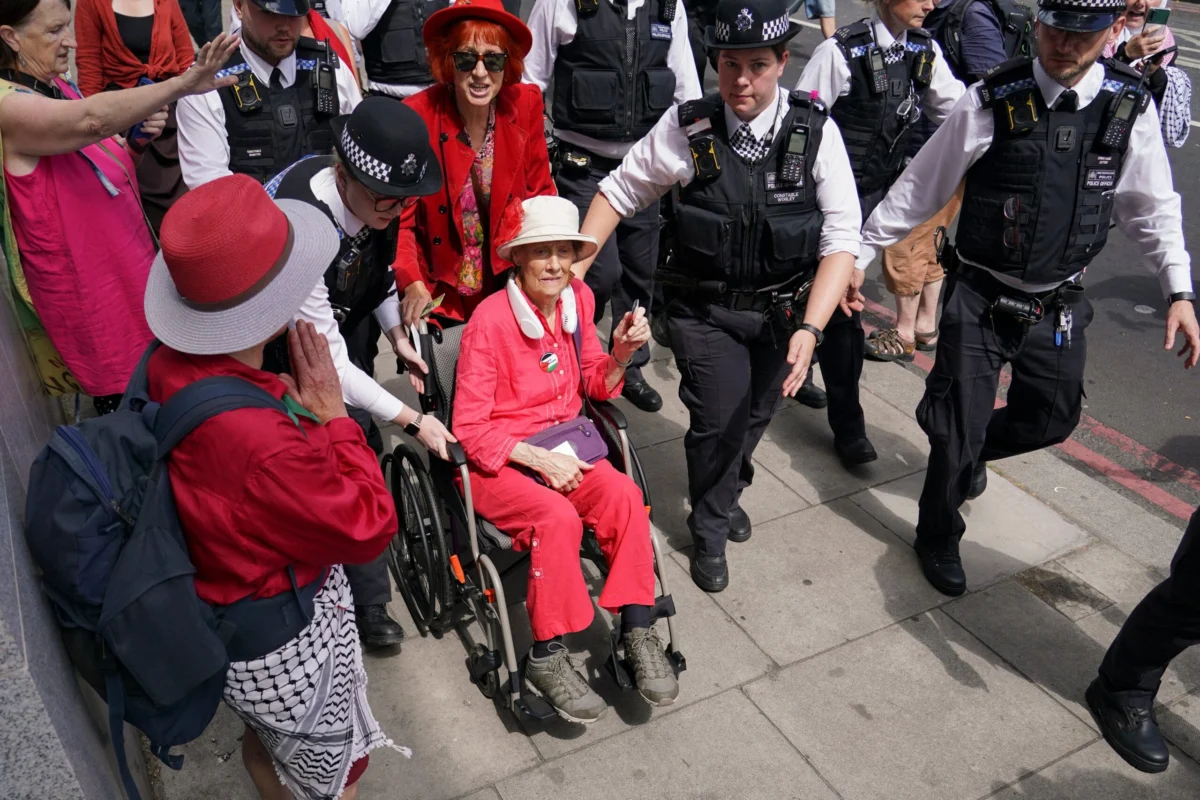
Dozens of arrests were made by British police on Thursday as crowds gathered outside a London courthouse to voice support for Palestine Action, an organization recently proscribed as a terrorist group in the United Kingdom. The demonstration, organized by the activist group Defend Our Juries, targeted the commencement of hearings against individuals facing charges for expressing solidarity with Palestine Action.
Proscription and Protest Spark Confrontation
The arrests underscore a significant escalation in the legal and political response to activism surrounding the Israeli-Palestinian conflict. Palestine Action was officially designated a terrorist organization by the UK government earlier this year, a move that carries severe legal repercussions for any expression of support. This proscription means that individuals can face up to 14 years in prison for activities deemed to be in support of the group, including public statements or endorsements.
Metropolitan Police Service officials confirmed the arrests, stating on the social media platform X that "Expressing support for Palestine Action is an offence under the Terrorism Act. Officers have begun making arrests." The rally outside Westminster Magistrates’ Court saw a visible police presence, with officers directly intervening as protesters made their views known.
Defend Our Juries, the group behind the protest, asserted that hundreds were present to challenge the proscription and what they describe as a crackdown on free speech. The group aims to "safeguard the legal process in the UK," suggesting concerns that the proscription is being used to suppress legitimate dissent. Critics of the government’s stance argue that such measures are designed to shield Israel from accountability for its actions in Gaza and the occupied West Bank, particularly in the context of what they term a "genocidal war."
Background to the Proscription and Charges
The legal ramifications for individuals supporting Palestine Action stem from the UK’s broad anti-terrorism legislation. The Terrorism Act 2000, and subsequent amendments, allows for the proscription of organizations deemed to be involved in terrorism. Once proscribed, membership in, or support for, the organization becomes a criminal offense. The specific charges brought against those appearing in court are reportedly related to expressing support for Palestine Action, highlighting the government’s intent to enforce the proscription rigorously.
Palestine Action has gained notoriety for its direct action campaigns targeting companies and institutions that it accuses of complicity in what it describes as Israeli apartheid and oppression. These actions have often involved disruptive protests, including occupations and damage to property, which have drawn both support from activists and condemnation from authorities and pro-Israel groups. The UK government’s decision to proscribe the group signifies a hardening of its stance against such activism.
Political Shift Under New Leadership
The rally occurs in the context of a recent shift in UK leadership, with Andy Burnham assuming the role of Prime Minister earlier this month. This marks the first significant public demonstration in support of Palestine Action since Burnham took office and became the leader of the Labour Party. His predecessor, Keir Starmer, faced considerable criticism for the Labour Party’s perceived lack of engagement with the crisis in Gaza, with opponents accusing his administration of complicity with Israeli policies.
Burnham has, since launching his campaign for leadership, attempted to reframe Labour’s foreign policy. He has publicly acknowledged that the party "didn’t get it right" on Gaza during Starmer’s tenure and offered an apology. However, human rights organizations have dismissed his apology as insufficient without concrete policy changes and actions to address the situation in the Palestinian territories.

The new Prime Minister’s administration has already authorized the use of some UK military bases by the United States for "defensive" strikes against Iran. This decision has drawn criticism from legal experts who have described the broader conflict as potentially illegal, further complicating the government’s foreign policy positioning and its approach to international law and human rights.
West Bank Violence and International Scrutiny
The protest in London also highlighted the ongoing violence in the occupied West Bank. Many demonstrators waved Palestinian flags, symbolizing solidarity with those in Gaza and the West Bank, which has experienced a surge in violence perpetrated by Israeli settlers. Human rights organizations and international observers have noted that this increase in settler violence is frequently facilitated by Israeli government policies and often protected by the Israeli army, further exacerbating the humanitarian crisis and political instability in the region.
Rights groups consistently document the impact of Israeli settlement expansion and settler aggression, arguing that these actions are in direct violation of international law and actively undermine prospects for a peaceful resolution to the conflict. The international community’s response to the escalating violence and the ongoing occupation remains a contentious issue, with varying degrees of pressure applied to Israel.
Calls to Reverse Proscription and Defend Civil Liberties
Prominent political figures have voiced opposition to the proscription of Palestine Action and the subsequent arrests. Zack Polanski, the leader of the UK Green Party and its first Jewish leader, has urged Prime Minister Burnham to reverse the decision. Polanski stated that "It is within the Prime Minister’s power to scrap this proscription and end these dystopian scenes for good. There is simply no excuse in a democracy for a crackdown in support for protest groups like this."
Polanski has been vocal in his support for Palestine and has accused right-wing media outlets of attempting to erase his religious identity due to his stance. His call to reverse the proscription reflects a broader concern among some political circles and civil liberties advocates about the erosion of democratic freedoms and the potential for overreach in the application of anti-terrorism laws.
Defend Our Juries has used its platform to sarcastically critique the UK’s terrorism laws, particularly as they apply to expressions of support for Palestine Action. The group highlighted a hypothetical scenario involving an elderly woman in a wheelchair facing severe penalties for stating her support for the group. This anecdotal example serves to illustrate their argument that the laws are being applied disproportionately and are creating an atmosphere of fear and suppression for dissent.
Broader Implications for Free Speech and Activism
The events in London raise significant questions about the balance between national security, counter-terrorism measures, and the fundamental right to freedom of expression and assembly. Critics argue that the broad interpretation and enforcement of anti-terrorism legislation can stifle legitimate political protest and silence advocacy for human rights. The proscription of Palestine Action and the subsequent arrests suggest a governmental approach that prioritizes the containment of certain forms of activism over the protection of dissenting voices.
The legal proceedings against individuals charged with supporting Palestine Action could set important precedents for future activism and the definition of what constitutes "support" for a proscribed organization. The outcome of these cases will likely be closely watched by human rights organizations, legal scholars, and activist groups across the UK and internationally. The situation also reflects a global trend of increased scrutiny and legal challenges faced by pro-Palestinian advocacy groups in Western countries.
The protest and arrests serve as a stark reminder of the deep divisions and intense emotions surrounding the Israeli-Palestinian conflict, and how these tensions are manifesting within domestic political and legal landscapes. The effectiveness of such proscriptions in deterring activism, versus their potential to fuel further opposition and galvanize support for the targeted groups, remains a subject of ongoing debate. The coming months will likely reveal the long-term impact of these developments on civil liberties and the nature of political protest in the United Kingdom.