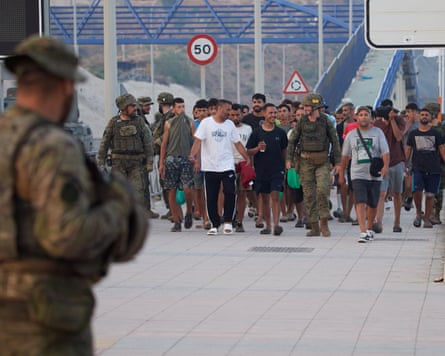
An unprecedented surge of approximately 72,000 migrants attempted to enter the Spanish enclave of Ceuta last week, triggering a humanitarian crisis and highlighting the volatile intersection of digital misinformation and rigid border controls. Local authorities reported that within 24 hours of the initial influx, the majority of those who crossed into the tiny territory on the northern tip of Morocco had already begun the process of returning home. The event, however, proved fatal for many; at least 88 individuals died during the attempt, with officials citing drowning and crushing as the primary causes of death in the turbulent Mediterranean waters.
The scale of the incident prompted an emergency meeting of European Union interior ministers on Tuesday. While officials sought to downplay the long-term impact on the passport-free Schengen area, the events in Ceuta have reignited a fierce debate over the security of Europe’s external borders. Despite official assurances that the situation was under control, media coverage and social media narratives have framed the surge as a direct territorial threat, leading to widespread calls for intensified security measures across the region.

The Anatomy of a Digital Hoax and the Ceuta Flashpoint
The sudden movement of thousands toward the Spanish border appears to have been catalyzed by a sophisticated social media hoax. False reports began circulating on platforms such as TikTok, Instagram, and Facebook, suggesting that the Spanish border with Morocco had been officially opened. These posts frequently referenced a recent Spanish Supreme Court ruling regarding the deportation of migrants arriving by sea, misinterpreting the legal decision to suggest that those who reached the enclave would be immune to summary removal.
In the days leading up to the surge, TikTok videos provided instructional guides on the safest locations to swim around the border fences, while Facebook groups tracked the movements of coast guard patrols in real-time. This digital orchestration created a sense of urgency and opportunity among young men seeking economic prospects in Europe. Analysts noted that as these hoaxes spread, Moroccan border surveillance appeared to diminish significantly, creating a vacuum that allowed the massive influx to occur.
The role of misinformation in turning Ceuta into Europe’s latest flashpoint cannot be overstated. By the time the Spanish government and EU officials could issue corrections, thousands were already in the water or clambering over rocks. The speed at which the misinformation propagated meant that the "crisis" was effectively over by the time the international community began to react, yet the visual impact of the events had already provided significant political ammunition for various actors across the continent.
Geopolitical Leverage and the Externalization of Borders
The events in Ceuta have also shed light on the complex geopolitical relationship between Spain and Morocco. Several analysts have suggested that the sudden lapse in Moroccan border enforcement may have been a deliberate political signal from Rabat. Tensions have recently simmered following a visit by Spanish Prime Minister Pedro Sánchez to Algeria, a regional rival of Morocco with which it shares a long-standing territorial dispute over the Western Sahara.
This phenomenon, often referred to by policy experts as the "externalization" of border policing, involves the EU providing financial and political incentives to non-EU countries to manage migration flows. However, this strategy gives neighboring states significant leverage over European capitals. By loosening border controls, countries like Morocco can exert diplomatic pressure on Europe, effectively using migration as a tool of foreign policy.
This is not the first time such tactics have been observed. In 2021, a similar diplomatic row resulted in approximately 10,000 people crossing into Ceuta after Moroccan authorities reportedly stood down. Similar patterns have been documented on the Greek-Turkish border and the frontier between Poland and Belarus. These incidents underscore a recurring vulnerability in European immigration policy: the reliance on third-party nations to maintain the integrity of the Schengen area’s perimeter.

How Hardened Immigration Policy Fuels Dangerous Bottlenecks
Since the 2015 refugee crisis, the European Union has adopted an increasingly hardline stance on migration, focusing on fortification and deterrence. While these measures are intended to reduce illegal crossings, experts argue they often produce the opposite effect by closing off legal avenues for asylum and labor migration. When legal routes are restricted, migrants are forced into more dangerous and clandestine methods of entry, which often results in the high-profile tragedies seen in Ceuta.
The hardening of immigration policy has created a cycle where increased security leads to more spectacular and desperate crossing attempts. These attempts produce the very images of "chaos" that right-wing politicians use to justify even more draconian restrictions. Daniel Trilling, a journalist specializing in migration, noted that the "performance of control" often leads directly to a public perception that things are out of control.
In Ceuta, the physical barriers and naval patrols did not stop the 72,000 people from attempting to cross; instead, they funneled them into a narrow, life-threatening bottleneck. The resulting deaths of 88 people serve as a grim reminder of the human cost associated with these policy shifts. Furthermore, because it is nearly impossible for undocumented individuals to travel from Ceuta to mainland Spain, the "invasion" narrative often pushed by media outlets is factually inconsistent with the reality of border enforcement.

Political Capitalization and the "Invasion" Narrative
The images of the Ceuta crossing were quickly seized upon by right-wing political figures across Europe and the United Kingdom. On social media platforms, the narrative of an "invasion" was amplified by high-profile accounts, including Elon Musk and British politician Nigel Farage. Musk’s assertion that the presence of "military-age males" constituted an act of war was echoed by various populist movements seeking to capitalize on the public’s anxiety regarding border security.
In the United Kingdom, Farage utilized the incident to revive his controversial "Breaking Point" rhetoric, advocating for the use of the Royal Navy to intercept small boats in the English Channel. While legal experts have pointed out that such a move would likely violate international maritime law and human rights conventions, the rhetoric has proven effective in shifting the political center of gravity.
The use of the term "fighting-age males" has become a staple of this narrative, framing migrants as a security threat rather than individuals seeking work or safety. This framing intentionally ignores the diverse motivations of those making the journey and the systemic failures that lead to such mass movements. By casting the events in Ceuta as a military-style incursion, these actors have successfully pressured more moderate governments to adopt increasingly conservative immigration stances.
Broader Implications for European Security and Unity
The fallout from the Ceuta flashpoint has extended deep into the heart of European domestic politics. In Germany, Chancellor Friedrich Merz was among dozens of officials who signed a letter suggesting that liberal migration policies in Southern Europe were compromising the collective security of the continent. This internal friction threatens the unity of the EU’s approach to migration, as frontline states like Spain and Italy often feel abandoned by their northern neighbors.
The political pressure is also being felt in the United Kingdom, where local leaders are attempting to navigate a path between humanitarian concerns and border enforcement. Andy Burnham, in a recent address from the White Cliffs of Dover, pledged a "relentless" approach to curbing illegal crossings while simultaneously calling for the establishment of safe and legal routes. This delicate balancing act reflects the broader struggle within center-left parties to address migration without fully adopting the rhetoric of the far right.
As Europe grapples with the aftermath of the Ceuta crisis, the underlying issues remain unresolved. The combination of digital misinformation, geopolitical maneuvering by neighboring states, and a lack of unified immigration reform continues to make the region’s borders a flashpoint for conflict.

The Path Forward Amidst Persistent Instability
The events in Ceuta serve as a case study for the future of migration management in a digital age. As long as there is a vast economic disparity between Europe and its neighbors, and as long as legal migration remain restricted, people will continue to take risks to reach the continent. The role of social media as a catalyst for these movements suggests that border security is no longer just a matter of physical fences, but also of information warfare.
Experts suggest that until the EU addresses the "externalization" trap and creates more pragmatic labor migration frameworks, tragedies like the one in Ceuta are bound to recur. The current reliance on hardening immigration policy has turned border enclaves into high-stakes stages for political theater, where the lives of migrants are often used as bargaining chips in larger diplomatic games.
For now, the situation in Ceuta has stabilized, but the political damage is extensive. The "invasion" narrative has taken root in the public consciousness, and the calls for more walls and more patrols are growing louder. However, as the recent events have demonstrated, the more the borders are fortified, the more spectacular the breaches become, ensuring that Ceuta will likely not be the last flashpoint in Europe’s ongoing migration crisis.