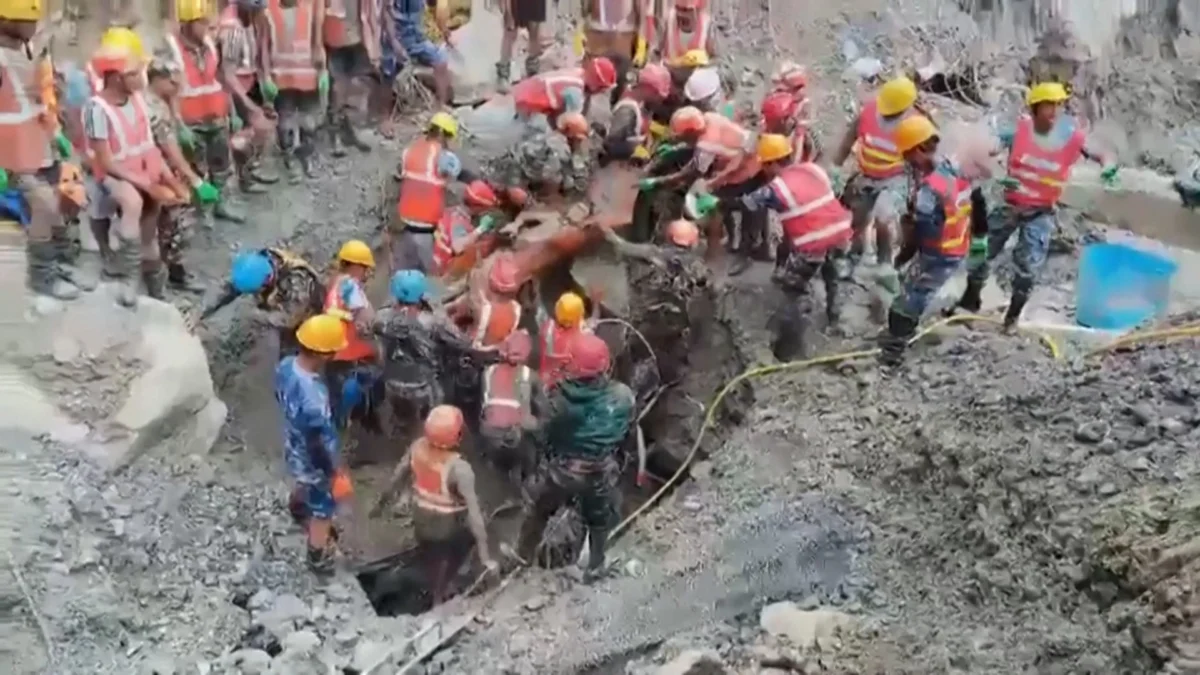
Rescuers on Saturday successfully extracted two construction workers alive from a submerged hydropower tunnel in Nepal, nine days after a catastrophic glacier collapse unleashed a torrent of ice, rock, and mud, burying the site and an unknown number of personnel. The dramatic rescue, which unfolded deep within the labyrinthine tunnels along the Trishuli River, injects a desperately needed glimmer of optimism as search and rescue operations continue for at least 900 others believed to be trapped.
Miracle Rescue in the Trishuli River Valley
The successful extraction of the two workers, whose identities have not yet been released, marks a significant, albeit small, victory in what is rapidly becoming one of Nepal’s most challenging disaster response efforts. For over a week, teams have been battling treacherous conditions, including unstable debris, freezing temperatures, and the constant threat of further landslides, to reach any potential survivors. Their survival is a testament to human resilience and the unwavering dedication of the rescue crews.
The initial reports of the rescue filtered out from the remote site early Saturday morning, sparking cautious jubilation among officials and the families of those still missing. The workers were reportedly disoriented but in stable condition upon their extrication, a remarkable outcome given the prolonged period they spent entombed. Medical teams were immediately on hand to provide critical care and transport them to a nearby medical facility for further assessment and treatment.
The Cataclysmic Glacier Collapse: A Day of Devastation
The disaster struck on the morning of August 27th, when a massive section of a glacier in the Himalayas gave way, triggering an avalanche of ice and debris that surged down a mountainside. The colossal debris flow, described by witnesses as a terrifying wave of destruction, overwhelmed the Sanjen Khola Hydropower Project site, located in the Gorkha district. The sheer force of the landslide obliterated infrastructure and, most tragically, inundated several tunnels where workers were believed to be on duty.
The Sanjen Khola project, a crucial component of Nepal’s ambitious hydropower development agenda, was nearing completion. The site was a hive of activity, with hundreds of workers, many of them migrant laborers from India and Bangladesh, engaged in the final stages of construction. The suddenness and scale of the collapse left little to no time for evacuation, trapping an estimated 900 to 1,000 individuals within the network of tunnels.
A Race Against Time: The Unfolding Search and Rescue
In the immediate aftermath of the disaster, Nepalese authorities, with the support of international aid organizations and neighboring countries, launched an extensive search and rescue operation. However, the challenging terrain and the nature of the debris presented formidable obstacles. Heavy machinery struggled to navigate the unstable slopes, and the sheer volume of mud, rocks, and ice made it incredibly difficult to locate potential survivors.
Rescue teams employed a multi-pronged approach, utilizing drones for aerial reconnaissance, specialized excavation equipment, and brave volunteers who physically sifted through the debris. The constant fear of secondary collapses and the freezing temperatures added to the immense pressure on the rescue workers. Each passing hour increased the grim prognosis for those trapped underground, making the rescue of the two workers all the more extraordinary.
Broader Implications: Nepal’s Hydropower Ambitions and Climate Vulnerability
The Sanjen Khola disaster casts a stark light on the dual realities of Nepal’s pursuit of economic development and its increasing vulnerability to climate change. Hydropower is a cornerstone of Nepal’s strategy to achieve energy independence and boost its economy, with numerous projects underway or planned across the country. However, these developments are often situated in ecologically sensitive regions prone to natural disasters.
The Himalayan region, in particular, is experiencing accelerated glacial melt due to rising global temperatures. This phenomenon increases the risk of glacial lake outburst floods (GLOFs) and other climate-induced hazards, posing a significant threat to infrastructure and human lives. Experts have long warned about the need for more robust environmental impact assessments and climate adaptation strategies in the planning and execution of large-scale development projects in the Himalayas.
The Sanjen Khola incident is likely to intensify scrutiny on the safety protocols and environmental considerations of hydropower projects in Nepal. Questions are already being raised about whether adequate measures were in place to mitigate the risks associated with operating in an area susceptible to such extreme events. The long-term sustainability of Nepal’s hydropower ambitions may hinge on its ability to balance economic growth with environmental stewardship and disaster preparedness.
The Human Cost: Families Awaiting News
For the families of the hundreds of missing workers, the past nine days have been an agonizing ordeal of uncertainty and mounting despair. Many have gathered at makeshift relief camps near the disaster site, clinging to any sliver of hope. The news of the two survivors, while uplifting, also underscores the immense challenge that remains in accounting for all those lost.
The Nepalese government has pledged to provide all necessary support to the affected families, including financial assistance and aid for the repatriation of deceased individuals. However, the emotional toll on these families is immeasurable, as they grapple with the possibility of never seeing their loved ones again. International humanitarian organizations are working tirelessly to provide counseling and support services to those affected by the tragedy.
International Response and Collaboration
The scale of the disaster has prompted an international response, with several countries offering assistance in the form of search and rescue expertise, equipment, and financial aid. India, a close neighbor and a significant investor in Nepal’s infrastructure projects, has been particularly active in providing support. Chinese rescue teams and equipment have also been deployed to the site.
This collaborative effort highlights the interconnectedness of global challenges and the importance of international cooperation in responding to large-scale humanitarian crises. The expertise and resources brought by international partners are invaluable in navigating the complexities of such a disaster. The successful rescue of the two workers is a shared success, demonstrating the power of unified action in the face of adversity.
Looking Ahead: The Long Road to Recovery
As the immediate focus remains on the ongoing search for survivors and the recovery of bodies, the long-term implications of the Sanjen Khola disaster are becoming increasingly apparent. The economic impact on the region, which relied heavily on the hydropower project for employment and development, will be significant. The environmental damage caused by the landslide will also require extensive remediation efforts.
Furthermore, the incident is likely to spur a re-evaluation of disaster preparedness and response mechanisms in Nepal. Authorities will need to invest in early warning systems, improve evacuation plans, and strengthen building codes for infrastructure in high-risk areas. The lessons learned from this tragedy must inform future development policies and ensure that Nepal’s progress does not come at the cost of its people’s safety and the environment.
The rescue of the two workers, while a moment of profound relief, also serves as a somber reminder of the immense task that lies ahead. The efforts to locate and account for the remaining individuals will continue with unwavering determination. The resilience of the Nepalese people and the spirit of international cooperation will be crucial in navigating the challenging path to recovery and rebuilding in the wake of this devastating event. The focus remains on bringing closure to grieving families and ensuring that such a catastrophe is prevented from recurring in the future.