Authorities in the British port city of Portsmouth arrested three individuals Saturday as a second weekend of anti-immigration demonstrations drew hundreds of activists and counter-protesters to the city’s center. The Hampshire and Isle of Wight Constabulary confirmed that two men and a teenage boy were taken into custody during the events, which followed a week of heightened tensions sparked by the arrival of a migrant vessel in the region. The demonstrations highlighted a deepening national divide over border security and the management of asylum seekers crossing the English Channel.
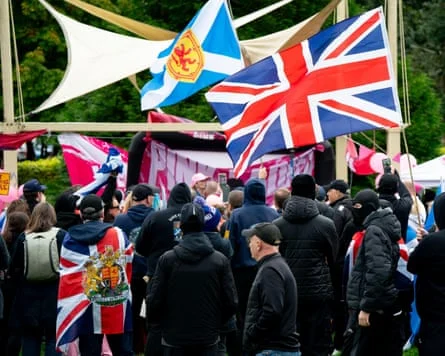
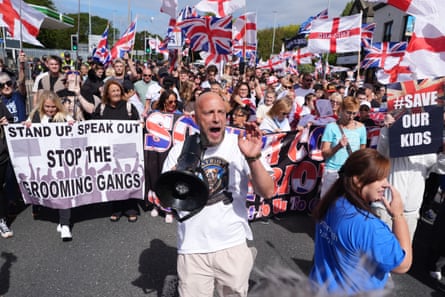
The Portsmouth experiences second weekend of anti-immigration protests began Saturday morning with a heavy police presence concentrated around Commercial Road. Far-right activists gathered outside All Saints Church, many wearing clothing branded with "Portsmouth Patriots" logos. The crowd, waving Union and St. George flags, was led by speakers using megaphones to chant "stop the boats," a slogan that has become a rallying cry for those frustrated with the ongoing arrival of small boats from the French coast.
Police commanders had prepared for the event by invoking specific legal powers under the Crime and Policing Act. Among those detained was a 76-year-old man from Southampton, arrested on suspicion of concealing his identity. Under the current enforcement strategy, officers have the authority to demand the removal of face coverings if they believe the items are being used to hide a person’s identity to prevent arrest or cause intimidation.

Law Enforcement Mobilizes for Portsmouth Anti-Immigration Protests
The Saturday mobilization follows a chaotic scene last Sunday, when a boat carrying approximately 140 asylum seekers was intercepted and brought into Portsmouth. That incident marked a significant shift in the geography of the migrant crisis, as most arrivals have historically been processed in Dover, dozens of miles to the east. The arrival of such a large group directly into Portsmouth triggered immediate unrest, leading to clashes with police and attempts by activists to block the processing of the new arrivals.
In addition to the 76-year-old man, a 33-year-old Portsmouth resident was arrested on Saturday for suspicion of obstructing a highway. A 16-year-old boy was also taken into custody in connection with violent disorder reported during the previous weekend’s unrest. Donna Jones, the Police and Crime Commissioner for Hampshire and the Isle of Wight, stated that the heavy police presence was necessary to prevent a recurrence of the assaults on officers and damage to property seen six days prior.
Commissioner Jones emphasized that while the right to protest is protected, the "fear factor" associated with masked demonstrators would not be tolerated. She noted that the majority of participants complied with the directive to keep their faces uncovered. "The people of Portsmouth deserve to go about their business without fear and disruption," Jones said in a public statement. She added that the police power to order the removal of masks would be used "proportionately and impartially" across the political spectrum.
Tensions Flare Following Small Boat Arrival
The catalyst for the Portsmouth experiences second weekend of anti-immigration protests was the unusual arrival of a 140-person vessel at the city’s docks. Maritime experts suggest that human smuggling syndicates are increasingly launching boats from points further west along the French coastline to evade the concentrated British and French naval patrols in the Dover Strait. While this maneuver avoids some surveillance, it requires a much longer and more hazardous journey across the open waters of the Channel.
The government’s Home Office has reported a 40% decrease in total small boat crossings compared to the same period last year, attributing the decline to a more aggressive disruption of smuggling networks. However, the arrival in Portsmouth suggests that the "business model" of the traffickers is evolving rather than disappearing. This evolution has brought the political flashpoint of immigration to cities that previously felt insulated from the immediate physical reality of the border crisis.
Protesters on Saturday argued that the arrival of "illegal men" on British shores constitutes an "invasion," a sentiment echoed by several speakers at the All Saints Church rally. Many expressed frustration with the perceived lack of speed in deporting those who arrive via unauthorized routes. The rhetoric at the rally was met with a stern response from the government, which has labeled the more aggressive tactics of these groups as "thuggish behavior."
Counter-Demonstrations and Community Response
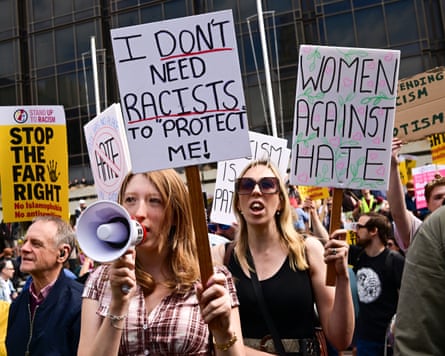
Parallel to the anti-immigration march, a significant counter-protest was staged by groups including Stand Up to Racism (SUTR) and Refugees Welcome. These demonstrators gathered in a neighboring parking lot, carrying banners that read "RNLI are heroes, no one is illegal" and "stop pretending your racism is patriotism." The counter-protesters praised the Royal National Lifeboat Institution (RNLI), whose volunteers have frequently been targeted with verbal abuse for their role in rescuing migrants in distress at sea.
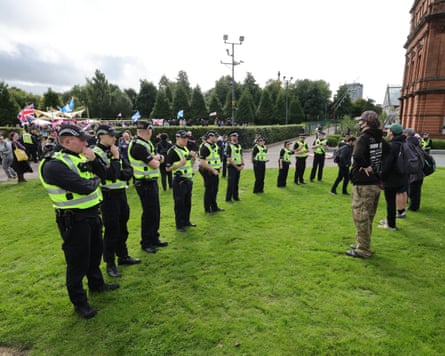
The two groups were kept separated by lines of police officers in high-visibility vests. Despite the proximity of the opposing factions, the event remained largely peaceful compared to the previous Sunday. The anti-immigration group eventually marched toward Guildhall Square, followed shortly after by the counter-protesters along the same route. The strategic segregation of the groups prevented the physical altercations that had characterized the unrest earlier in the week.
Local business owners in the city center reported a drop in foot traffic as shoppers avoided the area due to the protests. The disruption to the local economy has become a point of concern for city officials, who are balancing the need to uphold democratic protest rights with the requirement to maintain public order and economic stability.
A National Pattern: Protests Spread to Glasgow
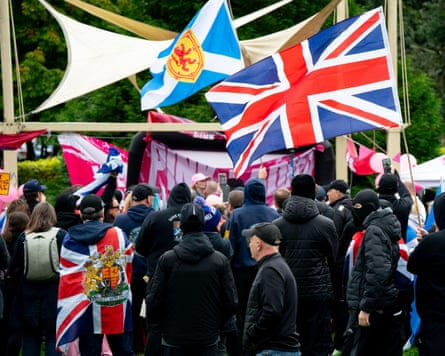
The unrest was not limited to the south coast of England. Hundreds of miles away in Scotland, a similar scenario unfolded at Glasgow Green. The "Pink Ladies" movement, a right-wing activist group, organized an anti-immigration rally that drew a large police response. Like in Portsmouth, the Glasgow event was met by a robust counter-protest organized by SUTR and various labor unions.
The Glasgow demonstrations were marked by a heavy police presence that included the segregation of the two groups by the People’s Palace, a historic landmark. Chief Superintendent Stevie Dolan of Police Scotland warned of a "strong response" to any violence, citing previous flashpoints during similar events in July. Prominent political figures, including Scottish government minister Alison Thewliss and Reform UK deputy leader Thomas Kerr, were present at their respective sides of the demonstration.
The dual protests in Portsmouth and Glasgow underscore a surge in anti-migrant vigilante groups across the United Kingdom over the last 18 months. Monitoring organizations have noted that these groups are becoming more organized, often using social media to coordinate rapid-response demonstrations when boats are spotted or when asylum seekers are moved into local hotels.
Legal Consequences and the "Stop the Boats" Movement
As the Portsmouth experiences second weekend of anti-immigration protests concluded, the judicial system began processing those involved in the previous week’s violence. Del Leon Somerville, 42, appeared before Portsmouth Magistrates’ Court on Saturday. He faces charges of violent disorder and assaulting a police officer. Assistant Chief Constable Tony Rowlinson described the prosecution as the "first of many," signaling a zero-tolerance approach to those who cross the line from protest to criminality.
Home Secretary Shabana Mahmood met with senior police officials earlier in the week to ensure that law enforcement agencies have the resources to move quickly against "far-right groups" seeking to intimidate communities. Mahmood noted that the use of balaclavas and black clothing by some protesters was a deliberate attempt to communicate "malign intent," distinguishing these events from traditional political demonstrations.
The Home Secretary’s stance reflects a broader government effort to reclaim the narrative on immigration. While the "Stop the Boats" slogan was a centerpiece of the previous administration’s policy, the current government is focusing on dismantling the smuggling gangs while condemning the civil unrest that has followed the arrivals. The challenge for the Home Office remains the perception of border control; as long as boats continue to arrive, even in smaller numbers, the political pressure from groups like the Portsmouth Patriots is expected to persist.
Broader Implications for British Policy and Culture
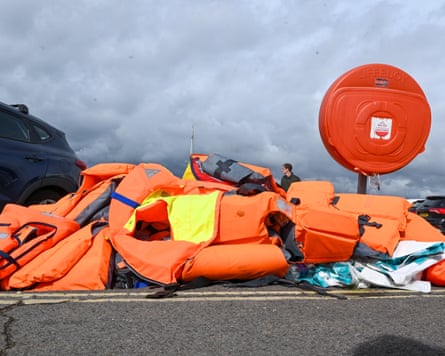
The events in Portsmouth are a microcosm of the larger debate over national identity and the obligations of a state toward those seeking asylum. The city, which has a proud naval history and serves as a major hub for the Royal Navy, has become an unlikely battleground for this domestic conflict. The sight of riot police on Eastney Beach—where lifejackets are still occasionally found discarded in the sand—has become a jarring image for residents.
The shift in arrival points from Dover to Portsmouth also has logistical implications for the Border Force. Processing centers in Kent are well-established, but the sudden influx of over a hundred individuals into a city like Portsmouth tests the local infrastructure and the speed of the Home Office’s response. It also creates a new theater for activists who previously had to travel to the southeastern tip of England to voice their opposition.
The emergence of groups like the "Portsmouth Patriots" and the "Pink Ladies" suggests that the anti-immigration sentiment is becoming more localized and grassroots-oriented. These groups often frame their mission as a defense of local resources and safety, though counter-protesters and government officials frequently label their rhetoric as xenophobic and dangerous.
Future Outlook for Coastal Communities
The Hampshire police have reaffirmed their commitment to supporting peaceful assembly while vowing to suppress any attempts to incite fear. As the autumn months approach, the weather in the English Channel typically becomes more volatile, which may naturally slow the number of crossings. However, the political climate remains at a boiling point, with more demonstrations planned in cities across the UK.
The government’s success in managing these protests will likely depend on its ability to demonstrate effective border control while simultaneously addressing the underlying social anxieties that fuel such movements. For the people of Portsmouth, the "second weekend" of protests serves as a reminder that their city is now on the front lines of one of the most contentious issues in modern British politics.
Law enforcement agencies are expected to maintain a high state of readiness in the coming weeks. The use of new policing powers, particularly regarding the removal of face masks and the swift prosecution of those involved in disorder, will be closely watched by civil liberties groups and political activists alike. The goal for authorities remains a return to normalcy for the city’s residents, even as the national debate over the "small boats" continues to rage.