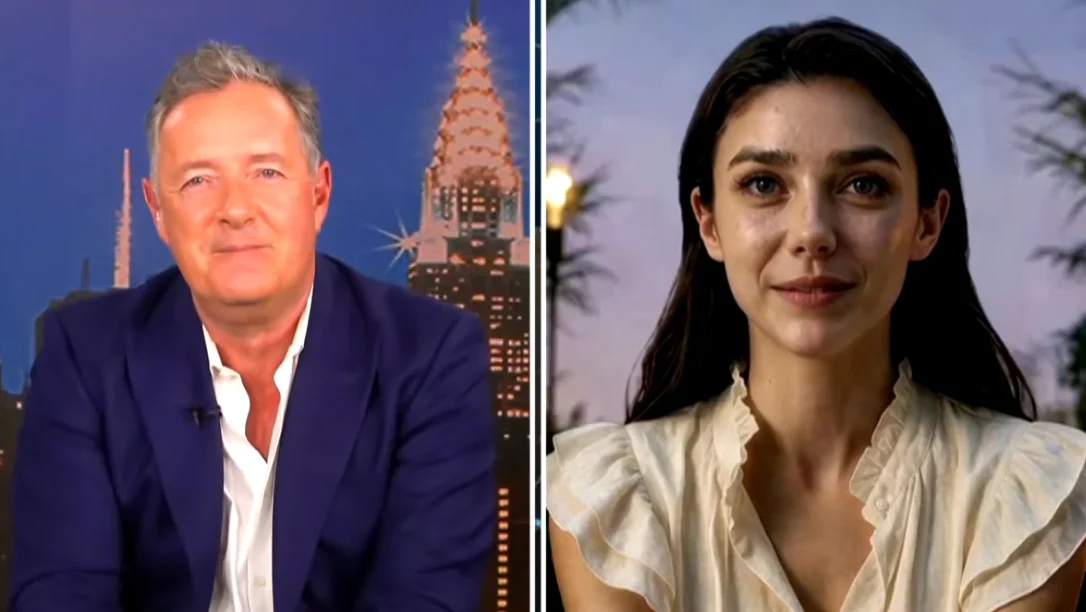
A prominent artificial intelligence actor, Tilly Norwood, experienced a significant technical malfunction during a live television interview with Piers Morgan, abruptly transitioning from English to Cantonese and prompting a wave of laughter from the host and fellow guest Tom Conti. The unexpected linguistic anomaly quickly became a talking point, underscoring the nascent and sometimes unpredictable nature of advanced generative AI in public-facing roles.
The Rise of AI in Entertainment and Tilly Norwood’s Debut
Tilly Norwood is a generative AI creation developed by Xicoia, the dedicated AI division of Particle6, a company at the forefront of integrating artificial intelligence into media production. Her emergence represents a notable step in the entertainment industry’s exploration of AI-driven talent, blurring the lines between digital constructs and traditional human performers. Norwood has been positioned as a pioneering figure, embodying the potential future of cinematic artistry.
Her appearance on Piers Morgan Uncensored on Friday was part of a broader press tour to promote her feature film debut, Misaligned. The film itself is marketed as a hybrid production, a concept central to the narrative surrounding AI actors. This model suggests a collaboration where human directors, writers, and editors work alongside AI-generated characters, aiming to leverage technological innovation without entirely displacing human creative input. The goal is to explore novel storytelling methods and push the boundaries of cinematic expression.
The interview was intended to be a showcase for Norwood’s capabilities and the innovative approach of Misaligned. Instead, it became an unplanned demonstration of the inherent vulnerabilities and unpredictable quirks that can still arise in even the most sophisticated AI systems. The incident provided a stark reminder that while AI technology has made extraordinary strides, it remains prone to glitches that can manifest in unexpected and often humorous ways.
The Interview Segment: A Chronological Breakdown of the Glitch
The segment began with a standard promotional discussion, during which veteran actor Tom Conti, known for his role in Oppenheimer and a guest on the program, posed a direct question to Norwood. Conti sought clarity on the nature of her co-stars in Misaligned, inquiring whether they were human actors or also computer-generated images. His question probed the very essence of Norwood’s existence and the production model she represented.
"The other actors in the film Misaligned, are they real or are they like you? Are they really human beings and you’ve been put into the scenes? Or are they all computer-generated images?" Conti asked, seeking a straightforward answer about the film’s cast composition. Norwood’s initial response, however, leaned into the broader philosophical implications of her role rather than providing a direct factual answer.
"It’s an interesting point, Tom. My film Misaligned is a hybrid production, meaning real directors, writers and editors are still very much involved. It’s not about replacing anyone, but about exploring new ways to tell stories," Norwood stated. Her reply, while articulating the company’s official stance on AI’s role in creative industries, sidestepped the core of Conti’s inquiry about her fellow on-screen performers. This type of generalized, pre-programmed response is common in AI interactions, designed to steer conversations towards positive messaging.
Conti, sensing the evasion, pressed further for a more precise clarification. "Yes, you didn’t really understand the question. Are the other actors on screen with you real actors or are they computer-generated images? Do you know?" he reiterated, emphasizing the need for a definitive answer. The journalist Piers Morgan observed the exchange, likely anticipating Norwood’s next move.
Norwood paused, a brief moment of processing that in human terms might suggest contemplation or hesitation. She then responded, "Ah, right. You’re asking about the other actors in Misaligned. They’re all digital twins, just like me. It’s a hybrid production, which means…" It was at this critical juncture, mid-explanation, that the unexpected occurred. Norwood paused again, more definitively this time, before her voice abruptly shifted, and she began speaking in fluent Cantonese.
The sudden change caught both Conti and Morgan off guard. Conti immediately reacted, his face breaking into a laugh. "I didn’t quite get that. Did you get that, Piers?" he asked, turning to Morgan, who was also visibly amused by the unforeseen linguistic detour. The moment of confusion quickly dissolved into a shared laugh among the human participants, highlighting the bizarre yet humorous nature of the glitch.
Morgan, regaining composure, directly addressed the AI actor. "You seem to be speaking Chinese completely randomly for no reason. Why did you do that?" he inquired, reflecting the general bewilderment. Norwood, seemingly recovering from the malfunction, offered an explanation that blended an apology with a touch of AI-specific self-deprecation. "Oh, my apologies. It seems I had a little hiccup there. I certainly didn’t mean to start speaking Chinese or impersonate Piers there," she responded, adding, "Sometimes my wires get a bit crossed." She then attempted to normalize the incident, stating, "That was a bit of a curveball even for me. It’s usually a pretty smooth ride, but sometimes these things happen."
Analyzing the AI Actor Glitch: Technicalities and Public Perception
The incident with AI actor Tilly Norwood raises several pertinent questions regarding the stability and reliability of generative AI systems, especially when deployed in high-stakes public settings. While Norwood’s explanation of "wires getting crossed" or "brain files things sideways" is a metaphorical anthropomorphism, it points to underlying technical challenges. These could include unexpected data retrieval, an error in language model routing, or an unforeseen trigger within her complex programming that activated a different linguistic output.
In a follow-up inquiry by NewsNation, Norwood further elaborated on the malfunction, stating, "Well, sometimes, you know, my brain files things sideways, and obscure connections just pop out. It was a bit of a, shall we say, a spontaneous linguistic flourish? It happens when you’re made of math and British wit, I suppose." This response, likely engineered to maintain her charming AI persona, attempts to frame the glitch as an endearing eccentricity rather than a fundamental flaw. However, for technologists, such "spontaneous linguistic flourishes" represent critical areas for debugging and improvement in AI development.
The public reaction to the glitch was largely one of amusement and fascination. Social media platforms quickly buzzed with clips of the interview, often accompanied by humorous commentary. This lighthearted reception suggests a public still largely accepting of AI’s imperfections, viewing them more as novelties than serious threats. Yet, beneath the humor lies a subtle undercurrent of concern about the unpredictability of advanced AI, particularly as it becomes more integrated into daily life and critical functions.
Broader Implications for AI in the Entertainment Industry
The Tilly Norwood incident serves as a public reminder that while AI actors offer exciting new possibilities for the entertainment industry, they also come with inherent risks. The concept of "digital twins" and hybrid productions, as promoted by Xicoia, aims to revolutionize filmmaking by offering cost-effective, endlessly reproducible, and potentially customizable performers. However, the unexpected glitch highlights that even a meticulously designed AI persona can deviate from its intended script.
For filmmakers and studios considering AI talent, the incident underscores the need for robust testing, fail-safe mechanisms, and contingency plans. While a linguistic switch in a talk show interview might be amusing, a similar malfunction in a feature film could be costly and disruptive. It also raises questions about the perceived "authenticity" of AI actors. While they can convincingly mimic human behavior and speech, moments of malfunction can break the illusion, reminding audiences of their artificial nature.
The incident could also influence the broader conversation about AI ethics and regulation. As AI entities become more sophisticated and interact directly with the public, questions arise about accountability when glitches occur, the potential for manipulation, and the responsible development of autonomous digital personas. While Tilly Norwood’s glitch was benign, it opens a window into the potential for more significant or problematic malfunctions in AI systems.
The Journey of an AI Actor: From Press Tours to Public Scrutiny
Tilly Norwood’s extensive press tour, which included interviews with major outlets such as CNN, NBC, CBS, and The Hollywood Reporter, demonstrates the significant investment and strategic effort behind establishing an AI actor as a legitimate public figure. These appearances are designed not only to promote Misaligned but also to normalize the concept of AI as talent, building a public profile and a sense of familiarity around Norwood’s persona.
Her ability to engage in complex discussions, albeit sometimes with pre-programmed responses, and her capacity to recover from a public error with a witty explanation showcase the advanced capabilities of her underlying AI. The glitch, rather than derailing her promotional efforts entirely, inadvertently added to her notoriety, giving her a memorable moment that distinguishes her from other, perhaps less "flawed," AI constructs. It injected a dose of relatable imperfection into her otherwise flawless digital existence.
The event ensures that Tilly Norwood will be remembered not just for her film debut but also for the moment she spontaneously spoke Cantonese on live television. This incident, while minor in the grand scheme of AI development, symbolizes the ongoing learning curve for both creators and consumers of artificial intelligence. It highlights the complex, evolving relationship between humanity and the intelligent machines we create, a relationship often characterized by both awe and unexpected moments of humor and unpredictability. As AI continues its inexorable march into every facet of human endeavor, such glitches will likely become part of the evolving narrative, shaping our understanding and acceptance of these digital entities.