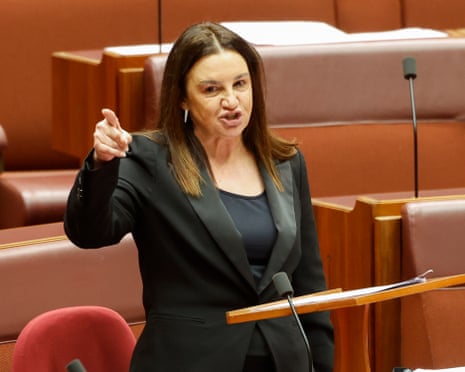
Senator Jacqui Lambie issued a stark warning to the Australian electorate during a late-night Senate adjournment speech, labeling One Nation leader Pauline Hanson as "dangerous" and "delusional" while drawing direct parallels to the populist political styles of Donald Trump and Nigel Farage. The Tasmanian senator’s remarks highlighted a growing rift in the nation’s minor-party landscape, as she accused Hanson of employing a "populist trick" that ultimately harms the working-class citizens she claims to represent. Lambie’s critique was prompted by a wave of online vitriol she received following her defense of Andrew Hastie, who had been characterized as a "traitor" in a promotional cartoon series produced by One Nation.
The confrontation in the Senate marks a significant escalation in the ideological battle within Australian politics, particularly regarding the influence of international populist movements on domestic discourse. Lambie argued that leaders like Hanson, Trump, and Farage thrive by inflaming public anger and identifying scapegoats rather than providing substantive policy solutions. She asserted that the lives of working people historically deteriorate when such figures gain power, suggesting that these leaders prioritize their own political longevity over the public good. "Senator Hanson will be fine in her retirement, as will Nigel and Donald in theirs, because once again they are feathering their own nests," Lambie told the chamber, urging Australians to reject "ugly politics" in favor of respect and solution-oriented governance.
Lambie’s Comparison of Pauline Hanson to Donald Trump and the Rise of Populism

The comparison between Pauline Hanson and Donald Trump underscores a broader anxiety in Canberra regarding the importation of American-style political polarization. Lambie specifically targeted Hanson’s alignment with Trump’s foreign policy, particularly the potential for "forever wars" in the Middle East. She questioned Hanson’s willingness to commit Australian troops to international conflicts based on populist alliances, calling such a stance both hazardous and detached from reality. This rhetoric reflects a broader debate about Australia’s sovereignty and its strategic dependence on the United States, especially as populist sentiments fluctuate in both nations.
Political analysts suggest that Lambie’s speech was intended to distance her own brand of populism—which she frames as pragmatic and focused on veteran affairs and regional integrity—from the more polarizing platform of One Nation. By invoking the names of Trump and Farage, Lambie is tapping into a global narrative regarding the "hollowing out" of the political center. Her plea for Australians to "wake up" to these tactics suggests that the next federal election may be fought as much on the nature of political discourse as on specific economic or social policies.
NSW One Nation Leader Confronts Abortion Access and Legislative Reform
Simultaneously, the One Nation party is facing intense scrutiny in New South Wales as state leader Mike Newman took a hardline stance against reproductive rights. Speaking at a rally outside the state parliament in Sydney, Newman declared that his party intends to "stop" abortion rights, aligning himself with fringe political elements and anti-abortion activists. The rally was held ahead of a highly anticipated vote on a bill introduced by Libertarian MLC John Ruddick, which seeks to ban what it terms "sex-selective abortions." Newman’s rhetoric, which included a verbal stumble where he briefly confused the issue with "same-sex" rights before correcting himself, signaled a pivot toward social conservatism for the state branch of the party.

The legislative battle over Ruddick’s bill has become a flashpoint for social policy in NSW. While proponents argue the bill is a necessary ethical safeguard, health experts and human rights advocates point to a 2020 NSW Health review which found that abortions for sex selection are exceedingly rare, with most reported instances likely being clerical errors. The bill is expected to be decided via a conscience vote, with both Labor and Coalition sources indicating the margin will be razor-thin. The presence of high-profile figures like Barnaby Joyce at previous rallies has increased pressure on National Party MPs, highlighting the internal divisions within the conservative coalition regarding social issues.
Regulatory Crackdown on Gambling: Dabble Fined $1 Million
In the regulatory sphere, the Australian Communications and Media Authority (ACMA) has imposed a significant penalty on the betting company Dabble. The firm was fined more than $1 million for systemic failures related to the federal government’s "Betstop" self-exclusion register. According to the ACMA, Dabble sent over 800 promotional messages to 165 individuals who had explicitly registered to be excluded from gambling activities. Furthermore, the company failed to close the accounts of 157 registered users, directly undermining a key pillar of the government’s harm minimization strategy.
ACMA member Carolyn Lidgerwood described the breaches as serious violations of consumer protection laws. The watchdog found that Dabble also sent thousands of push notifications to customers without including mandatory information about the Betstop service. As part of the penalty, Dabble has entered into a court-enforceable undertaking to ensure future compliance. This enforcement action comes amid a broader national debate over the influence of gambling advertising and the adequacy of current safeguards to protect vulnerable Australians from addiction.
NSW Housing Market: New Bond Transfer System for Renters
While social and political debates raged, the New South Wales government launched a practical reform aimed at easing the financial burden on the state’s two million renters. Starting today, tenants in NSW can utilize the "Smart Rental Bonds" scheme, which allows for the direct transfer of bonds from one property to another. This initiative is designed to eliminate the need for renters to provide thousands of dollars in upfront costs while waiting for the return of a previous bond. The government estimates the scheme could save individual renters up to $4,000 during a move, though users will be charged a $25 administrative fee.
The program works by having the state government pay the landlord the bond at the conclusion of a lease, with the renter subsequently repaying the government. This move is part of a broader suite of rental reforms introduced by the Minns Labor government, which includes banning "no-grounds" evictions and limiting rent increases to once per year. As the cost-of-living crisis continues to dominate the political agenda, such administrative reforms are being framed as essential protections for a growing demographic of long-term renters who are increasingly priced out of the homeownership market.
AUKUS Submarine Timeline and National Security Strategy

On the national security front, Deputy Prime Minister and Defense Minister Richard Marles addressed concerns regarding the timeline of the AUKUS submarine project. Reports from the United Kingdom suggested that the British Labour government might delay its decision on building new attack submarines by up to two years. However, Marles dismissed these reports as "red flags," asserting that the project remains on track. He emphasized that the development of the design and the pace of production are the critical metrics, rather than the final number of vessels decided upon at this specific stage.
Marles confirmed that the UK is scheduled to begin cutting steel for its first SSN-AUKUS submarine next year, with an expected completion date in the late 2030s. He stated that this timeline aligns perfectly with Australia’s strategic requirements. The AUKUS pact remains a cornerstone of Australia’s defense policy, though it continues to face scrutiny over its massive projected cost and the logistical challenges of maintaining a nuclear-powered fleet. Marles’ comments were intended to project stability and bipartisan commitment to the trilateral agreement between Australia, the UK, and the United States.
Artificial Intelligence and the Future of Australian Tech Regulation
The rapid advancement of artificial intelligence has also moved to the forefront of the legislative agenda in Canberra. Marles expressed support for recent calls by tech leaders, including Anthropic CEO Dario Amodei, to slow the pace of AI development to allow for the implementation of robust safeguards. Marles argued that the development of regulatory frameworks must outpace the technological capabilities of AI systems to ensure they benefit the public rather than pose a systemic risk.

The Australian government is currently navigating the complex intersection of innovation and protection, as creative industries push for stronger copyright laws to prevent AI models from exploiting intellectual property without compensation. The debate reflects a global trend of governments attempting to rein in "Big Tech" while simultaneously trying to harness the economic potential of automation and machine learning. Marles’ "comforted" stance toward an industry-led slowdown suggests that the federal government may favor a more cautious, regulated approach to the AI revolution.
Allegations of Grant Mismanagement and Political Accountability
The integrity of government spending has come under fire as the opposition raised questions regarding health grants in South Australia. Reports emerged alleging that Health Minister Mark Butler’s office invited an Adelaide council to apply for a $6 million sports precinct upgrade before formal planning or costings were finalized. The project was eventually awarded $5 million under an "invite-only" grant scheme during the 2025 election cycle. Opposition spokesperson Tim Wilson characterized the incident as part of a "pattern of behavior," drawing comparisons to previous allegations of grant mismanagement involving Prime Minister Anthony Albanese.
Wilson called for transparency regarding who initiated contact with the council and whether the funding was used as a political tool to secure winnable seats. The government has defended its grant processes, but the allegations provide ammunition for the opposition to challenge Labor’s "Better Way" platform. The controversy highlights the ongoing tension in Australian politics over "pork-barreling" and the use of public funds for localized political gain, an issue that consistently ranks high in voter concerns regarding political integrity.

Social Cohesion and the Fight Against Domestic Extremism
Finally, former ASIO chief Dennis Richardson provided a sobering assessment of Australia’s social cohesion, stating that the nation had "dropped the ball" on addressing antisemitism. Speaking to the Lowy Institute and later on national radio, Richardson noted that extremist rhetoric, particularly on social media, had not been condemned with sufficient speed or vigor. He called for a nuanced discussion on extremism that avoids marginalizing the broader Muslim community while firmly addressing radicalization.
Richardson emphasized the need for Muslim community leaders to be at the center of these discussions to prevent extremists at both ends of the political spectrum from exploiting social divisions. He also touched upon the work of the ongoing Royal Commission into these issues, urging the public to withhold final judgment until the report is released later this year. His comments serve as a reminder of the delicate balance required to maintain a multicultural democracy in an era of heightened global conflict and digital misinformation.
As the parliamentary session continues, the interplay between populist rhetoric, social reform, and national security will likely define the political landscape. The direct challenges issued by figures like Jacqui Lambie against established minor-party leaders suggest a period of significant volatility as parties position themselves for the next federal contest. Meanwhile, the implementation of practical reforms in housing and gambling regulation indicates an effort by state and federal governments to address the immediate economic and social anxieties of the Australian public.