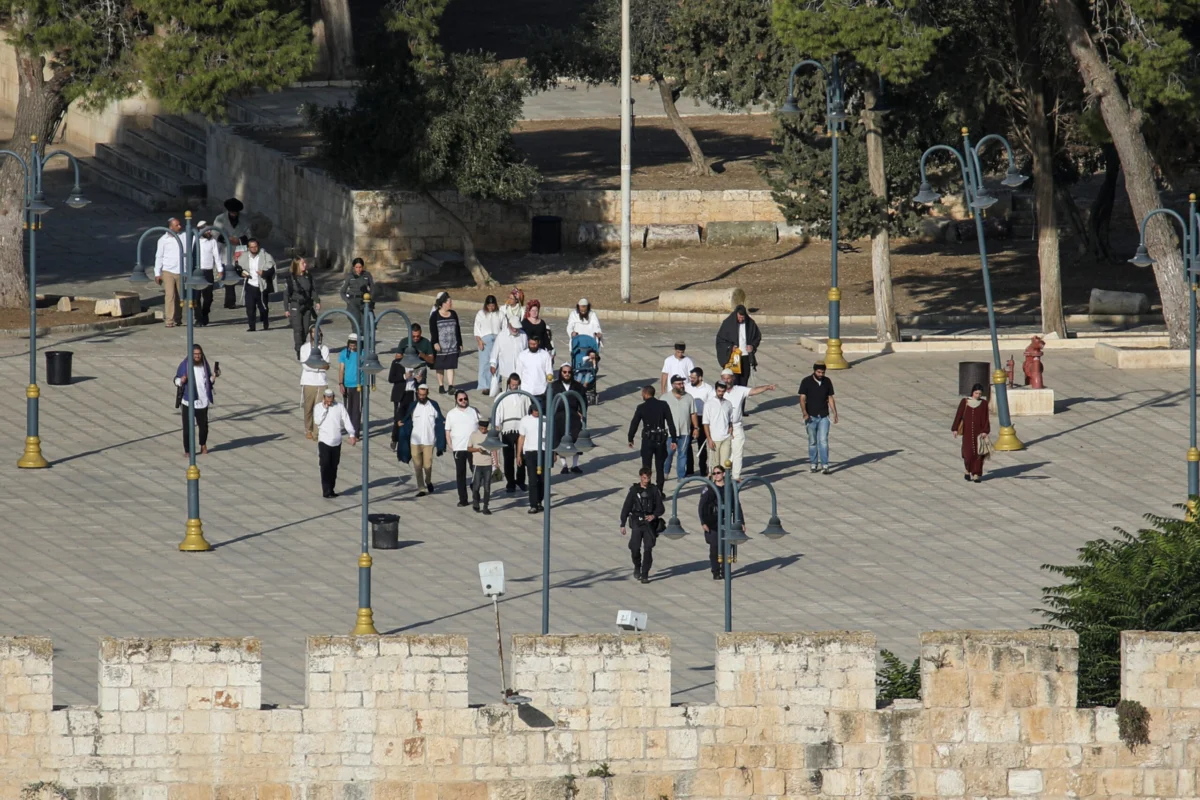
Hundreds of Israelis, including National Security Minister Itamar Ben-Gvir, participated in a highly publicized incursion into the Al-Aqsa Mosque compound on Monday, a move that has intensified existing tensions in occupied East Jerusalem and drawn sharp condemnation from Palestinian officials. The event, occurring on the third day of the Jewish holiday of Sukkot, saw Israeli forces impose significant security measures around the Old City, closing off access routes leading to the sacred site, which is known to Jews as the Temple Mount.
The Jerusalem governorate reported that the Israeli police secured the entry of approximately 900 Israelis into the compound during the morning hours. Witnesses described scenes of Israelis dancing in circles and singing within the mosque’s courtyards, an act perceived by Palestinians as a deliberate provocation. Minister Ben-Gvir himself made inflammatory remarks during the visit, declaring, "We are the owners of the place in Al-Aqsa and in the prisons, and we have turned the lives of terrorist prisoners into hell." He further asserted, "The people of Israel are on the path to absolute victory, and today we pray in Al-Aqsa, which is the most important place for the Jewish people."
Escalating Tensions During Sukkot Holiday
The incursion into the Al-Aqsa Mosque compound took place against a backdrop of heightened Israeli control in the area. On the same day, Israeli authorities compelled numerous Palestinian shopkeepers to shutter their businesses and residents to remain confined to their homes in neighborhoods adjacent to the mosque. This was ostensibly to facilitate Jewish prayers and gatherings during the Sukkot festival. The Association for Civil Rights in Israel reported that dozens of Palestinian owners of shops, cafes, and restaurants in the Cotton Merchants Market within the Old City were forced to close, clearing the way for Jewish worship.
This forced closure of Palestinian businesses and the restrictions on residents underscore a pattern of Israeli policies that often prioritize Jewish religious observances over Palestinian daily life and access to their own cultural and religious sites. The presence of armed police and security forces creating a buffer for Israeli visitors further highlights the disparity in freedom of movement and access for Palestinians in their own city.
Palestinian Condemnation and Warnings of Religious Conflict
Palestinian leadership swiftly denounced the incursion, characterizing it as a dangerous act of provocation. Nabil Abu Rudeineh, the Palestinian presidential spokesman, described the raid as "playing with fire and a dangerous provocation to the feelings of Muslims around the world." He issued a stark warning, suggesting that Israel was actively seeking to ignite a "religious war" across the region. This rhetoric reflects deep-seated Palestinian fears that Israeli actions are aimed at altering the status quo of the Al-Aqsa Mosque compound and escalating religious conflict.
The historical and religious significance of the Al-Aqsa Mosque compound, known as Haram al-Sharif to Muslims and Temple Mount to Jews, makes it a focal point of the Israeli-Palestinian conflict. Control over and access to this site have been a recurring source of violence and diplomatic friction. For Muslims, it is the third holiest site in Islam, revered as the place from which Prophet Muhammad ascended to heaven. For Jews, it is the holiest site in Judaism, believed to be the location of the First and Second Temples.
A Precedent of Israeli Incursions and Restrictions
The current incident is not an isolated event. Since 2003, Israeli police have routinely permitted groups of Israelis to enter the Al-Aqsa Mosque compound for visits, with exceptions typically made on Fridays and Saturdays. However, these visits are often conducted under heavy police escort and can be accompanied by provocative displays. Simultaneously, Israeli authorities frequently impose restrictions on Palestinian worshippers, limiting their access to the mosque, particularly during sensitive periods.
This pattern of differential access was evident earlier in the year when Israel reportedly blocked Eid al-Fitr prayers at Al-Aqsa. In another instance, only 10,000 Palestinians from the occupied West Bank, a region with a population of 3.3 million, were permitted entry for the first Friday prayers of Ramadan. These measures highlight a consistent policy of restricting Palestinian movement and access to one of Islam’s holiest sites, while facilitating and often encouraging Jewish visits.
The Role of Itamar Ben-Gvir and Far-Right Agendas
Itamar Ben-Gvir’s participation and public statements underscore the influence of far-right Israeli politicians who advocate for increased Jewish presence and control over the Al-Aqsa Mosque compound. Ben-Gvir, known for his hardline stances and rhetoric, has repeatedly called for greater Israeli sovereignty over the site, challenging the existing understanding of its administration, which is overseen by the Jordanian Waqf (Islamic trust) under Israeli security control.
His declaration of Israelis being "the owners of the place" directly contradicts the delicate arrangements that have historically governed the compound and ignores the religious sensitivities of the Muslim world. Such pronouncements are seen by Palestinians and many international observers as an attempt to systematically erode Palestinian rights and alter the religious and political character of East Jerusalem.
Broader Implications for Regional Stability
The repeated incursions into the Al-Aqsa Mosque compound, especially when led by government ministers and accompanied by forceful actions against Palestinians, have significant implications for regional stability. These events serve as potent symbols of occupation and dispossession for Palestinians and can easily ignite wider unrest. The international community has consistently called for the preservation of the status quo at the holy sites and has expressed concern over actions that could lead to increased violence.
The United Nations and various human rights organizations have documented the pattern of Israeli practices in East Jerusalem, including restrictions on movement, forced evictions, and the expansion of settlements, all of which contribute to a climate of instability. The Al-Aqsa Mosque compound, due to its profound religious and political significance, is particularly volatile. Any perceived threat to its sanctity or Muslim control can have far-reaching consequences, potentially drawing in neighboring Arab nations and exacerbating existing geopolitical tensions.
Historical Context and the "Temple Mount" Controversy
The differing names for the site—Al-Aqsa Mosque compound for Muslims and Temple Mount for Jews—are emblematic of the deep historical and political contestation surrounding it. The compound’s historical layers are complex, housing structures from both Islamic and Jewish history. However, the current political reality involves Israeli occupation of East Jerusalem since 1967 and its subsequent annexation, a move not recognized by most of the international community.
The Israeli government maintains that it allows freedom of worship for all religions at the site, but the practical implementation of these policies often leads to accusations of bias and discrimination against Palestinians. The ongoing debate over access, administration, and religious rights at the Al-Aqsa Mosque compound remains a central and intractable issue in the broader Israeli-Palestinian conflict, with each incident serving as a reminder of the fragile peace and the potential for renewed escalation. The presence of armed forces and the forceful displacement of local populations during religious holidays highlight the stark power imbalance and the daily realities faced by Palestinians in occupied East Jerusalem.