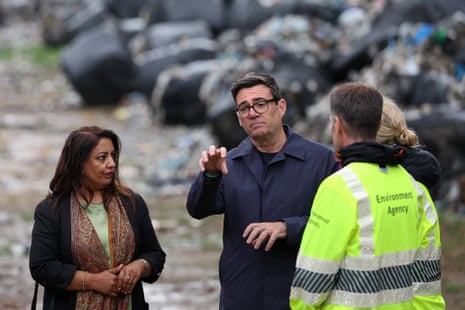
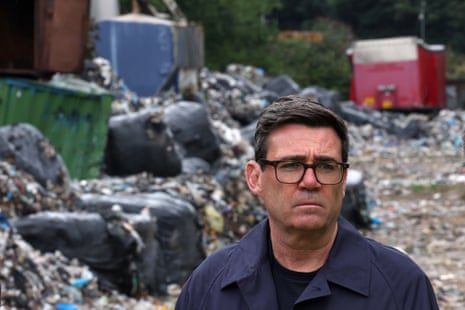
Prime Minister Andy Burnham announced a sweeping national crackdown on organized waste crime Thursday, vowing that criminal gangs will be held financially responsible for the environmental damage they cause. During a high-profile visit to an illegal dumping ground in West Yorkshire, the Prime Minister detailed a new "networked approach" that enlists the National Crime Agency (NCA) to dismantle the sophisticated syndicates behind large-scale fly-tipping.
The initiative marks a significant escalation in the government’s efforts to combat "waste gangs," shifting the responsibility for multi-million-dollar cleanup operations from the taxpayer to the perpetrators. By utilizing the Proceeds of Crime Act, authorities intend to seize assets from convicted illegal dumpers to fund the restoration of blighted communities.
"We have begun a much more networked approach to this, where we’re bringing the National Crime Agency in to work with the Environment Agency," Burnham told reporters while standing before a massive mound of refuse. He emphasized that the government is increasing penalties and "bearing down" on the organized crime structures that orchestrate these environmental offenses.
National Crime Agency Mobilized Against Organized Waste Gangs
The decision to involve the NCA, often referred to as Britain’s version of the FBI, signals that the government now views illegal dumping as a top-tier law enforcement priority rather than a mere local administrative nuisance. Burnham explained that the agency’s involvement is critical for building the high-level intelligence necessary to map out the networks behind these operations.

"It’s building the intelligence as to who is behind this, the networks that are orchestrating what is a very serious crime," Burnham said. He noted that the public purse has been unfairly exposed to the costs of clearing these sites for too long, and that a more aggressive, early-intervention strategy is required to ensure "the polluter pays."
Illegal waste sites have become a pervasive issue across England, with recent investigations identifying several "supersites" containing more than 20,000 tonnes of rubbish each. These sites often involve the illegal transport and disposal of toxic industrial materials, construction debris, and household waste, frequently linked to broader criminal activities including money laundering and tax evasion.
Targeting the ‘Supersites’ and High-Tech Enforcement
The government has identified several priority locations for the next phase of its national cleanup effort, including sites in Bradford, Runnymede, and the Isle of Sheppey. Collectively, these three locations alone are estimated to hold approximately 22,000 tonnes of illegal waste.
To prevent future dumping, the Prime Minister announced that the government will deploy AI-powered drones to monitor vulnerable areas. These drones are designed to detect illegal activity in real-time, allowing law enforcement to apprehend dumpers before they can vacate the scene. The technology is part of a broader "prevention-first" strategy aimed at making waste crime a high-risk, low-reward venture.
One of the most notorious sites mentioned is located in Burnham’s own constituency of Makerfield. A rat-infested mountain of waste has remained there for nearly two years, serving as a potent symbol of the "North-South divide" and the perceived neglect of industrial heartlands. Local residents have long argued that such sites would never be tolerated in more affluent southern regions, a sentiment Burnham acknowledged by stating that these dumps are a sign that "politics hasn’t been working" for these communities.

Internal Strife and the Culture of Governance
While the Prime Minister focused on environmental policy, the broader political landscape was dominated by revelations concerning the internal culture of his administration. Sue Gray, Burnham’s former chief of staff and a central figure in British administrative history, recently described the working environment at 10 Downing Street as "unbearable."
In an interview shared with the media, Gray revealed she feared her private conversations were being recorded by colleagues looking to leak information. She expressed disappointment that the Prime Minister did not act on her concerns regarding a "boys’ club" atmosphere and acrimonious briefings against her. Gray, who resigned in 2024, was the most powerful unelected official in the building, and her critique suggests deep-seated tensions within the heart of the government.
The leaks against Gray often focused on her salary and her supposedly difficult relationships with other senior advisers. Her departure was seen at the time as a sign that the Prime Minister was struggling to maintain discipline within his inner circle, a narrative that these new revelations have reignited.
Social Normalization of Hate and the Digital ‘Cesspit’
Adding to the government’s challenges, Equalities Minister Bridget Phillipson warned that racism and sexism are becoming "normalized" in British society. Phillipson attributed this trend to the influence of social media, which she described as a "cesspit" fueling violent misogyny and racial prejudice among young men.
In a candid assessment of the national mood, Phillipson argued that statements and attitudes that would have been deemed unacceptable just a few years ago are now commonplace. She specifically criticized the police for not taking violence against women and girls seriously enough and accused several high-profile opposition politicians of contributing to a climate of intolerance.
"I worry that we are at kind of a ground zero in terms of attitudes around violence against women and girls," Phillipson said. She suggested that the intersection of online radicalization and provocative political rhetoric has created a dangerous environment for marginalized groups, requiring a fundamental shift in how the state addresses social cohesion.
Education and the Push for a Skills Revolution
The political discourse on Thursday also touched on the future of the British workforce following the release of GCSE results. Education officials noted that the gender gap in academic performance has shrunk to its narrowest point this century, with nearly 25 percent of boys in England receiving top grades in mathematics.
However, Suella Braverman, representing Reform UK, issued a sharp critique of the current university system. She urged young people to avoid "pointless degrees at mediocre universities," which she characterized as a "scam." Instead, Braverman advocated for a "skills revolution," proposing the creation of 600,000 new apprenticeship starts per year.
"Don’t waste your time," Braverman told students receiving their results. "If you want to move forward, earn a wage, and have opportunities in your life, look for apprenticeships." Her comments reflect a growing debate in the UK over the value of higher education versus vocational training, a divide that Reform UK has sought to capitalize on.
Immigration Policy and the Return of the Sussexes
On the issue of immigration, Home Secretary Shabana Mahmood announced a new model for asylum seeker accommodation, aiming for a "fair spread" across the country. The policy is intended to prevent the concentration of asylum seekers in the nation’s poorest communities, a situation the Prime Minister has previously called unsustainable.
Mahmood’s plan involves a mix of military sites, former student housing, and residential bedsits. Simultaneously, the Home Office published new guidance for asylum seekers, explicitly stating that rape and domestic abuse are serious crimes in the UK. Burnham defended the guidance, arguing that it is essential to make "societal norms" clear to those entering the country.
The news cycle was rounded out by the expected return of the Duke and Duchess of Sussex to the United Kingdom. Prince Harry and Meghan Markle are reportedly moving back to Britain this month with their two children, Prince Archie and Princess Lilibet. When asked if the taxpayer would foot the bill for their security, Burnham called it a "private matter," noting that the couple is no longer entitled to state-funded protection after stepping down as senior royals.
A Government Facing Multiple Fronts
As the Burnham administration moves to clear the 22,000 tonnes of illegal waste blighting the countryside, it remains clear that the physical cleanup is only one of many challenges facing the Prime Minister. From the "unbearable" culture of his own office to the "cesspit" of social media and the complexities of immigration and education reform, the government is operating on multiple high-stakes fronts.
The fly-tipping crackdown serves as a primary example of Burnham’s attempt to project a "law and order" image that resonates with working-class voters. By framing waste crime as an issue of organized crime and fairness, the administration is attempting to bridge the gap between environmentalism and populist justice. Whether the involvement of the National Crime Agency and the use of AI drones will be enough to dismantle the waste gangs remains to be seen, but the message from Downing Street is clear: the era of the "polluter pays" has officially begun.