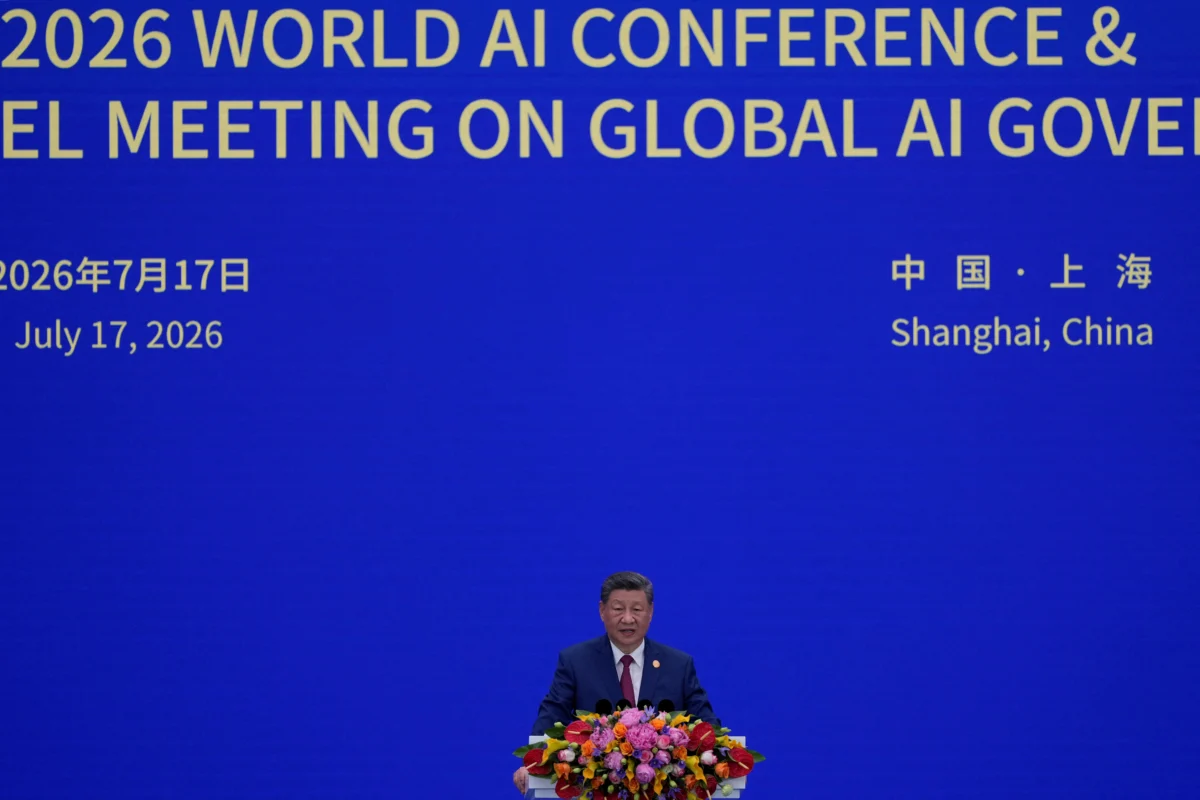
Chinese President Xi Jinping has declared that the development of artificial intelligence should not be the exclusive domain of any single nation, advocating strongly for international collaboration and a globally equitable approach to this transformative technology. Speaking at the prestigious World Artificial Intelligence Conference in Shanghai, Xi underscored his vision for AI as a collective endeavor, urging a departure from what he termed a "solo performance" by any one country. This call for cooperation comes at a pivotal moment as China actively seeks to expand its influence and capabilities in the global AI landscape, positioning itself as a significant player alongside established leaders.
The conference, a showcase of China’s rapidly advancing technological prowess, highlighted the nation’s ambition to rival the United States in AI innovation. Chinese AI models are increasingly demonstrating their competitiveness, attracting a growing international user base often due to their cost-effectiveness. However, the rapid ascent of AI has also ignited crucial debates regarding its governance, particularly concerning its potential deployment in military applications and the risks posed by malicious actors. Xi’s remarks directly addressed these anxieties, framing China’s role as a facilitator of equitable AI development, especially for developing nations.
A Call for Global AI Harmony
Xi’s keynote address emphasized the imperative of avoiding the creation of "new historical injustices" through unequal access to AI capabilities. He announced China’s commitment to partnering with international organizations across Africa, Latin America, Asia, and BRICS nations to foster AI-related opportunities. This initiative signals Beijing’s intent to shape the global AI governance framework and to ensure that emerging economies are not left behind in the AI revolution.
"AI development should not be a solo performance by a single country, but a symphony of international cooperation," Xi stated, drawing a powerful analogy to underscore his message. He further elaborated on the need to collectively resist the overextension of national security concerns into the AI domain, cautioning against prioritizing one nation’s security interests at the expense of others. This stance directly challenges the prevailing trend of technological nationalism and export controls, particularly those imposed by the United States and the European Union on Chinese tech imports, often citing national security justifications.
Navigating Geopolitical Tensions in AI
The United States, in particular, has implemented stringent measures to curb China’s access to advanced semiconductor technology, crucial for AI development. Recent actions by the U.S. Commerce Department have aimed to close potential loopholes in export controls, impacting shipments of AI chips to Chinese-affiliated companies globally. This has intensified the technological competition between the two global powers, with AI emerging as a central battleground.
Xi’s call for international cooperation can be interpreted as a strategic move to counter these restrictive policies and to build a broader coalition of nations that favor a more open and collaborative approach to AI. By framing AI development as a global public good, China aims to position itself as a responsible stakeholder and to garner support for its vision of a multipolar AI order. The emphasis on equitable access also serves to enhance China’s soft power and influence among developing countries, many of whom are eager to leverage AI for economic growth and development.
The Human Element in Artificial Intelligence
Beyond international cooperation, Xi also stressed the critical importance of a "people-centered" approach to AI, ensuring that humans remain firmly in control of the technology. He advocated for the establishment of robust legal frameworks, technological monitoring systems, and early warning mechanisms to safeguard against unintended consequences and to maintain human oversight. This focus on human control is a nuanced aspect of China’s AI strategy, acknowledging both the immense potential and the inherent risks associated with advanced AI.
"We should put in place laws and regulations, technological monitoring, early warning, and emergency response systems, in order to… ensure AI is always under human control," Xi asserted. This commitment to governance and safety is crucial for building public trust and for fostering a responsible AI ecosystem. It also aligns with global discussions on AI ethics and the need for international standards to guide its development and deployment.
China’s AI Ambitions and Strengths
Artificial intelligence has become a cornerstone of China’s industrial policy, fueled by substantial state investment aimed at cultivating a comprehensive domestic AI ecosystem. This strategy encompasses everything from chip manufacturing to the widespread adoption of AI-powered consumer applications. The sheer scale of AI usage in China is staggering; state media reports indicate that the daily consumption of "tokens"—an industry metric for AI usage—has increased a thousandfold over the past two years.
While China has faced challenges in accessing the most cutting-edge semiconductors, it possesses a significant advantage in its ability to power the vast data centers that are essential for running AI systems. These data centers are enormous consumers of electricity, with a single facility capable of using as much power as 100,000 households. Next-generation "hyperscale" facilities can demand power equivalent to two million homes, according to the International Energy Agency.
China’s abundant and relatively inexpensive electricity supply positions it ideally to meet these colossal energy demands. The nation generates more than twice the electricity of the United States, and this lead is projected to widen due to aggressive state-led investments in its energy grid. This energy advantage provides a crucial underpinning for China’s AI ambitions, allowing it to scale its AI infrastructure effectively, even amidst global semiconductor supply chain complexities.
Implications for the Global AI Landscape
Xi’s pronouncements at the World Artificial Intelligence Conference carry significant implications for the future of AI development and governance. His call for international cooperation, while seemingly altruistic, also reflects China’s strategic goal of shaping global norms and standards in its favor. By positioning itself as a proponent of a multipolar AI world, China seeks to dilute the influence of Western technological dominance and to create an environment more conducive to its own growth and innovation.
The emphasis on a "people-centered" approach and human control resonates with global concerns about the ethical implications of AI. However, the practical implementation of these principles will be closely watched, especially in light of China’s domestic surveillance capabilities. The tension between state control and individual freedoms in the context of AI remains a critical area of scrutiny for international observers.
The ongoing technological competition, particularly between the U.S. and China, is likely to continue to shape the global AI landscape. Restrictions on technology transfers and the race for AI supremacy are expected to persist, creating both challenges and opportunities for other nations. China’s commitment to fostering AI development through international partnerships, especially with developing countries, could lead to new alliances and a more diversified global AI ecosystem.
The Future of AI: A Collaborative or Contested Frontier?
The World Artificial Intelligence Conference served as a platform for China to articulate its vision for the future of AI, a future it clearly sees as collaborative rather than monopolistic. President Xi’s message of shared responsibility and equitable access is a direct response to the increasingly fragmented and competitive global environment surrounding artificial intelligence. As AI continues its rapid evolution, the ability of nations to find common ground and to establish shared principles for its development and deployment will be paramount.
The success of China’s initiative will depend on its ability to translate rhetoric into concrete actions and to build genuine trust with international partners. The world is watching to see if AI will indeed become a "symphony of international cooperation," as Xi envisions, or if it will remain a stage for a geopolitical "solo performance" by a select few. The ongoing dialogue and the actions taken by global leaders in the coming months and years will determine the trajectory of this transformative technology.