President Donald Trump, concluding a high-profile visit to his Doonbeg golf resort in County Clare, reaffirmed his stance that the unification of Northern Ireland and the Republic of Ireland is a natural progression, a move that has sent shockwaves through the corridors of power in London and Dublin. The president’s remarks, delivered with his characteristic bluntness, have upended decades of carefully maintained U.S. diplomatic neutrality regarding the constitutional status of the British province. During his final appearance on Irish soil, Trump brushed off the formal opposition of the British government, suggesting that political resistance often collapses under the weight of historical momentum.
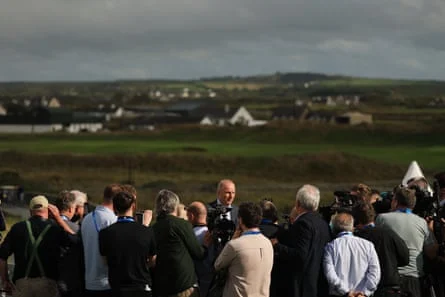
The president’s visit culminated at the Trump International Golf Links and Hotel, where he participated in the conclusion of the Irish Open. While presenting the winner’s trophy to Irish golfer Shane Lowry, Trump transitioned from sportsmanship to geopolitics, addressing a crowd that responded with chants of "USA" and cheers. The visit, which began with controversial statements regarding the border, ended with a definitive signal that the White House is prepared to favor Irish nationalist aspirations over the traditional "special relationship" with the United Kingdom.
Donald Trump doubles down on support for united Ireland during Doonbeg visit
The controversy began on Saturday when Trump first stated he would "love" to see a united Ireland, adding that such a transition "may as well happen now." On Sunday, he showed no signs of retreating from those comments despite a swift rebuke from 10 Downing Street. When asked about British Prime Minister Andy Burnham’s stated opposition to a referendum on Irish unity, Trump was dismissive. "Everybody says that. Then things happen," the president said, suggesting that the current British leadership’s stance might be temporary or ultimately inconsequential.
The president’s rhetoric centers on what he describes as a common-sense approach to the geography and culture of the island. "It seems to me that one of the naturals of all time is to put them together," Trump said, referring to the six counties of Northern Ireland and the 26 counties of the Republic. This "natural" alignment, in Trump’s view, overrides the complex legal and social frameworks that have governed the separation of the two jurisdictions since the early 20th century.
Trade Policy and the Removal of Irish Whiskey Tariffs
Beyond the constitutional debate, Trump utilized his visit to enact a significant shift in transatlantic trade policy. In a move that surprised many industry analysts, the president announced the immediate removal of tariffs on Irish whiskey. The 10% tariff had been part of a broader package of White House measures targeting European Union imports, but Trump indicated that he had been swayed by personal appeals from the Irish public and business leaders.
"Everyone’s been bugging me," Trump told the crowd at Doonbeg. "They say, ‘will you do me a favor, it’s so unfair, could you possibly take the tariffs off Irish whiskey?’ And I said, ‘on behalf of the United States of America, I’m going to take the tariffs off Irish whiskey.’" The decision is expected to provide a substantial boost to the Irish spirits industry, which had faced a competitive disadvantage against Scotch and whiskey produced in Northern Ireland, neither of which were subject to the same levies.
Industry experts noted that the tariff removal serves a dual purpose: it rewards the Republic of Ireland for its hospitality during the presidential visit and creates an economic incentive that aligns with Trump’s broader vision for a more integrated Irish economy. By removing the trade barrier, Trump has effectively signaled that he views the Republic’s economic health as a priority, further distancing himself from the EU’s collective trade stances.
The Collapse of Diplomatic Neutrality on Northern Ireland
The decision of a sitting U.S. president to take a definitive side on the "national question" in Ireland marks a radical departure from the role of the United States as an "honest broker." Since the 1990s, Washington has traditionally balanced its support for the Good Friday Agreement with a respect for the "principle of consent," which dictates that Northern Ireland’s status can only change if a majority of its citizens vote for it.
By suggesting that unification "may as well happen now," Trump has bypassed the cautious language of his predecessors. This shift has created significant friction with the British government. Downing Street issued a statement following the president’s remarks, clarifying that Prime Minister Burnham remains committed to the 1998 peace accord. The UK government maintains that there is currently no evidence of the widespread support required to trigger a border poll, noting that Burnham recently declared a referendum to be "off the table."
Donald Trump doubles down on support for united Ireland despite UK opposition

The reaction in London has been one of controlled frustration. Angela Rayner, the UK’s Communities Secretary, attempted to downplay the impact of the president’s words during an interview with Sky News. "Donald Trump is Donald Trump, and the president will say and speak his mind as he sees it," Rayner said. She emphasized that the British government remains "serious about the Good Friday Agreement" and will continue to follow the established legal path regardless of external commentary.
However, the president’s comments have emboldened Irish nationalists who have long sought international support for a border poll. Sinn Féin, the largest nationalist party in Northern Ireland, welcomed the remarks as a reflection of a broader sentiment within the Irish diaspora in the United States. Gerry Adams, the former leader of Sinn Féin, stated that Trump’s comments "reflect the broad North American sentiment towards Irish unity." Adams took the opportunity to criticize the Irish government in Dublin, accusing it of being "incredibly shortsighted" for failing to prepare for the logistical and economic realities of a unified state.
Regional Reactions and the Impact on Anglo-Irish Relations
The Irish government, led by Taoiseach Micheál Martin, has found itself in an awkward diplomatic position. While Martin’s party, Fianna Fáil, is historically Republican, the current administration has focused on "Shared Island" initiatives rather than an immediate push for a border poll. Martin has previously expressed frustration with colleagues who demand a referendum, famously stating he "goes bananas" when the issue is pushed prematurely.
On Sunday, Martin sought to lower the political temperature, describing the reaction to Trump’s comments as an "overreaction." Speaking at the Irish Open, Martin urged for a "calm perspective," suggesting that the president’s unique rhetorical style should be taken into account. "He takes a different sort of perspective on things. We know that," Martin told reporters, signaling that Dublin is not yet ready to abandon its cautious approach to constitutional change despite the president’s encouragement.
Conversely, Northern Irish Unionists, who are committed to maintaining the link with the United Kingdom, expressed sharp disapproval. Ian Paisley Jr., a prominent figure in Unionist politics, dismissed the president’s comments as factually and culturally incorrect. "Everyone is allowed a personal opinion even when it’s wrong," Paisley said. He reiterated that the "political, cultural and economic reality" is that the people of Northern Ireland remain British and wish to stay within the UK.
The Rising Tide of Constitutional Reform in the British Isles
The president’s intervention comes at a time of heightened constitutional anxiety across the United Kingdom. As Trump spoke in Ireland, leaders from Plaid Cymru, the Scottish National Party (SNP), and Sinn Féin prepared to meet in Cardiff to discuss a coordinated strategy for constitutional reform and potential independence movements. Trump’s comments on Ireland have provided a tailwind for these groups, although the president was notably more reserved when asked about Scotland.
"I won’t talk about Scotland yet, I will save that," Trump remarked when questioned about the possibility of Scottish independence. This strategic silence suggests that the president may be timing his interventions in UK internal affairs to maximize their impact. The prospect of a U.S. president supporting the dissolution of the United Kingdom’s current form is a scenario that has long haunted British diplomats, and Trump’s weekend in Doonbeg has made that scenario appear increasingly plausible.
The broader implications for the "Special Relationship" between the U.S. and the UK are profound. Traditionally, the two nations have operated with a high degree of synergy on global issues, but Trump’s willingness to challenge the UK on its most sensitive internal issue suggests a shift toward a more transactional and less deferential foreign policy. By aligning with the Irish diaspora and the nationalist cause, Trump is tapping into a powerful domestic American constituency while simultaneously exerting pressure on London.
A New Chapter in Transatlantic Diplomacy
As the president departed Ireland, the political landscape of the British Isles remained in a state of flux. The removal of whiskey tariffs serves as a tangible reminder of the president’s ability to use economic levers to influence political narratives. For the Irish whiskey industry, the news is a windfall; for the British government, it is a sign that the White House is willing to use trade policy to reward those who align with its vision.
The debate over Irish unification is no longer confined to local politics or academic circles. By doubling down on his support for a united Ireland, Donald Trump has moved the issue to the center of the international stage. Whether this leads to a formal referendum or remains a point of diplomatic friction, the president has ensured that the "natural" unification of the island will remain a primary topic of discussion for the foreseeable face of Anglo-American relations.
The visit to Doonbeg, ostensibly a stop at a private business venture, has ultimately functioned as a significant diplomatic event. The echoes of the "USA" chants and the president’s dismissive attitude toward Downing Street’s objections suggest a new era where traditional alliances are subject to the personal whims and "natural" instincts of the American executive. For now, the island of Ireland remains divided, but the political pressure for change has rarely been higher on the global stage.