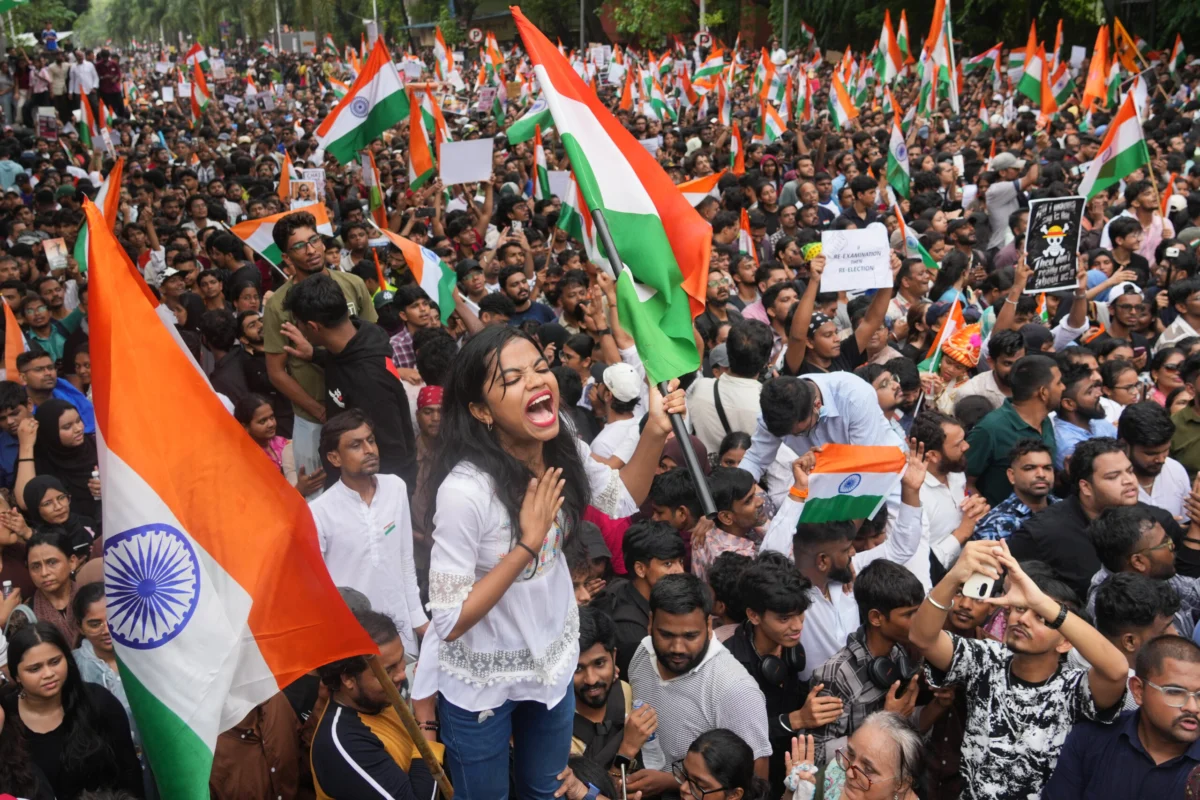
The Indian government has adopted a dual strategy in response to the widespread "Cockroach" protests that have recently captivated New Delhi and several other Indian states. This approach combines a measured crackdown on protesters with a concerted effort to engage and win over the nation’s youth demographic. The demonstrations, primarily centered around examination paper leaks and demands for educational reforms, have highlighted significant discontent among students and young citizens, posing a notable challenge to Prime Minister Narendra Modi’s administration.
The protests, initially ignited by the scandalous leak of crucial medical examination papers in June, quickly escalated into a broader movement demanding systemic changes within India’s education sector. The gravity of the situation was underscored by reports of student suicides, a tragic consequence of years of diligent preparation rendered futile by the leaks. These events coalesced into a powerful outcry at Jantar Mantar, a historic 18th-century astronomical observatory in New Delhi, situated near the Indian Parliament, drawing significant attention to the perceived failings of the current educational governance.
Crackdown and Legal Repercussions
In the wake of the protests, several states governed by Modi’s right-wing Bharatiya Janata Party (BJP) implemented a series of arrests, targeting hundreds of young men and women, some as young as 17 years old. These individuals faced serious charges, reflecting the government’s initial stance of asserting control and deterring further dissent. The scale of these arrests, coupled with the severity of the charges, prompted widespread criticism from protest leaders and opposition political parties, who decried the government’s heavy-handed tactics.
The situation took a significant turn when India’s Supreme Court intervened, issuing a pivotal order on Tuesday. The apex court mandated the immediate release of all individuals under the age of 18 who had been arrested during the protests. This judicial directive provided a crucial reprieve for the youngest participants and signaled a recognition of the need for a more sensitive approach to juvenile involvement in political demonstrations.
Even before the Supreme Court’s explicit order, a number of the arrested protesters had been released. This earlier release was largely a consequence of the vocal opposition from protest organizers and political figures who relentlessly challenged the government’s crackdown. The pressure exerted by these groups played a significant role in compelling authorities to reconsider the detentions.
Targeting Online Dissent and Surveillance Concerns
Beyond physical arrests, a new dimension of the government’s response has emerged: the targeting of social media accounts. Numerous students and members of Gen Z participating in the protests have reported their online presences being scrutinized, with cases being filed against them for expressing criticism of the government. This development has raised serious concerns about freedom of expression and the extent of digital surveillance employed by authorities.
In a notable instance, Delhi Police filed a First Information Report (FIR) concerning allegedly "derogatory, malicious and defamatory content" circulating on social media platforms that targeted constitutional heads. This action prompted a request to X (formerly Twitter) for details of the accounts involved. The authorities sought immediate deletion of the posts and videos, along with comprehensive personal information of the account holders, including login and logout times. This aggressive stance on online speech has amplified fears of a widening net of government surveillance and control over digital spaces.
Adding to these concerns, there have been reports of police officers meticulously noting the Instagram handles of protesters arriving at the Jantar Mantar protest site. This suggests a deliberate effort to track and potentially identify individuals engaging in online discourse related to the demonstrations. Critics, including opposition parties and digital rights advocates, have long accused the Modi government of expanding surveillance powers and exerting tight control over online platforms, accusations that the government consistently refutes, asserting that its actions are in the public interest.
The Government’s Two-Pronged Strategy: Deterrence and Engagement
The government’s response to the "Cockroach" protests can be characterized by a duality of action. On one hand, there has been a visible demonstration of force and legal action, aimed at quelling immediate dissent. This includes the deployment of riot control measures such as batons, tear gas, and even pellet guns in some instances, as reported in locations like New Delhi. A particularly disturbing incident in Bihar’s Siwan district involved a police officer reportedly firing an AK-47 in the air at protesters, leading to his suspension.

Furthermore, allegations have surfaced regarding the use of AI-powered surveillance technologies to track and apprehend protesters. Student activist Aishe Ghosh has taken legal action, petitioning the Delhi High Court to declare this mass surveillance unconstitutional and to demand the destruction of all personal data collected during the protests. Ghosh herself faced an attempted arrest at the office of the Communist Party of India (Marxist) (CPM), underscoring the perceived government efforts to silence prominent voices.
On the other hand, the administration is actively pursuing a strategy to win over the crucial Gen Z demographic. Recognizing that individuals under 29 constitute roughly half of India’s population, the BJP has launched a targeted campaign to connect with this generation. This initiative involves the creation of social media content that incorporates pop culture references, casual conversations, and relatable everyday settings, all designed to deliver political messaging in a format appealing to younger audiences.
These efforts include social media videos that frame political developments, such as the resignation of Education Minister Dharmendra Pradhan, not as concessions to protest demands, but as demonstrations of democratic strength and progress. The messaging often highlights infrastructural development and expansion of educational institutions as evidence of the government’s commitment to youth empowerment and national advancement. Prime Minister Modi himself has participated in this outreach, sharing rare Instagram-style selfie videos to connect directly with the younger generation.
Judicial Scrutiny and Protest Leader Responses
The Supreme Court’s involvement has provided a critical layer of oversight. In its hearing, the court addressed petitions concerning alleged excessive force used by police and paramilitary forces during the demonstrations. Chief Justice Surya Kant emphasized the need for a thorough and independent investigation into any instances of excess or atrocities committed against protesters, stating, "Whoever has committed excess… atrocities on innocent people, the law will take care of them." The court also mandated the preservation of all relevant footage, including drone, body camera, and CCTV recordings, and directed authorities to safeguard protesters’ data.
Despite these judicial pronouncements and some government concessions, protest leaders have expressed continued skepticism. Saurav Das, a spokesperson for the Cockroach Janta Party (CJP), highlighted the lack of written assurances from the government regarding the withdrawal of all FIRs and the guarantee of no future action against protesters. He noted that government officials pointed to Supreme Court Direction No. 4, which allows for investigations into existing FIRs, as a basis for continuing legal proceedings. The CJP has vociferously questioned why ordinary citizens should fear reprisal for questioning their government, arguing that in a democracy, citizens have an inherent right to demand accountability from their elected representatives.
Broader Implications and Public Impact
The "Cockroach" protests and the government’s multifaceted response have illuminated several critical aspects of contemporary Indian society. The widespread examination paper leaks have exposed systemic vulnerabilities within the education sector, fueling public anger and demanding greater accountability from the Ministry of Education. The resignation of Education Minister Dharmendra Pradhan, a rare occurrence during Modi’s tenure, signals the significant political pressure generated by the crisis.
The government’s approach to dissent, characterized by both legal action and attempts at online narrative control, has intensified debates surrounding civil liberties and freedom of speech in India. The use of surveillance technologies and the pursuit of individuals for social media posts raise profound questions about the balance between national security and the fundamental rights of citizens. Digital rights advocates and opposition parties continue to voice concerns that these measures could stifle legitimate criticism and create a chilling effect on public discourse.
The strategic outreach to Gen Z underscores the BJP’s awareness of the demographic’s significant political influence. By employing modern communication strategies and tailoring messages to resonate with younger voters, the party aims to solidify its support base and counter any erosion of goodwill stemming from the protest-related controversies. This focus on youth engagement is likely to remain a central pillar of the BJP’s political strategy moving forward.
The enduring impact of these protests and the government’s response will likely shape future discourse on education reform, digital rights, and the dynamics of political activism in India. The Supreme Court’s intervention has set a precedent for judicial oversight in cases of alleged police brutality and surveillance overreach, while the government’s dual strategy of deterrence and engagement highlights the complex challenges of managing public dissent in an increasingly digital and youth-centric nation. The coming months will reveal the long-term effectiveness of these government strategies in addressing the underlying issues that fueled the "Cockroach" protests and in shaping the political landscape for the youth demographic.