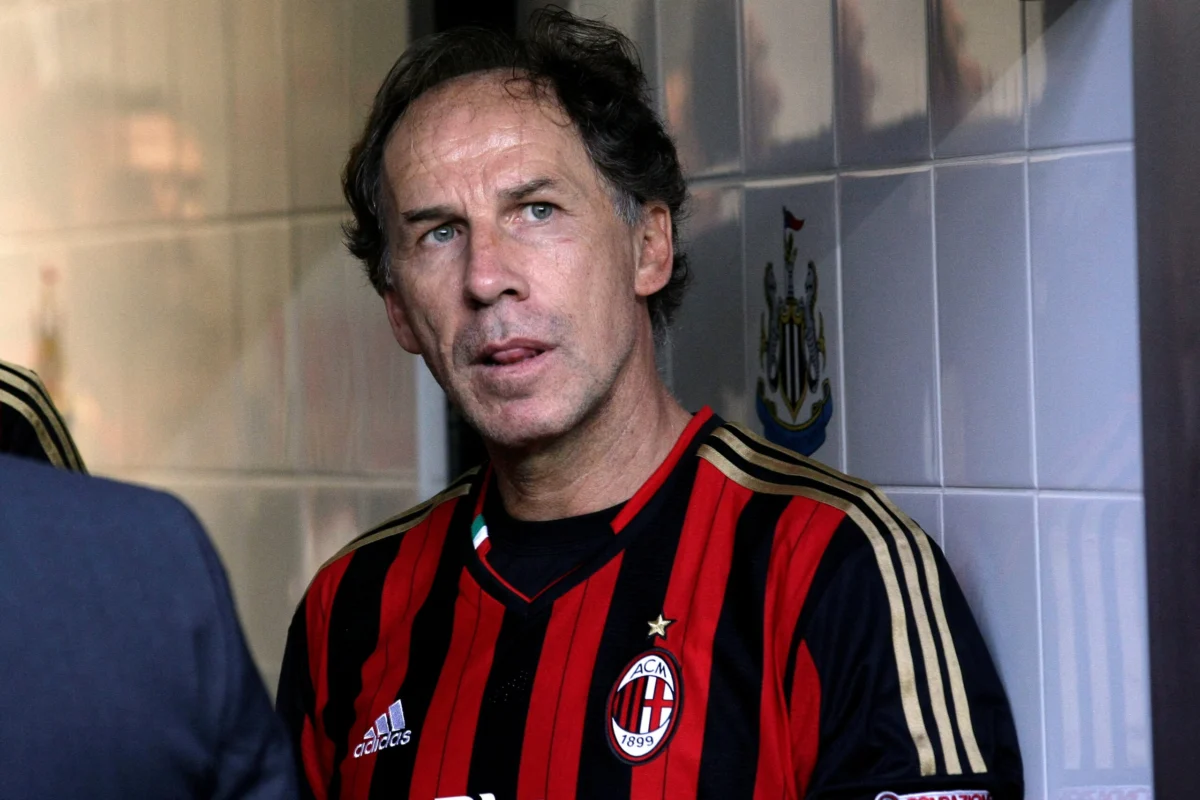
Franco Baresi, a towering figure in Italian football and an undisputed legend of AC Milan, has died at the age of 66. The club announced his passing on Friday, sending shockwaves through the sport and eliciting profound tributes from across the footballing world. Baresi, who spent his entire illustrious 20-year playing career with the Rossoneri, is widely remembered as one of the greatest defenders in the history of the game.
His death marks the end of an era for AC Milan, a club where he not only achieved unparalleled success but also became an enduring symbol of loyalty, leadership, and unwavering dedication. Milan released a somber statement, reflecting the deep sorrow felt by the club and its vast global fanbase: "The entire history of AC Milan is in tears." The cause of his death was not immediately disclosed.
Baresi’s final public appearance was a poignant moment at the opening ceremony of the Milano Cortina Winter Olympics in February. Alongside former Inter Milan defender Giuseppe Bergomi, he had the honor of carrying the Olympic torch into the San Siro, the iconic stadium that was his home turf for two decades. This memorable scene underscored his lasting connection to the city of Milan and the sport he so profoundly influenced.
The club emphasized Baresi’s indelible legacy, stating, "His example and integrity will be forever etched into the Club’s DNA, just as his iconic number 6 shirt is." The outpouring of grief from AC Milan’s supporters, known as "Rossoneri," was palpable, with the club adding that "The condolences AC Milan extends to Franco Baresi’s family at such a difficult time are shared by every Rossonero, who feels this loss as their own."
A World Cup winner with Italy in 1982, Baresi’s career transcended club loyalty, earning him national hero status. Italian Premier Giorgia Meloni paid tribute on social media platform X, recognizing his immense contribution to the nation’s sporting heritage. "With the passing of Franco Baresi, Italy loses not only one of the greatest champions in its sports history, but also an example of loyalty, professionalism, and dedication," Meloni stated.
A One-Club Man Etched in AC Milan History
Franco Baresi’s career is a testament to unwavering commitment, a rarity in modern football. He rose through the ranks of AC Milan, a club that would become synonymous with his name. His senior debut for the Rossoneri came at the tender age of 17 in April 1978, a precocious talent stepping onto the grand stage.
Remarkably, Baresi chose to remain loyal to Milan even during a challenging period for the club. In 1982, just months before he would help Italy lift the World Cup, AC Milan was relegated to Serie B for the second time in three seasons. Despite this setback, Baresi stayed, demonstrating a deep-seated commitment that would define his career. By the age of 22, he had been entrusted with the captaincy, a leadership role he would hold with distinction for years to come.
Over his 20-year tenure, Baresi amassed over 700 appearances for AC Milan, a staggering figure that highlights his consistency and enduring presence. As captain, he led the club to an era of unprecedented global dominance in the late 1980s and early 1990s. His commanding presence at the heart of the defense was the bedrock upon which Milan built its formidable reputation.
A Trophy-Laden Career at the Summit of European Football
The list of accolades Baresi collected with AC Milan is extraordinary, reflecting a golden age for the club. He was instrumental in securing three UEFA Champions League titles, a testament to Milan’s supremacy on the European stage. Domestically, he captained the team to six Serie A championships, solidifying their status as Italy’s premier club.
Beyond Europe’s premier club competition and domestic titles, Baresi also contributed to Milan’s success in winning two Intercontinental Cups, three European Super Cups, and four Italian Supercups. These victories cemented AC Milan’s place among the elite clubs in world football during his playing days.

AC Milan owner Gerry Cardinale acknowledged Baresi’s profound impact, stating, "For generations, Franco embodied the values, character and excellence that define this club." Cardinale further reflected on Baresi’s personal strength, noting his continued engagement with the club even during his health struggles. "Even as he battled his greatest challenge over the last year, he was always there for the club, quietly reminding us all what it means to wear these colours."
Cardinale concluded by emphasizing the lasting nature of Baresi’s influence: "Franco’s legacy is profound and will endure forever. Our thoughts are with his family and all those whose lives he touched." Baresi himself, in a final interview with La Gazzetta dello Sport last year, spoke of his lifelong connection to the club, recalling his childhood dreams of playing for Milan. "When I arrived at Milanello (Milan’s training centre) for the first time as a 14-year-old, it seemed like entering paradise," he reminisced, underscoring the deep personal significance of his journey with the Rossoneri.
Baresi: The First to Have AC Milan Jersey Retired
Baresi’s international career was as distinguished as his club achievements, though marked by both triumph and near misses. He was a vital member of the Italian squad that claimed the 1982 World Cup title, a career-defining moment. He also played a pivotal role in Italy’s run to the final of the 1994 World Cup, where they ultimately lost to Brazil in a dramatic penalty shootout. Baresi was one of three Italian players to miss their spot-kick in that fateful shootout, a moment of heartbreak in an otherwise stellar international career.
Individually, Baresi’s brilliance was recognized on the global stage. He finished as runner-up to his AC Milan teammate Marco van Basten in the prestigious Ballon d’Or awards in 1989, a testament to his standing among the world’s elite players.
Upon his retirement from playing in 1997, AC Milan made a historic decision: they retired Baresi’s iconic No. 6 jersey. This was a landmark moment, as it was the first time an AC Milan player had their number permanently taken out of circulation, and it marked a precedent for Italian football. The club also hosted a celebratory testimonial match in his honor, drawing legendary players from across the globe who had shared the pitch with or competed against Baresi, further underscoring his widespread respect. In 2020, Baresi was appointed honorary president of AC Milan, a fitting recognition of his lifelong dedication.
The Italian football federation president, Giovanni Malago, lamented the loss, calling Baresi "an extraordinary champion who wore only two shirts for his entire career: those of Milan and Italy." Malago confirmed that the national team would organize a tribute to honor Baresi’s memory during their next match.
The Milan Derby’s Unlikely Family Connection
The narrative of Franco Baresi’s career is also intertwined with a fascinating family connection to AC Milan’s city rivals, Inter Milan. As a young hopeful, Baresi had trials with Inter but was ultimately overlooked. Instead, the club opted to sign his older brother, Giuseppe Baresi, who went on to become a captain for Inter. This twist of fate led Franco to join the youth academy of AC Milan, setting the stage for a legendary rivalry played out within the same family.
The image of the two Baresi brothers exchanging pennants before the Milan derby became a powerful symbol of the fierce rivalry between AC and Inter Milan throughout the late 1980s. It was a unique and poignant representation of family ties and sporting allegiances colliding on the grandest stage.
Gianluigi Buffon, the legendary former Italy and Juventus goalkeeper, shared a personal anecdote that highlighted Baresi’s impact. "On November 19, 1995, I made my Serie A debut against Milan. I was 17 years old, and on the other side was the captain of that team: Franco Baresi," Buffon wrote on X. He reflected on the profound impression Baresi made on him as a young player. "For a boy my age, finding myself on the field against champions like him was something incredible," Buffon continued. "From that day on, I had an even clearer understanding of what it meant to represent football with class, leadership, and respect. Ciao Franco. Rest in peace." Buffon’s words encapsulate the respect and admiration Baresi commanded from peers and opponents alike.
Franco Baresi’s passing leaves a void in the footballing world, but his legacy as a defender, captain, and gentleman will continue to inspire generations of players and fans. His name is indelibly linked to the glory days of AC Milan and the proud history of Italian football.