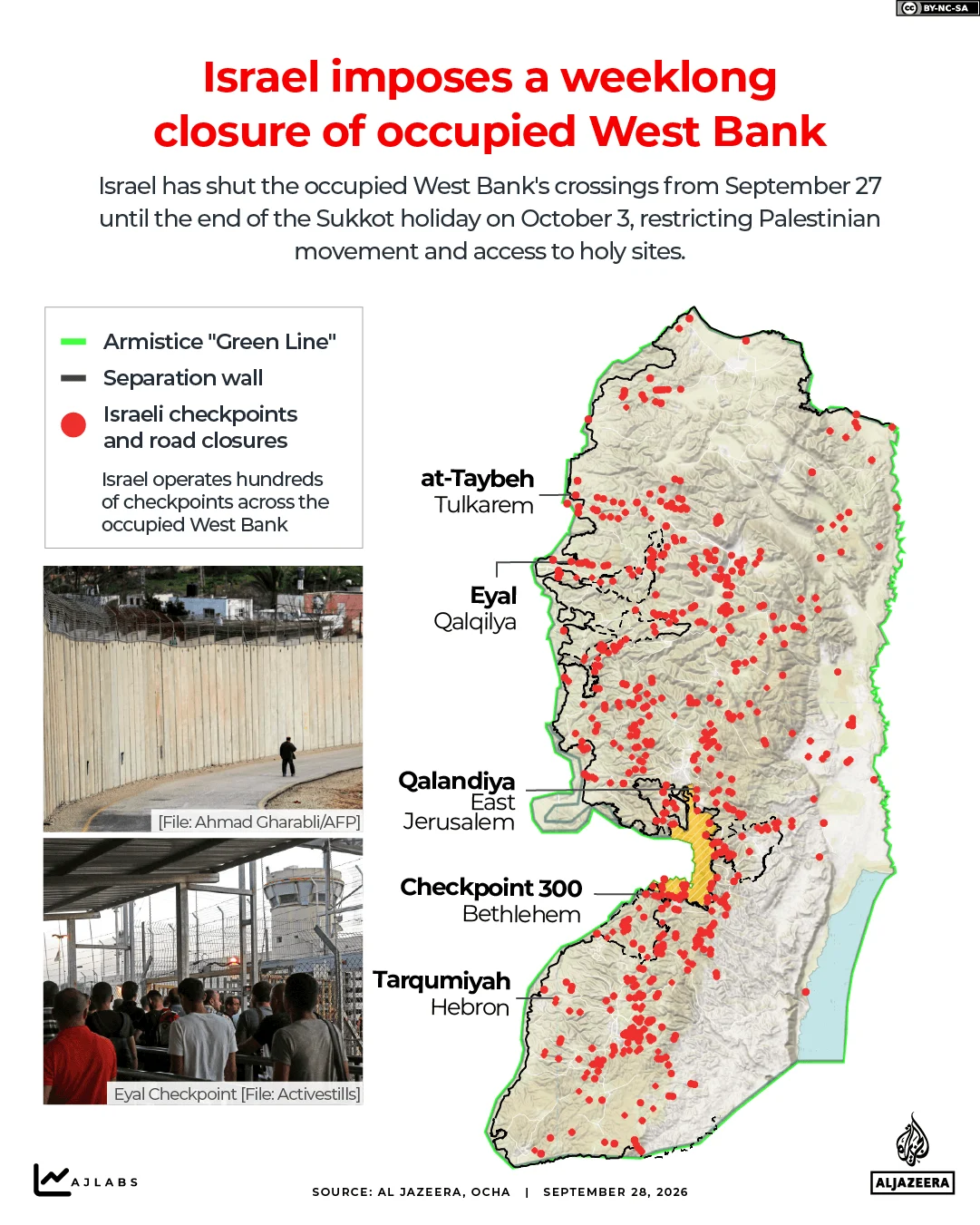
Israel has imposed a week-long closure on the occupied West Bank, significantly restricting Palestinian movement and access to holy sites in observance of the Jewish holiday of Sukkot. This measure, ordered by Defense Minister Israel Katz and effective until Saturday, exacerbates existing limitations faced by Palestinians due to a pervasive network of hundreds of Israeli checkpoints and barriers throughout the territory.
The closure, implemented on Sunday, involves the sealing of West Bank crossings and a tightening of controls at existing checkpoints and barriers. This directly impacts Palestinians’ ability to travel between their communities and restricts access to vital religious sites, including the Al-Aqsa Mosque in occupied East Jerusalem and the Ibrahimi Mosque in Hebron. Reports from the Ramallah and el-Bireh governorate indicate that Israeli forces blocked roads leading to several Palestinian towns, including Turmus Aya, Aboud, Nabi Saleh, Atara, and Taybeh. Additionally, temporary checkpoints were established in Yabroud, Ein Siniya, and Jaba, where soldiers conducted vehicle searches and checked identification.
This intensified closure also bars Palestinians who hold permits to work in Israel and its settlements. This workforce, already significantly diminished since the start of Israel’s military operations in Gaza in October 2023, now faces further drastic reductions. Only those deemed essential workers are permitted entry into Israeli industrial zones within the West Bank.
The economic hardship imposed by these restrictions is particularly acute for Palestinians in the West Bank. For decades, many have sought employment in Israel due to persistent high unemployment and low wages within their own territory, a situation directly linked to the ongoing Israeli occupation that has curtailed economic development and freedom of movement for nearly six decades.
The Economic Impact of Movement Restrictions
The Palestinian labor market has been severely impacted by Israeli policies. Before the escalation of conflict in Gaza in October 2023, an estimated 160,000 Palestinians from the West Bank were employed by Israeli entities, with the majority working within Israel proper and the remainder in West Bank settlements. This figure, according to the Palestinian Institute for Economic Policy Research, highlights a significant reliance on the Israeli economy for livelihoods.
However, following the onset of the Gaza war and subsequent policy shifts, this number plummeted. By mid-2024, only around 27,300 permit holders were able to enter Israel for work. This dramatic decline has contributed to a surge in unemployment within the West Bank. Data from the Israeli rights group Gisha indicates that unemployment rates rose from 12.9 percent in September 2023 to a staggering 30.7 percent just one year later. This economic downturn has far-reaching consequences for Palestinian families and the broader economy of the occupied territories.
Israel’s Checkpoint Network: A System of Control
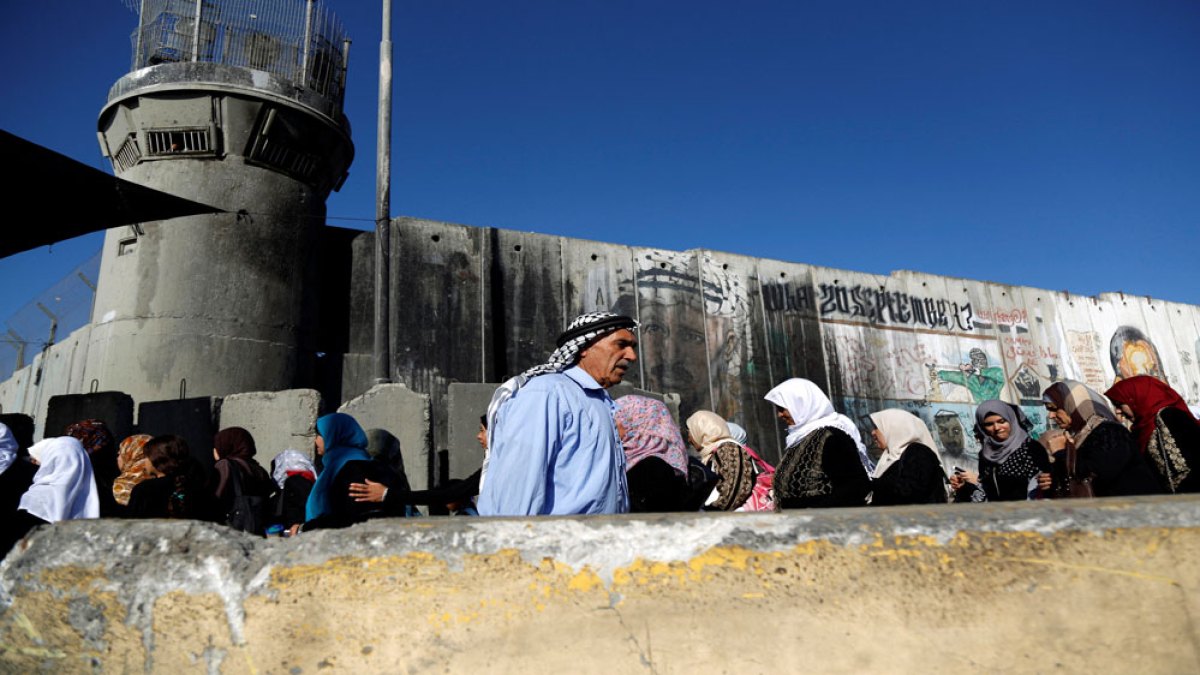
The closure during Sukkot is the latest manifestation of a long-standing system of movement restrictions imposed by Israel across the West Bank. The United Nations Office for the Coordination of Humanitarian Affairs reports that there are over 300 Israeli checkpoints operating throughout the West Bank. These checkpoints, along with other physical obstacles, form a complex network designed to control and limit the movement of the Palestinian population.
As of December, these checkpoints were part of a larger infrastructure comprising 925 obstacles that restrict the daily lives and mobility of approximately 3.4 million Palestinians residing in the West Bank and East Jerusalem. These obstacles are not merely temporary inconveniences; they represent a systematic effort to segment Palestinian communities and control access to essential services, employment, and religious sites.
The presence and operation of these checkpoints are a critical factor in the daily lives of Palestinians. They serve as physical manifestations of the occupation, impacting everything from commuting to work and attending school to accessing healthcare and maintaining social connections.

Types of Obstacles to Palestinian Movement
The obstacles restricting Palestinian movement are multifaceted and include various forms of control:
- Permanent Checkpoints: These are established, often fortified, structures where individuals and vehicles are routinely stopped, searched, and questioned. They are strategically located on major routes connecting Palestinian communities and separating them from Israeli settlements and bypass roads.
- Flying Checkpoints: These are temporary checkpoints that can be set up and dismantled without notice at various locations. Their unpredictable nature adds an element of constant anxiety and disruption to daily travel.
- Roadblocks and Barricades: These include concrete blocks, earth mounds, and other physical barriers that obstruct roads, forcing detours or completely blocking access. They are often used to close off entrances to villages or neighborhoods.
- Physical Barriers: This category encompasses the separation barrier, also known as the "apartheid wall," which runs through the West Bank, and other fencing and trench systems that divide Palestinian land and communities.
These measures collectively create a fragmented landscape where freedom of movement is severely curtailed, with significant implications for the social, economic, and psychological well-being of the Palestinian population.
Key Checkpoints and Their Impact
The strategic placement of these checkpoints significantly impacts Palestinian communities, acting as gatekeepers to essential routes and services. For hundreds of thousands of Palestinians, these checkpoints necessitate significantly longer and more arduous journeys for work, education, and medical care. The cumulative effect is a profound disruption of daily life and a constant reminder of the restrictions imposed by the occupation.
While the exact number and operational status of all 300+ checkpoints can fluctuate, several are recognized as major chokepoints that significantly influence movement patterns across the West Bank. These include:
- Checkpoint 300 (Rachel’s Tomb checkpoint): Located near Bethlehem, this is one of the busiest checkpoints, connecting Bethlehem to Jerusalem and other Palestinian areas. It is a critical transit point for thousands of commuters and pilgrims.
- Qalandia Checkpoint: Situated between Ramallah and Jerusalem, Qalandia is another highly significant and often heavily congested checkpoint. It serves as a major artery for Palestinians traveling between the northern and southern West Bank, as well as for those seeking to enter Jerusalem.
- Huwara Checkpoint: Located south of Nablus, this checkpoint controls access to and from one of the largest Palestinian cities in the West Bank. Its presence and the accompanying restrictions have a profound impact on the region’s economy and social fabric.
- Container Checkpoint: While primarily associated with goods movement, this checkpoint also impacts Palestinian civilian passage and is located near Bethlehem.
These checkpoints are not merely points of passage; they are sites where Palestinian identity is scrutinized, and their right to movement is constantly evaluated. The delays, searches, and potential for denial of passage contribute to a climate of uncertainty and can have immediate and severe consequences for individuals’ ability to reach their destinations.

The Broader Context of Occupation and International Law
The extensive network of checkpoints and movement restrictions is intrinsically linked to the broader context of the Israeli occupation of Palestinian territories, which began in 1967. Critics, including many international bodies, view these measures as a violation of international law, particularly the Fourth Geneva Convention, which prohibits an occupying power from transferring its own population into occupied territory and from imposing collective punishment.
The United Nations General Assembly passed a resolution in September 2024 calling on Israel to end its "unlawful" occupation within a year. However, rather than de-escalating, Israel has, according to reports, intensified its military presence, conducted increased raids, deployed soldiers to accompany settlers during attacks on Palestinian towns, and continued to expand settlements, which are considered illegal under international law.
The ongoing expansion of settlements and the accompanying infrastructure, including roads and checkpoints designed to facilitate settler movement, further fragment Palestinian land and restrict Palestinian access to their own resources. This creates a system where the mobility and well-being of Palestinians are systematically subordinated to the needs and security concerns of the occupation.
The impact of these policies extends beyond the immediate physical restrictions. The constant surveillance, the humiliation of searches, and the unpredictability of passage contribute to a pervasive sense of insecurity and a deterioration of mental health among the Palestinian population. The economic stagnation fostered by restricted movement and access to markets further perpetuates cycles of poverty and dependency.
The recent closure for Sukkot, while framed as a holiday-related security measure, underscores the vulnerability of Palestinian access to their own land and holy sites. It highlights how religious and security justifications can be used to implement measures that have profound and lasting impacts on the lives of millions of Palestinians, reinforcing the reality of a highly controlled and restricted existence under occupation. The continued presence and operation of over 300 checkpoints serve as a stark and constant reminder of the pervasive nature of Israeli control over Palestinian movement and daily life.