Search and rescue teams across the Himalayan region are facing a humanitarian crisis of staggering proportions as the number of missing in Nepal and Tibet rises to nearly 3,000 following a catastrophic glacial collapse and subsequent flash floods. The death toll from the disaster has officially climbed to 682, with authorities in Nepal confirming 675 fatalities and Chinese state media reporting seven deaths in Tibet. The disaster, triggered by the collapse of a glacier on Mount Langtang Lirung, unleashed a wall of water and debris that decimated entire villages and critical infrastructure along the river systems of the world’s highest mountain range.
The scale of the tragedy continues to expand as government agencies revise their figures. In addition to the confirmed deaths in Nepal and Tibet, at least seven bodies have been recovered from rivers in India that flow from the Nepali highlands, suggesting the torrent carried victims across international borders. On Saturday, Nepal’s National Disaster Risk Reduction and Management Authority significantly adjusted the list of the missing, revealing that the nearly 3,000 people unaccounted for include a large number of foreign tourists and industrial laborers.

Among the missing are 517 foreigners and 933 workers who were stationed at various hydropower projects along the river’s path. The suddenness of the surge, which witnesses described as a "lethal torrent," left little time for evacuation at these remote industrial sites. The disaster has also taken a heavy toll on the first responders themselves; 45 Nepali army soldiers and 40 police officers are among those currently missing in the field.
The Mount Langtang Lirung Glacial Collapse and Initial Impact
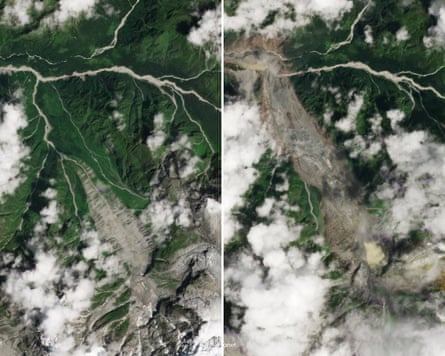
The catastrophe began when a massive section of the glacier on Mount Langtang Lirung failed, sending millions of tons of ice and rock into the valleys below. Satellite imagery provided by Planet Labs shows a stark "before and after" of the mountain, revealing a massive scar where the glacier once sat. The resulting displacement of water created a flash flood that gained momentum as it descended, picking up boulders, trees, and the remains of buildings.
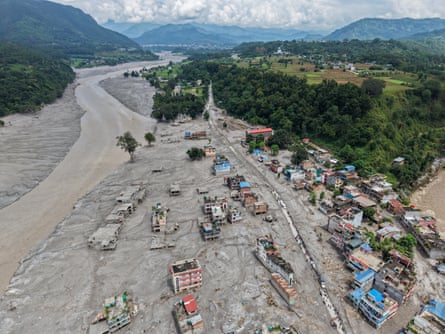
In the Rasuwa district of Nepal, the impact was particularly devastating. The floodwaters slammed into several hydropower tunnels where workers were underground. While more than 350 people have been successfully evacuated from these sites under what officials described as "extremely risky" conditions, at least 100 remains trapped deep within the mud-filled tunnels. Rescue workers, including specialized army units, are using drilling equipment to cut through layers of sludge to reach potential survivors.

The disaster has virtually obliterated the Gyirong border crossing, a critical trade link between China and Nepal. When Chinese rescue teams reached the complex on Friday, they reported finding nothing but ruins. Surveillance footage from the site captured the terrifying moments the flood arrived, showing people attempting to outrun a massive wave of debris that eventually swallowed the entire facility.
Search and Rescue Challenges Amidst the Number of Missing in Nepal and Tibet
The search for the nearly 3,000 missing in Nepal and Tibet is being hampered by the very environment that caused the disaster. Rescue workers from the Nepal Scout Disaster Response Team have described the terrain as "leg-sucking mud" that makes every movement an exhausting struggle. In many areas, the mud is several feet deep, concealing both survivors and the deceased. Operations were briefly halted on Saturday morning due to thick fog and heavy rain, which grounded helicopters and made ground movement impossible, before resuming in the afternoon as weather conditions cleared.
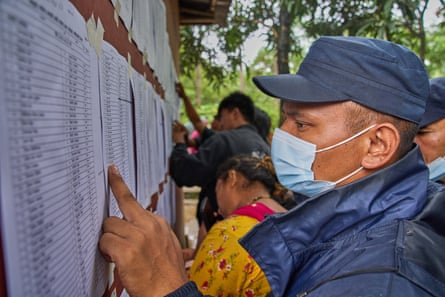
The emotional toll on the local population is mounting as families gather at hospitals in Kathmandu and community centers in Nuwakot. Posters of missing relatives have been plastered across the walls of medical facilities, and lists of the rescued are being scrutinized by crowds of anxious citizens. In many cases, the bodies being recovered are decomposed beyond recognition due to the violent nature of the flood and the time elapsed, leading authorities to prepare for an extensive DNA identification process.
Nepal’s foreign minister, Shisir Khanal, has clarified the country’s stance on international aid. While Kathmandu initially stated it could manage the rescue efforts independently, the government has now requested specialized technical assistance. This includes expertise in DNA testing for victim identification, specialized tunnel rescue teams, and long-term storage facilities for bodies. The government has specifically requested that India and China provide "bailey bridges"—portable, pre-fabricated truss bridges—to replace the two dozen permanent structures that were swept away.
Regional Geopolitics and the Information Vacuum in Tibet
The disaster has drawn the immediate attention of the highest levels of government in both Kathmandu and Beijing. Chinese Premier Li Qiang arrived in the Gyirong area on Thursday, signaling that the Chinese government view the disaster as a top national priority. The Gyirong port is not only a border crossing but a vital node in China’s Belt and Road Initiative, serving as a gateway for logistics and trade into South Asia.
However, the flow of information from the Tibetan side of the border remains tightly controlled. While global media outlets have broadcast harrowing footage of the floods, reports indicate that such videos have been largely absent from Chinese social media platforms. Tibet remains one of the most sensitive and heavily monitored regions under Beijing’s administration, and the strict control of data is complicating efforts by international NGOs to assess the full extent of the damage on the northern side of the Himalayas.
Despite the information restrictions, the Chinese Politburo, chaired by President Xi Jinping, has called for a significant increase in the monitoring of glacial lakes and landslide risks. This move highlights a growing recognition of the environmental instability in the region, where climate change is accelerating the melting of glaciers and increasing the frequency of glacial lake outburst floods (GLOFs).
Economic Consequences and the Threat of Barrier Lakes
The financial impact of the disaster is expected to be staggering. Nepal’s Finance Minister, Swarnim Waglé, has provided an initial estimate that the country will need between $4 billion and $5 billion for reconstruction. This figure accounts for the destruction of the hydropower plants, which are central to Nepal’s energy security and export economy, as well as the loss of roads, bridges, and private property. Over 90,000 people have been directly affected by the floods, according to estimates from the Red Cross.
Adding to the anxiety of the survivors is the continued threat of barrier lakes. These are temporary reservoirs created when debris from a landslide or flood blocks a river’s natural flow. Authorities are currently monitoring two such lakes upstream. If the debris walls holding back these lakes were to fail, a second wave of flooding could strike the already devastated downstream communities. Satellite data shows that one of these lakes is growing in size with no visible outlet, suggesting that water pressure is reaching dangerous levels.
Chinese geohazards experts have warned that more than 100 other glacial lakes scattered throughout the high-altitude region could pose similar threats. The instability of the mountain terrain following the initial collapse means that even moderate rainfall could trigger further landslides or floods.
International Aid and Long-Term Recovery Efforts
As the number of missing in Nepal and Tibet remains high, international neighbors have begun moving resources into the region. India has dispatched three flights carrying approximately 60 tons of relief materials, including medicines, water purification tablets, and blankets. More importantly, India has sent a specialized tunnel rescue team to assist at the hydropower sites. China has also sent five tunnel experts from Tibet to help with the delicate work of searching for the workers trapped in Rasuwa.
The recovery process will likely take years. Beyond the immediate search for the missing, the region faces a massive logistical challenge in restoring communication and transport. The destruction of bridges has cut off dozens of villages, leaving them reliant on airlifts for basic supplies. The "bailey bridges" requested by Nepal are seen as a stopgap measure to allow heavy machinery to reach the disaster zones for more permanent repairs.

For the families of the nearly 3,000 missing, the wait for news is agonizing. Rescue workers have emphasized that while the window for finding survivors is closing, the mission remains focused on providing closure to the families. "People want their family member’s body back, either dead or alive," said one rescue worker after an 18-hour shift in the mud. As the Himalayan nations grapple with the aftermath of this glacial collapse, the focus remains on the grueling, slow-moving task of recovery in one of the world’s most inhospitable environments.