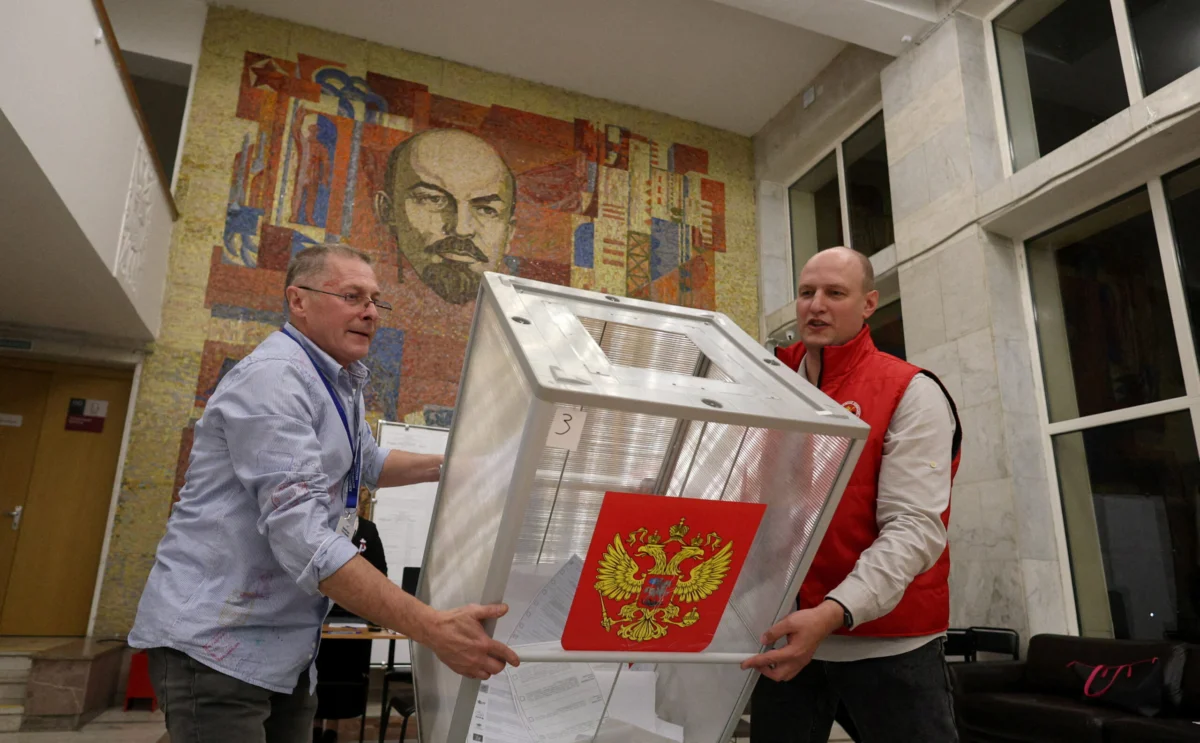
Voting has concluded across Russia in the nation’s first parliamentary elections held under the shadow of an ongoing conflict in Ukraine, with the ruling United Russia party poised for a decisive victory in a tightly controlled electoral process. President Vladimir Putin has framed the election as a critical referendum on public backing for his protracted military campaign.
The Kremlin sought to leverage these parliamentary elections, the first since the full-scale invasion of Ukraine commenced in February 2022, as a means to project an image of robust popular support for the war and to legitimize its actions on the international stage. The outcome, widely anticipated to favor the incumbent party, is seen as a key indicator of domestic sentiment amidst unprecedented geopolitical tensions and extensive international sanctions.
The electoral process was marred by a significant escalation of Ukrainian aerial attacks. Russian authorities reported that Kyiv launched hundreds of drones targeting Moscow and other regions across Russia. State news agency TASS characterized this as the most extensive drone assault since the conflict began, underscoring the escalating nature of the war’s reach into Russian territory.
The coordinated drone strikes, occurring on Sunday, resulted in casualties. At least three individuals were reported killed in the Moscow region. Further fatalities were reported in the Russian-occupied portion of Ukraine’s Kherson region, where an election official was among the two deceased. These incidents highlight the pervasive security concerns and the tangible impact of the conflict even on the day of domestic elections.
Beyond aerial assaults, Russian officials also cited cyberattacks targeting the country’s electronic voting systems and communication infrastructure. Despite these disruptions, the Central Election Commission maintained that the electoral process largely proceeded smoothly. Preliminary results indicated a substantial lead for the United Russia party, with the commission announcing a final turnout of 56.66 percent as polls closed. More definitive results and official turnout figures were slated for release on Monday morning.
Voting in Occupied Ukrainian Territories Sparks International Condemnation
A significant and contentious aspect of these elections involved voting in four Ukrainian regions that Moscow has unilaterally annexed following the commencement of the war. These territories, including parts of Donetsk, Luhansk, Kherson, and Zaporizhzhia, remain under partial Russian control, adding a layer of complexity and illegality to the electoral proceedings. Crimea, the Black Sea peninsula illegally annexed by Russia in 2014, also participated in the vote.
Kyiv vehemently denounced the voting within these Russian-occupied areas, labeling it an illegal act and urging the international community to disregard any outcomes. The European Union echoed this sentiment, issuing a statement on Friday that characterized the inclusion of these Ukrainian territories in Russian elections as a "blatant violation of international law." This condemnation underscores the deep divisions and lack of international recognition for Russia’s territorial claims.
The electoral mechanics involved voters casting two separate ballots. Half of the State Duma’s 450 seats were allocated through party-list proportional representation, while the remaining seats were contested in single-seat constituencies, allowing voters to select individual candidates. This dual system is designed to ensure broad representation across various political factions, though in practice, the landscape is heavily curated.
United Russia’s Dominance Expected Amidst Controlled Political Environment
The United Russia party, the primary political vehicle of the Kremlin, was widely expected to maintain its overwhelming majority in the State Duma. This anticipated outcome is attributed to a combination of factors, including a pervasive state-controlled media apparatus, stringent limitations on genuine political opposition, and the strategic exclusion of dissenting voices.
Several smaller parties, often referred to as the "systemic opposition," which generally align their voting records with President Putin’s directives on key issues, were also projected to retain their parliamentary presence. These parties function within the established political framework, providing a semblance of multi-party democracy without posing a substantive challenge to the ruling elite.
The election campaign was characterized by a massive state media push, designed to amplify pro-government narratives and suppress alternative viewpoints. The absence of credible opposition, with many anti-war politicians either imprisoned or forced into exile, further cemented the Kremlin’s control over the political discourse. This environment effectively guarantees United Russia’s continued dominance in Russian politics, even as the nation grapples with the mounting economic costs of the war and an increasing frequency of Ukrainian drone attacks within its borders.
Suppression of Dissent and Absence of International Scrutiny
The political climate in Russia has seen a marked suppression of dissent, particularly concerning the war in Ukraine. The liberal Yabloko party, the sole registered political entity that had openly criticized the military operation, was controversially removed from the ballot last month by Russia’s Supreme Court. While a few dozen Yabloko candidates competed in single-constituency races, their impact was significantly curtailed.
The broader crackdown on anti-war sentiment has seen numerous activists and politicians face imprisonment or compelled to flee the country to avoid persecution. This systematic silencing of opposition voices has created an environment where genuine political debate is virtually nonexistent.
Furthermore, Russia did not extend invitations to election observers from the Organization for Security and Cooperation in Europe (OSCE). The Russian Foreign Ministry has previously accused the OSCE of exhibiting "double standards" in its criticisms of Russia’s electoral processes and human rights record. The absence of independent international observation raises further concerns about the fairness and transparency of the elections.
Escalating Conflict and Domestic Repercussions
The timing of these elections, coinciding with heightened military activity and significant drone attacks, underscores the interconnectedness of Russia’s domestic political landscape and its ongoing military engagement. The Kremlin’s narrative consistently links domestic stability and national pride to the success of its military objectives in Ukraine.
The drone attacks, while aimed at disrupting the electoral process and demonstrating Ukraine’s capacity to strike deep within Russian territory, also serve as a stark reminder of the war’s human cost and its expanding reach. The casualties reported in Moscow and occupied Ukrainian regions highlight the volatile security situation and the constant threat posed by the conflict.
The economic strain of the war, exacerbated by international sanctions, adds another layer of pressure on the Russian government. The ability to project an image of national unity and strong leadership through controlled elections is crucial for maintaining domestic morale and potentially mitigating internal discontent.
Broader Implications for Geopolitics and Regional Stability
The outcome of these elections is expected to reinforce President Putin’s authority and solidify the Kremlin’s policy direction regarding Ukraine and its broader foreign policy agenda. A decisive victory for United Russia will likely be interpreted as a mandate to continue the current course, potentially leading to a prolonged conflict and increased tensions with the West.
The international community’s response to the elections, particularly the voting in annexed Ukrainian territories, will be closely watched. The lack of recognition from key global players, including the European Union and the United States, will likely further isolate Russia diplomatically.
The ongoing war and the political consolidation within Russia have significant implications for regional stability and global security. The sustained conflict raises concerns about potential escalation, the humanitarian crisis in Ukraine, and the long-term impact on international relations. The controlled nature of the Russian electoral process, coupled with the ongoing war, paints a picture of a nation increasingly entrenched in its current trajectory, with limited avenues for internal political change.