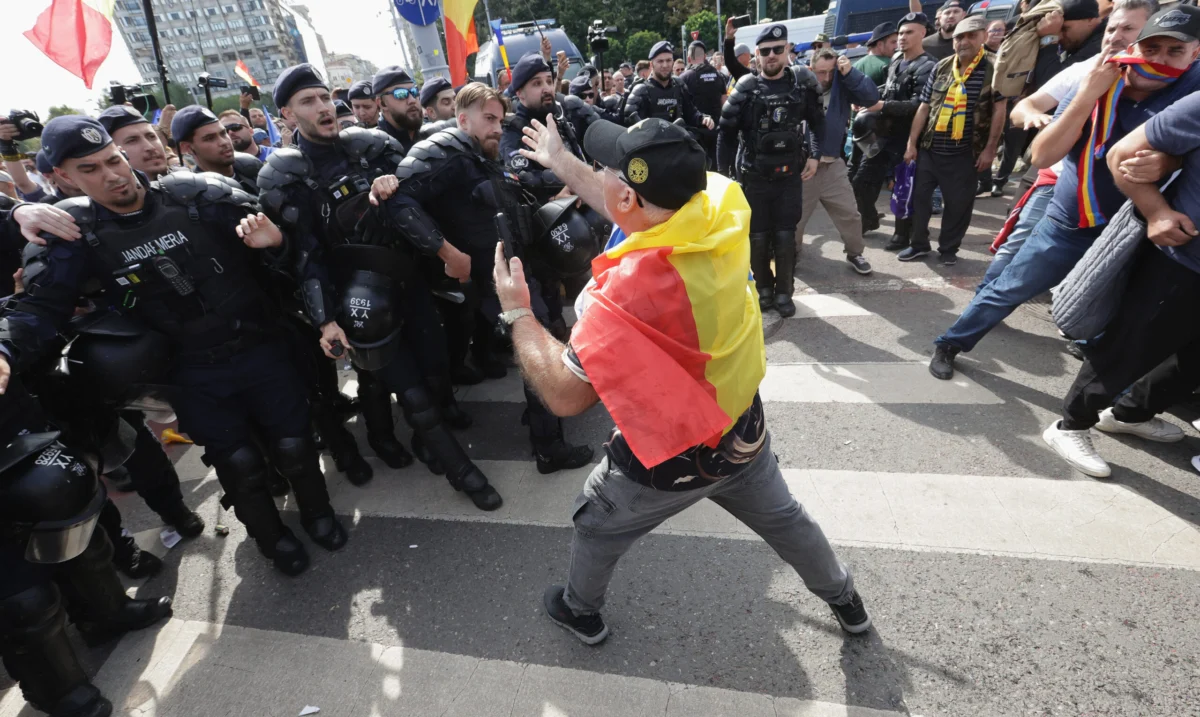
BUCHAREST, Romania – A fiery protest against an extended European Union ban on livestock exports erupted into violent clashes between thousands of Romanian shepherds and farmers and riot police in the capital, Bucharest, leaving dozens injured and numerous arrests. The demonstration, which drew an estimated 2,000 agricultural workers, was amplified by support from far-right political factions, highlighting deepening frustrations within Romania’s crucial agricultural sector.
The unrest unfolded in front of the Romanian government building as protesters, incensed by the prolonged prohibition on live sheep exports, began hurling rocks, metal barriers, and other projectiles at law enforcement officers. The police responded with tear gas in an effort to disperse the increasingly volatile crowd. In the immediate aftermath, authorities reported 26 individuals were detained, with 24 demonstrators and police officers requiring medical attention for injuries ranging from broken bones to the effects of tear gas exposure. Four individuals were subsequently hospitalized.
The ban, initially imposed by the European Commission due to outbreaks of highly contagious diseases such as Peste des Petits Ruminants (PPR) and sheep and goat pox, has been extended through December 31, 2026. Officials attribute the spread of these diseases, in part, to insufficient preventive measures implemented by Romanian authorities. This extended ban directly impacts thousands of shepherds and farmers who rely on live exports for a significant portion of their income, particularly to markets in the Middle East.
The demonstration was meticulously organized by various shepherd and farmer associations, with banners prominently displayed calling for the resignation of the country’s president and prime minister. The protest also became a platform for supporters of far-right politician Călin Georgescu, a former presidential candidate currently facing trial for acts against the constitutional order, to rally. Georgescu’s supporters had actively promoted the protest on social media, urging participation. George Simion, the leader of the prominent far-right group Alliance for the Union of Romanians (AUR), publicly declared his party’s solidarity with the farmers but cautioned for peaceful demonstration.
Farmers’ Grievances Fueling Broader Discontent
The agricultural sector in Romania, a cornerstone of the national economy, has been grappling with a confluence of challenges, including adverse weather conditions, rising operational costs, and what many farmers perceive as inadequate government support. The livestock export ban has become the focal point of this mounting frustration, but it is not the sole grievance.
Farmers in the crop sector are also expressing deep dissatisfaction over compensation for drought-affected crops. They were initially promised 100 euros per hectare, but are now set to receive only 19 euros per hectare. This significantly reduced amount falls far short of covering their substantial losses incurred due to extreme and prolonged drought conditions, further exacerbating economic hardship.
The political landscape in Romania has been tumultuous, marked by high inflation, the EU’s highest, and a persistent political crisis. A pro-European government that implemented austerity measures to curb a high budget deficit was ousted in a no-confidence vote in May. A subsequent period of parliamentary deadlock has prevented the confirmation of a successor, leaving the nation in a state of political uncertainty that many believe amplifies the impact of economic anxieties.
Escalation from Legitimate Grievances to Street Fighting
The Romanian government issued a statement condemning the protest for having "degenerated into regrettable acts of violence" and appealed for "calm." President Klaus Iohannis, through his office, condemned the "extremely serious" violence and "any attempt to turn a legitimate protest into street fighting." This sentiment was echoed by the opposition, which also called for an end to the violence.

This latest eruption of unrest follows similar protests by Romanian shepherds outside the government building at the end of July, also stemming from the EU’s live sheep export ban. The dissatisfaction among agricultural producers is not an isolated phenomenon, mirroring broader farmer protests that have swept across Europe in recent years. These movements often highlight concerns about agricultural policies, environmental regulations, and the economic viability of farming in the face of global market pressures.
The far-right’s involvement in these protests is a recurring theme, with these groups often positioning themselves as champions of rural communities and national interests. Their engagement can mobilize larger crowds and inject a more radical tone into demonstrations, as seen in Bucharest. However, it also raises concerns about the politicization of legitimate economic grievances and the potential for instability.
Impact on Romania’s Agricultural Sector and Beyond
The extended livestock export ban has significant implications for Romania’s agricultural economy. Sheep farming is a traditional and vital part of rural life in many parts of the country, providing livelihoods for thousands of families. The inability to export live animals not only affects immediate income but also disrupts established trade relationships and market access.
For years, Romania has been a key exporter of live sheep, with a substantial portion of its production destined for markets in the Middle East and North Africa. The EU’s stringent biosecurity regulations, while aimed at preventing disease spread, have created substantial economic hurdles for these export-dependent sectors. The current ban, driven by concerns over animal health, forces producers to seek alternative markets or focus on domestic processing, which may not be readily equipped to absorb the surplus.
The violence witnessed in Bucharest is a stark indicator of the desperation felt by many in the agricultural sector. It underscores a breakdown in communication and trust between the farming community and the government, as well as with EU institutions. The perception among many farmers is that their concerns are not being adequately addressed, and that they are bearing the brunt of policies designed to protect public health and animal welfare.
The involvement of far-right groups, while providing a platform for vocal opposition, also risks alienating more moderate voices and potentially undermining the long-term effectiveness of the protest movement. The challenge for Romania’s agricultural sector lies in finding a way to articulate its legitimate concerns constructively and to forge a path toward sustainable solutions that balance economic needs with animal health and welfare.
Looking Ahead: The Road to Resolution
The immediate aftermath of the protest in Bucharest involves continued efforts by authorities to maintain order and address the legal ramifications of the violence. The government faces the dual challenge of managing public dissent while upholding EU regulations and ensuring animal health. For the farmers and shepherds, the fight for their livelihoods is far from over.
The current situation highlights the urgent need for dialogue and collaborative problem-solving. This could involve exploring alternative export strategies, enhancing biosecurity measures to meet international standards, and providing robust financial and technical support to the agricultural sector to help it adapt to evolving regulatory environments and market demands. The long-term stability and prosperity of Romania’s agricultural heartland depend on finding a sustainable balance between these complex, and often competing, imperatives.