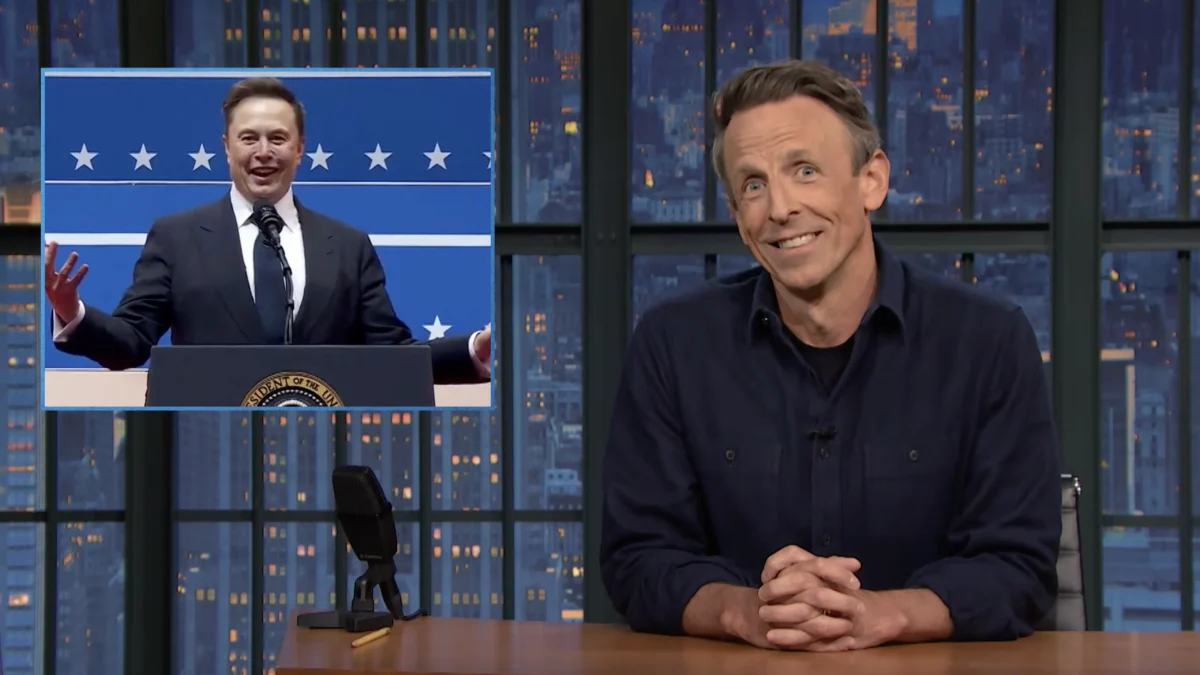
Late-night host Seth Meyers delivered a pointed critique of tech billionaire Elon Musk during a recent broadcast of "Late Night with Seth Meyers," focusing on Musk’s announced plans to produce an artificial intelligence-generated adaptation of Homer’s epic poem, The Odyssey. Meyers joined a growing chorus of media figures and industry professionals questioning the feasibility and creative merit of Musk’s vision, which the Tesla CEO claimed would be a "historically accurate" rendition of the ancient Greek foundational text. The segment highlighted the widening chasm between Silicon Valley’s push for AI-driven entertainment and the traditional creative community’s concerns over intellectual property and artistic integrity.
The controversy began when Musk suggested that his AI company, xAI, could utilize its Grok platform to develop a cinematic experience based on the travels of Odysseus. Musk’s insistence on "historical accuracy" for a work rooted in mythology became the primary target for Meyers’ monologue. The host noted the inherent contradiction in applying rigorous historical standards to a narrative featuring gods, sirens, and a one-eyed cyclops. Meyers’ commentary reflected broader public skepticism regarding the use of generative AI to replace human-led film production, a topic that has remained at the forefront of labor discussions in Hollywood.
During the segment, Meyers expressed immediate doubt about the quality of the proposed project, stating, "Wow, I can’t wait for that to suck." He argued that Musk’s approach would likely result in a hollow imitation of cinema, utilizing technology that relies on the synthesized data of existing human performances. This critique touches on the sensitive issue of "data scraping," where AI models are trained on the work of actors, writers, and directors without explicit consent or compensation, a practice that was a central point of contention during the recent SAG-AFTRA and Writers Guild of America strikes.
Seth Meyers Roasts Elon Musk and the Logic of AI-Generated Content
Meyers’ dismantling of the proposal centered on the technical and narrative limitations of current AI models. He mocked the potential dialogue that an AI-generated Odyssey might produce, comparing it to the often generic and overly helpful tone of chatbots like ChatGPT. By personifying the AI as an eager but ultimately soulless assistant, Meyers illustrated the difficulty of capturing the gravitas and linguistic complexity of Homeric Greek in a machine-learned environment. The host suggested that the nuance of the human experience, which The Odyssey explores through themes of longing, hubris, and homecoming, would be lost in a digital translation.
The late-night host also interrogated the specific phrase "historically accurate" as applied to a myth. Meyers pointed out that The Odyssey is a work of fiction that blends oral tradition with legendary elements. He drew a satirical parallel by asking if Musk intended to create a "historically accurate" version of The Santa Clause, the 1994 Disney film. This comparison served to highlight what critics describe as a fundamental misunderstanding of the humanities by tech leaders who view storytelling primarily as a data-processing problem rather than an artistic endeavor.
Beyond the humor, Meyers’ roast touched on the ethical implications of using "fake actors stolen from real actors." This refers to the process of creating digital twins or synthetic voices that can mimic the likeness and performance style of human performers. In the current media landscape, the protection of one’s "image, likeness, and voice" has become a legal battlefield. Meyers’ comments resonate with industry professionals who fear that the normalization of AI-generated films could lead to the devaluation of human labor and the erosion of copyright protections.
The Role of Grok and xAI in an AI Version of The Odyssey
The technical backbone of Musk’s proposed project is xAI, a company founded to compete with industry leaders like OpenAI and Google. The flagship product, Grok, is designed to be an AI with a "rebellious streak" and a willingness to answer "spicy" questions that other models might avoid. Musk has positioned xAI as a tool for seeking "absolute truth," which may explain his framing of The Odyssey project as "historically accurate." However, the application of a truth-seeking AI to a work of epic poetry has left many literary scholars and tech analysts puzzled.

Industry analysts suggest that Musk’s foray into AI-generated media is part of a larger strategy to transform his social media platform, X, into an "everything app" that includes original content. By bypassing traditional Hollywood studios and using internal AI tools, Musk could theoretically produce high-budget-looking content at a fraction of the cost. This prospect is particularly alarming to creative unions, who see it as a direct threat to the ecosystem of actors, set designers, and cinematographers. The "historically accurate" AI version of The Odyssey serves as a high-profile test case for whether AI can sustain a long-form narrative that resonates with audiences.
The skepticism voiced by Meyers is mirrored by other figures in the entertainment industry. Colman Domingo, serving as a guest host on Jimmy Kimmel Live!, also addressed Musk’s proposal, suggesting that the tech mogul’s entrance into the film world was unwelcome. The consistent pushback from late-night television indicates a broader cultural resistance to the idea that AI can replicate the collaborative spirit of a film set. Critics argue that while AI can generate impressive still images or short clips, it lacks the intentionality required to direct a cohesive feature-length film.
Analyzing the Feasibility of a Historically Accurate AI Film
From a technical standpoint, creating a "historically accurate" AI version of The Odyssey presents significant hurdles. While AI can be fed historical data regarding Bronze Age Mediterranean architecture, clothing, and seafaring technology, the translation of that data into a cinematic narrative requires a level of creative judgment that current generative models struggle to achieve. There is also the issue of "hallucinations," where AI generates factually incorrect or visually distorted information. In a project branded as "historically accurate," such errors would be particularly glaring.
Furthermore, the "uncanny valley" effect—where human-like digital figures appear slightly "off" to viewers—remains a major obstacle for AI-generated cinema. Meyers’ prediction that the project would "suck" likely refers to the visual and emotional disconnect often found in synthetic media. If the characters in The Odyssey lack the subtle emotional cues of human actors, the epic’s emotional stakes may fail to land with the audience. This technical limitation is why many in Hollywood believe that AI will remain a tool for visual effects rather than a replacement for directors and actors.
The debate also extends to the philosophical nature of "accuracy" in ancient texts. There is no single "accurate" version of The Odyssey; it is a poem that evolved through centuries of oral performance before being transcribed. By claiming historical accuracy, Musk may be attempting to appeal to a demographic that values "traditional" storytelling, yet the method of production—using cutting-edge, disruptive technology—is anything but traditional. This paradox is a recurring theme in Musk’s various business ventures, which often claim to protect the past while aggressively digitizing the future.
Broader Implications for the Future of AI in Hollywood
The reaction to Seth Meyers’ roast of Elon Musk indicates that the public remains deeply divided over the role of technology in the arts. As AI tools become more sophisticated, the pressure on traditional media companies to adopt these technologies will likely increase. However, the backlash from figures like Meyers suggests that there is a significant market for human-centric content that AI cannot easily satisfy. The "authenticity" of a human performance remains a primary selling point for the global film industry.
Legal challenges are also expected to mount as Musk and others move forward with AI-generated projects. If an AI version of The Odyssey uses the likenesses of actors without permission, it could trigger lawsuits under new "Right to Publicity" laws currently being debated in various state legislatures and at the federal level. The outcome of these legal battles will determine whether AI-generated films become a viable commercial product or remain a niche experiment relegated to social media platforms.
As the entertainment industry navigates this transition, the role of late-night comedy as a cultural watchdog remains vital. By using humor to point out the absurdities of "historically accurate" AI myths, Seth Meyers and his peers provide a necessary critique of tech-driven narratives. The skepticism expressed on "Late Night" serves as a reminder that while technology can change how stories are told, the value of the story itself is still judged by its ability to connect with the human spirit—a feat that AI has yet to master.