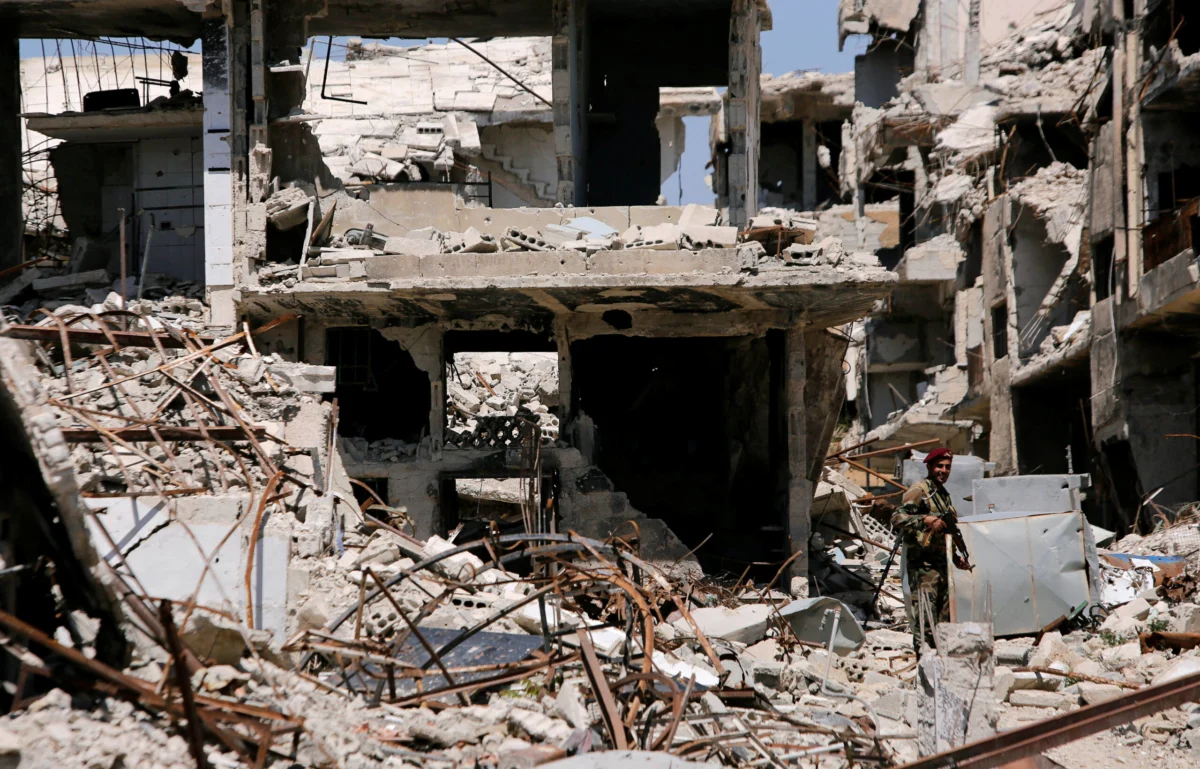
Jobar, Syria – In the eastern suburbs of Damascus, the skeletal remains of buildings in Jobar tell a stark story of devastation and the arduous path to recovery. Ahmad, a Syrian man in his mid-30s, navigates the rubble-strewn streets, pointing to a small, dilapidated house. "That was my grandfather’s house," he shared, requesting anonymity due to his precarious situation. Nearby stand the remnants of his mother’s home and the small shop where she once sold clothing. Before the outbreak of the Syrian civil war in 2011, Jobar was a vibrant community, a place of historical significance boasting a mosque and a synagogue. Today, it is a ghost town, a testament to years of relentless shelling, air strikes, and the use of chemical weapons.
The neighborhood became a critical frontline between 2012 and 2018, when it was largely under rebel control. Government forces subjected Jobar to sustained bombardment, leading to the destruction of approximately 95 percent of its structures. When Syrian government forces recaptured the Damascus suburbs in 2018, the area was largely emptied of its civilian population. Now, Jobar presents a formidable post-war challenge for both the new Syrian government and its displaced citizens, who are grappling with the complexities of reconstruction and the possibility of returning to their ancestral homes.
The Labyrinthine Legacy of Jobar’s Tunnels
During the intense fighting, opposition groups carved out an intricate network of tunnels beneath Jobar. These underground passages served as a vital defense against the regime’s aerial bombardments and shelling. The labyrinthine nature of these tunnels led residents to dub the area "the Bermuda Triangle," a moniker reflecting the disorientation and potential for inhabitants to become lost within its subterranean depths.
In 2018, a deal was brokered between the regime and opposition factions. This agreement allowed fighters, their families, and other civilians to evacuate the area, with many relocating to rebel-held Idlib. The government subsequently imposed a ban on civilians re-entering Jobar. However, following the opposition’s takeover of Damascus in December 2024 and the subsequent flight of President Bashar al-Assad, some former residents began returning to survey the damage to their properties for the first time in eight years.
Salem Sawan, 59, a former medic also known as Abu Yehya, now rents an apartment in a nearby suburb. He expressed a strong desire to return to his home but, like many other locals, faces significant obstacles to rebuilding. "Residents have been blocked from rebuilding," he stated. Ahmad, during a tour of the area, indicated a large tunnel entrance that had recently been filled with dirt and debris. "The government must have closed this recently," he observed, suggesting official intervention in sealing off the underground network.
The subterranean infrastructure has contributed to ongoing safety concerns. Reports have emerged of individuals becoming lost within the extensive tunnel system, and there are also documented instances of building collapses attributed to the compromised ground beneath them. The combination of the underground network, a severe lack of basic infrastructure, and ongoing mine clearance operations underscores the immense difficulties Syria faces in its broader reconstruction efforts.
Monumental Hurdles in Rebuilding Jobar
A primary impediment to reconstruction in areas like Jobar is the scarcity of financing. The prolonged conflict and the preceding years of Bashar al-Assad’s rule left the nation’s infrastructure in ruins and its economy crippled. Compounding these issues were international sanctions, although the new Syrian government has reportedly made progress in their removal.
The World Bank has estimated the total reconstruction cost for Syria at approximately $216 billion, a staggering figure given that nearly 90 percent of the Syrian population currently lives below the poverty line. "The need for reconstruction is really big, and if a specific neighborhood has no infrastructure at all, the question is how to channel money into reconstruction," explained Cao Yue, author of a recent report on Syria’s reconstruction for ODI Global, a UK-based think tank. "We know the government has a limited public budget, so they have targeted international capital, and especially international private capital, and that’s why there’s been an effort to cut agreements with international investors, especially from neighboring countries."
During a guided tour of Jobar, Ahmad pointed to a building with a gaping hole where its facade once stood. The multi-story structure has lost its floors, a consequence of the theft of iron rods that once provided structural integrity. This widespread looting of building materials has become a common sight in devastated areas.
Notably, Mohammad Hamsho, a former business partner of Bashar al-Assad’s brother Maher al-Assad, has been subject to U.S. and EU sanctions for alleged war profiteering and ties to the former regime. One of his companies has faced repeated accusations of extracting iron from destroyed areas for steel production. In January 2026, Hamsho reportedly reached a financial settlement with the new Syrian government, now led by President Ahmed al-Sharaa.
Locals like Ahmad and Abu Yehya have reported being informed by officials that they are prohibited from rebuilding their homes, even if they possess the means to do so. When questioned about the reasons, they were informed of a broader development plan for the area, but no specific details were provided. This lack of transparency fuels frustration and uncertainty among returning residents.
Development Plans and Displaced Aspirations
There are growing indications that both the government and private developers are eyeing areas like Jobar for investment. Its strategic geographic proximity to central Damascus makes the land inherently valuable. Media reports suggest that local officials have proposed a foreign-backed project valued at $21 billion, with the potential to create up to 200,000 jobs.
However, this ambitious plan carries significant implications for the existing residents. The proposal reportedly stipulates that locals would only receive 50 percent of their former home entitlements and 30 percent of areas classified as "agricultural." When this plan was presented to local councils and community activists, it was met with widespread anger and opposition, highlighting a deep rift between development ambitions and the rights of displaced populations.
This ongoing tension between governmental development strategies and the aspirations of local residents lies at the heart of Syria’s struggle to define its future. "People need housing, but also need basic services like education, sanitation, water, electricity, and governance," stated Mauricio Vazquez, Head of Policy at ODI’s Global Risks and Resilience program and a co-author of the report. Vazquez emphasized that the challenge extends beyond mere physical reconstruction, focusing on "ways to build back societies that are better for Syria."
For individuals like Abu Yehya, the desire to rebuild remains strong, despite the physical toll of his past experiences. During the war, he frequently had to retrieve wounded individuals and bodies amidst active conflict. These experiences have left him with back problems, including two slipped discs, rendering him unable to lift heavy objects. "If a body is 70 kg alive, it’s 140 dead," he quipped grimly, underscoring the physical demands of such work. This has made it impossible for him to earn a living.
"Anyone who doesn’t have a child outside [Syria] will die," he lamented, sitting near the local cemetery, which is filled with the graves of former neighbors and friends. Yet, the spirit of reclaiming his home in Jobar persists.
Mahmoud al-Ajouz, a gravedigger in his 60s, stands nearby. He never abandoned Jobar, even after losing his children to the conflict and facing evacuation orders from the regime and its allies. When asked about the prospects of reconstruction, al-Ajouz expressed unwavering optimism. "We will rebuild with our own hands," he declared, adding, "us and the state together." This sentiment reflects a deep-seated resilience and a yearning for a restored community, even as the path forward remains fraught with uncertainty and competing interests.