T-Mobile customers across the United States reported a massive service disruption on Monday afternoon, with tens of thousands of users finding their mobile devices locked in "SOS mode." The sudden T-Mobile outage, which began surfacing in the late afternoon hours of July 27, 2026, left a significant portion of the carrier’s subscriber base unable to make standard calls, send text messages, or access cellular data services. The disruption hit major metropolitan hubs and rural areas alike, sparking widespread concern over the reliability of the nation’s telecommunications infrastructure during peak business hours.
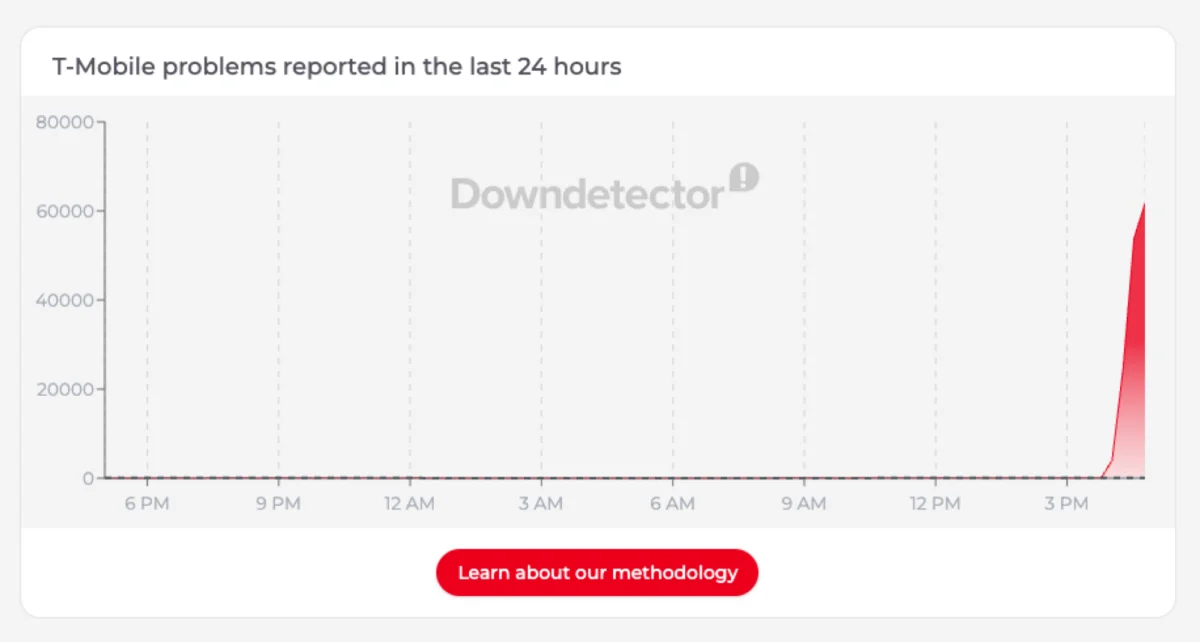
The scale of the technical failure became apparent as reports flooded crowdsourced monitoring platforms. According to data from Downdetector, user-submitted error reports began to spike sharply at approximately 3:48 p.m. ET. By 5:15 p.m. ET, the number of confirmed reports had surged past 64,000, with the trajectory of complaints continuing to climb as the evening commute began on the East Coast. The majority of affected users categorized their issues as having "No signal" or a complete failure of "Mobile phone" functionality, indicating a potential systemic collapse of core network routing or authentication servers.
The Rapid Escalation of the T-Mobile Outage
As the T-Mobile outage progressed, the geographic concentration of the reports suggested a nationwide impact rather than a localized equipment failure. Heat maps indicated heavy concentrations of service loss in New York City, Chicago, Los Angeles, Atlanta, and Dallas. For many, the first sign of trouble was the disappearance of the familiar 5G or LTE icons in the top corner of their smartphone screens, replaced by the ominous "SOS" or "SOS Only" indicator. This transition typically occurs when a device cannot connect to its home network but remains within range of another carrier’s towers for emergency purposes.
The timing of the event exacerbated the frustration of the user base. Occurring on a Monday afternoon, the disruption interrupted remote work sessions, ride-sharing services, and digital payment systems that rely on constant cellular connectivity. In an era where mobile devices serve as the primary gateway for both professional and personal logistics, the sudden loss of service highlighted the precarious nature of modern digital dependence. Retailers reported issues with point-of-sale systems that utilize cellular backups, and commuters found themselves unable to access navigation apps or transit schedules.
Understanding SOS Mode and Emergency Connectivity
The appearance of SOS mode on iPhones and Android devices is a specific protocol designed for public safety, yet its appearance during the T-Mobile outage caused significant confusion among the general public. When a phone displays "SOS," it signifies that the device is not registered with its primary service provider but is still capable of placing emergency calls to 911. This is made possible through a regulatory framework that requires all cellular carriers to carry emergency traffic from any compatible device, regardless of the user’s subscription status or network affiliation.
While SOS mode ensures that the most critical life-safety functions remain active, it leaves the user disconnected from all other forms of communication. During this specific T-Mobile outage, searches for "what is SOS mode" and "T-Mobile down" surged on Google and other search engines as customers sought to understand why their devices had suddenly become restricted. The technical reality is that while the T-Mobile "handshake" between the device and the tower was failing, the hardware remained functional enough to detect signals from competing networks like AT&T or Verizon, which are then reserved exclusively for emergency routing.
Timeline of the Disruptions
The chronological progression of the T-Mobile outage suggests a rapid-onset event rather than a gradual degradation of service. Following the initial spike at 3:48 p.m. ET, the volume of reports doubled every fifteen minutes for the first hour. By 4:30 p.m. ET, social media platforms, particularly X (formerly Twitter), were inundated with screenshots of disconnected phones and queries directed at the carrier’s official support accounts. Many users reported that toggling Airplane Mode or restarting their devices—standard troubleshooting steps—offered no resolution to the problem.
By 5:00 p.m. ET, the outage had reached a critical mass that drew the attention of industry analysts and federal regulators. Historically, outages of this magnitude are often traced back to software updates within the core network, fiber optic cable cuts, or issues with the Border Gateway Protocol (BGP) that directs internet traffic. However, in the early hours of the event, T-Mobile remained silent regarding the root cause. The lack of an immediate official statement from the company’s headquarters in Bellevue, Washington, led to a vacuum of information that was quickly filled by speculation and user-driven troubleshooting forums.
The Digital Fallout and Social Media Reaction
The social media reaction to the T-Mobile outage was swift and multifaceted. On X and Reddit, the hashtag #TMobileDown began trending nationally within an hour of the first reports. Users shared their locations and device types in an effort to find patterns in the disruption. Some noted that while their physical SIM cards were failing, their eSIM configurations remained active, while others reported the exact opposite. This inconsistency suggested that the issue might be related to the subscriber database or the authentication modules that verify a user’s identity on the 5G network.

Beyond the technical complaints, the outage sparked a broader conversation about the "single point of failure" in the modern household. With many consumers having moved away from traditional landline telephones, a cellular outage of this scale effectively cuts off entire families from the outside world. Parents expressed concern over being unable to reach their children during after-school activities, and caregivers noted the danger of being unable to monitor medical alert systems that rely on cellular bridges.
Infrastructure Vulnerabilities in the 5G Era
The T-Mobile outage brings to light the inherent complexities of the 5G era. As carriers have aggressively expanded their 5G footprints, the underlying architecture has become increasingly reliant on cloud-native software and complex virtualization. While these advancements allow for faster speeds and lower latency, they also introduce new vectors for systemic failure. A single misconfiguration in a software-defined network can propagate through the entire system in milliseconds, leading to the kind of nationwide "blackout" observed on Monday.
Industry experts point out that the transition to "Standalone 5G" (SA)—a goal T-Mobile has pursued more aggressively than its competitors—means the network no longer relies on older 4G LTE infrastructure for signaling. While this improves performance, it also means that if the 5G core experiences a glitch, there is no "legacy" layer for the phones to fall back on for standard voice and data. This may explain why so many devices defaulted directly to SOS mode, as they were unable to find any viable T-Mobile signaling layer to latch onto.
Regulatory Oversight and the Path to Restoration
Nationwide disruptions of this scale typically trigger inquiries from the Federal Communications Commission (FCC). The agency monitors "Major School and Residential Outages" and requires carriers to file detailed reports when service is interrupted for a significant number of users for a specific duration. The primary concern for regulators is always the integrity of the 911 system. Even though SOS mode is designed to mitigate this risk, the confusion caused by a mass outage can lead to an influx of non-emergency calls to 911 dispatchers as users test their phones, potentially clogging emergency lines.
In previous instances of major carrier failures, the FCC has investigated whether the companies maintained adequate redundancy and whether their notification systems were sufficient to inform the public of the crisis. For T-Mobile, the focus of future investigations will likely be on the speed of their public response and the technical safeguards that were or were not in place to prevent a localized issue from cascading into a national event. As of the late afternoon, the company had not yet provided a definitive timeline for full service restoration.
Impact on the Business and Gig Economy
The economic impact of the T-Mobile outage extends far beyond the inconvenience of missed social calls. The "gig economy," which powers a significant portion of the modern U.S. labor market, is entirely dependent on mobile connectivity. Delivery drivers for platforms like Instacart and Grubhub found themselves unable to complete orders or navigate to drop-off locations. Similarly, ride-share drivers were forced to pull over, unable to accept new fares or communicate with current passengers.
Small businesses that utilize T-Mobile for their primary internet connectivity or as a backup for their credit card processors also faced immediate financial losses. In an increasingly cashless society, the inability to process transactions for even a few hours can result in thousands of dollars in lost revenue. This event serves as a stark reminder for business owners to consider multi-carrier redundancy or "failover" systems to protect against the volatility of a single provider’s network.
Moving Toward a Resolution
As the evening progressed, some users began to report a sporadic return of service, suggesting that T-Mobile engineers were beginning the process of re-routing traffic or restarting affected nodes. However, the recovery process for a cellular network is rarely instantaneous. Once the "core" is fixed, there is often a "thundering herd" effect where millions of devices attempt to re-authenticate at the same time, potentially creating a secondary wave of congestion.
T-Mobile’s technical teams are expected to work through the night to stabilize the environment and ensure that the "SOS mode" indicators are replaced by active signal bars for all subscribers. Until a full post-mortem is released, the exact nature of the glitch remains internal company data. For the millions of affected users, the incident remains a frustrating disruption that underscores the fragility of the invisible signals that power modern life. The company is expected to issue a formal statement once the service levels return to a baseline of 100% stability across all impacted regions.