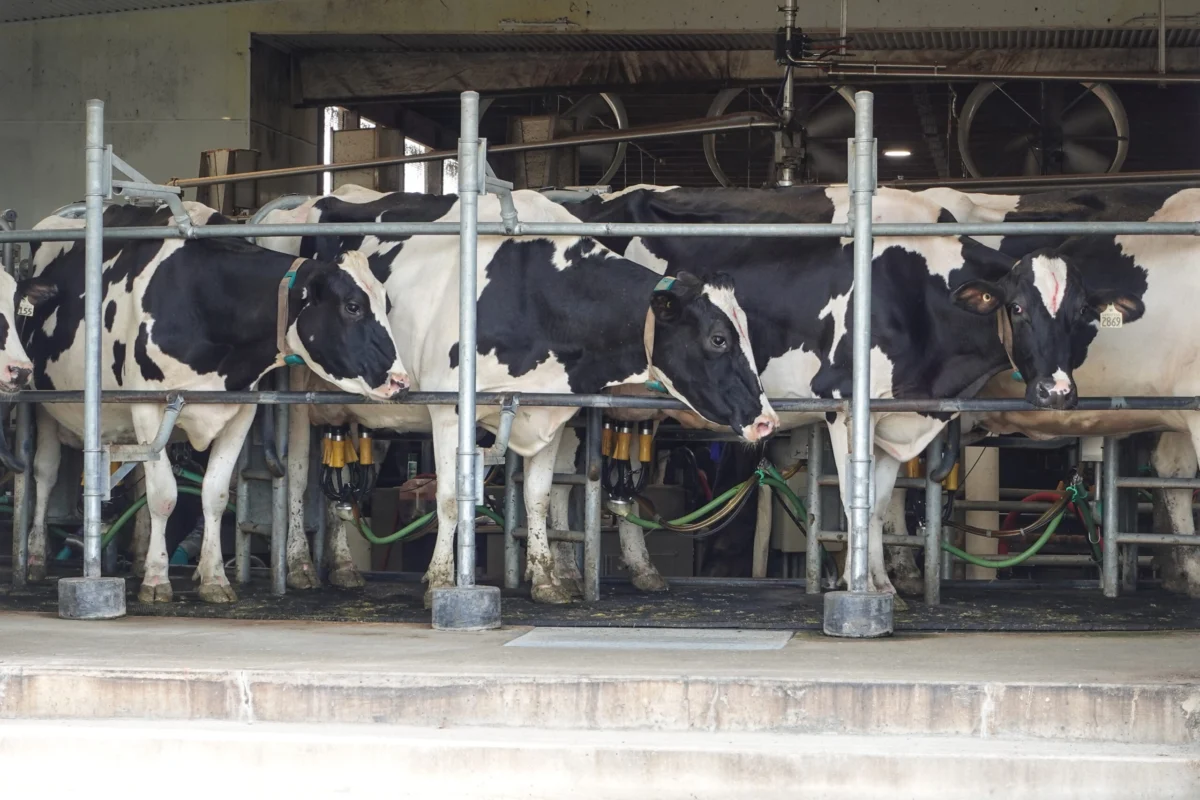
Abbotsford, British Columbia – The flow of raw milk from Casey Pruim’s farm, a consistent 28,000 liters every second day, is built upon a predictable distribution system. This steady supply chain, crucial for both domestic consumption and exports to the United States, has been severely disrupted by the recent imposition of significant U.S. tariffs on Canadian dairy products. The retaliatory measures, part of an escalating trade dispute, have brought sales across the border to a near standstill, creating immediate financial pressure on Canadian producers.
Pruim, who also chairs the British Columbia Dairy Association, representing approximately 400 farmers in the province, explained that individual farmers do not control export decisions. Instead, producers like Pruim, whose operation milks 330 cows three times daily, sell their milk into a provincial marketing system. This system allocates milk to processors based on demand, including the portion destined for export markets such as the United States.
When processors face a sudden drop in U.S. demand due to prohibitive tariffs, their need for raw milk diminishes. This reduction in demand is then disseminated throughout the provincial milk pool, impacting all participating farmers. The ripple effect of these trade actions underscores the interconnectedness of the dairy industry and its vulnerability to geopolitical trade disputes.
"If the processor who’s exporting some of his product to the United States can no longer sell into that market because he’s now priced out of the market with a 50 percent tariff, that’s how it would impact the dairy farm," Pruim stated. The uncertainty surrounding the long-term implications of these tariffs is a significant concern for the industry.
Dylan Kruger, director of public affairs at BC Dairy, acknowledged the considerable uncertainty surrounding the impact of the U.S. tariffs. He noted that it remains too early to fully assess the industry’s response or determine if displaced milk could be rerouted to alternative markets to mitigate financial losses. However, the immediate consequence has been a palpable sense of instability for businesses reliant on cross-border trade.
The Perilous Nature of Perishable Goods in Trade Wars

The dairy sector’s particular susceptibility to tariff disputes stems from the inherent perishability of its products. Milk must be collected on a strict schedule and processed by facilities whose demand can fluctuate far more rapidly than agricultural production can be adjusted. This creates a challenging environment for farmers, who cannot simply turn off the milk supply.
"Cows aren’t like a tap; you can’t just turn them on or off," Pruim emphasized, highlighting the stark reality of dairy farming. In a worst-case scenario, processors facing reduced demand might be forced to discard milk, a significant economic loss. Should these conditions persist, farmers may face the difficult decision of reducing their herds, a drastic measure with long-term consequences for their livelihoods and the industry.
David Wiens, president of Dairy Farmers of Canada, characterized the tariffs as "completely unwarranted" and warned of their detrimental effect on the entire supply chain, impacting both Canadian and U.S. markets. The disruption extends beyond the farm gate, affecting processors, distributors, and ultimately, consumers.
Navigating the Supply Management System
The recent trade tensions have brought Canada’s dairy supply management system into sharp focus. This national agricultural policy, designed to ensure stable and predictable prices for farmers while maintaining domestic supply, utilizes production quotas and import controls, including tariffs. It has been a cornerstone of Canadian dairy policy for decades, aiming to shield producers from the volatile price swings common in global commodity markets.
However, the system has long been a point of contention with the United States. U.S. officials, including former President Donald Trump, have frequently criticized Canada’s supply management as protectionist and a barrier to American dairy exports. Trump’s public statements accused Canada of "ripping off the United States" and imposing "ridiculously high tariffs" that disadvantage U.S. farmers.
Canadian producers counter these assertions, arguing that the existing trade agreement, the Canada-United States-Mexico Agreement (CUSMA), already grants substantial tariff-free access for U.S. imports, which has not been fully utilized. Data from the Dairy Processors Association of Canada indicates a significant growth in Canada’s dairy trade deficit with the U.S. since CUSMA’s implementation on July 1, 2020.
In 2020, Canada exported C$241.3 million ($173 million) in dairy products to the U.S. and imported C$647.4 million ($462.7 million) worth of dairy and dairy-derived products. By 2025, Canadian dairy exports had climbed to C$308.7 million ($220.7 million), while imports from the U.S. more than doubled to C$1.355 billion ($968.5 million). This surge in imports represented 13.8 percent of the total value of U.S. dairy exports, according to the association’s figures.

Economic Repercussions and Market Realities
The immediate shock of losing a major export market like the United States presents a formidable challenge for Canadian dairy producers. Finding replacement buyers for their products cannot happen overnight, especially given the logistical complexities and the need for new market access.
Bryan Yu, chief economist at Central 1 credit union, cautioned that "there is going to be pain in the near term for a lot of our producers." He elaborated that adapting to a 50 percent tariff is exceptionally difficult, as it pushes Canadian products out of the U.S. market, particularly for producers operating with thin profit margins.
Yu suggested that while Canadian consumers might absorb some of the surplus milk, and exporters might seek new markets, these adjustments are neither instantaneous nor without cost. The search for alternative global markets for dairy products, especially chilled items, depends on identifying new buyers and navigating potentially different regulatory environments.
Canada’s Retaliatory Measures and Broader Economic Impact
In response to the U.S. tariffs, Canada implemented its own retaliatory measures, effective September 8, targeting approximately $20 billion worth of U.S. products. Dairy items are among the goods subjected to these new tariffs, including a 50 percent levy on milk, cream, and whey products, and a 25 percent tariff on many U.S. cheeses.
Canadian Prime Minister Mark Carney framed these retaliatory tariffs as a necessary step to protect Canadian workers, farmers, families, and businesses, vowing to match Washington’s measures "dollar for dollar." This approach aims to demonstrate Canada’s resolve in trade negotiations and mitigate the immediate economic fallout.
However, retaliatory trade actions carry their own set of risks. A report by Oxford Economics suggested that while these tariffs might benefit some specific industries, they could ultimately harm most sectors and weaken overall economic growth by increasing costs for both producers and consumers across Canada.

For perishable goods like dairy, geographical proximity remains a critical factor. Products that once moved seamlessly across the U.S. border cannot be easily redirected to distant markets without significant investment in new logistics, identifying new buyers, and securing necessary regulatory approvals. These are not immediate solutions for a sector facing an urgent crisis.
Seeking New Markets and Navigating Uncertainty
Ottawa’s Trade Commissioner Service is actively advising affected companies. They are encouraged to review their compliance with CUSMA, explore available relief programs, and connect with trade commissioners to identify potential new markets. This outreach aims to provide practical support and guidance during a challenging period.
Yu anticipates that a resolution to the tariff dispute might emerge in the coming months, but the interim period is likely to be marked by "higher prices, weaker economic activity, and deeper mistrust" between the two trading partners. This period of instability could have lasting effects on the bilateral trade relationship.
For farmers like Casey Pruim, the overarching uncertainty is as destabilizing as the tariff threat itself. "I think, like [for] any Canadian, it’s disappointing to have these trade talks collapse again and just the uncertainty around it," he expressed. The inability to plan for the future, coupled with the immediate financial pressures, creates a difficult operating environment for Canadian dairy farmers. The long-term consequences of these trade disruptions will likely unfold over the coming months and years, impacting not only the agricultural sector but also broader economic ties between Canada and the United States.