The widespread disruption began Tuesday afternoon following a major technical failure at the National Air Traffic Services (Nats), the United Kingdom’s primary provider of air traffic control services. The glitch, which paralyzed flight processing systems for several hours, resulted in the cancellation of more than 1,000 flights by 8 p.m. local time, leaving travelers at major hubs including London Heathrow and Gatwick in a state of prolonged uncertainty. Aviation experts suggest the ripple effects of the stoppage will be felt across the global aviation network for several days as airlines struggle to reposition aircraft and crews.
The technical issue forced Nats to restrict the flow of aircraft into and out of British airspace to maintain safety, a move that effectively grounded hundreds of planes during one of the busiest periods of the week. While Nats engineers identified and implemented a fix approximately four hours after the initial failure, the sheer volume of delayed traffic created a massive backlog. By the time the system was restored, the damage to flight schedules was extensive, affecting not only domestic travel but also international routes connecting the U.K. to Europe, North America, and Asia.
The Immediate Impact of the UK Air Traffic Control Problem
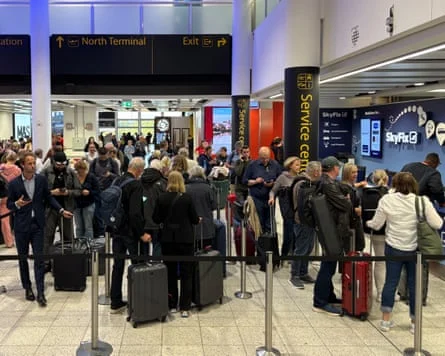
The scale of the disruption became apparent within minutes of the system failure at 1 p.m. on Tuesday. According to data provided by the flight monitoring website Flightradar24, the "technical issue" triggered a cascade of cancellations across the country’s most critical infrastructure. At London’s Heathrow Airport, the busiest in Europe, arrivals were suspended late into the evening, while departures were allowed to resume only under significant restrictions. Gatwick, Manchester, Birmingham, Edinburgh, and Belfast airports all reported similar levels of chaos, with terminal floors filled with passengers awaiting news of their flights.
Major carriers bore the brunt of the operational meltdown. EasyJet led the cancellation figures with 137 flights scrubbed from the schedule by late afternoon, followed closely by British Airways with 111 cancellations. Other international airlines, including KLM, Eurowings, and Ryanair, were also forced to cancel dozens of flights as the U.K. airspace became a bottleneck. British Airways warned that the severity of the incident meant that operations would likely be hampered through Wednesday and potentially into the weekend, prompting the airline to offer free rebooking services to affected customers.
Anatomy of a Technical Failure: What Went Wrong at Nats
At the heart of the crisis was a failure in the flight processing system, the digital architecture that handles flight plans and coordinates the movement of aircraft through various sectors of controlled airspace. When this system fails, air traffic controllers are often forced to move to manual input methods, which significantly reduces the number of aircraft they can safely manage at any given time. This "flow management" is a standard safety protocol, but on a scale as large as the U.K. network, it results in immediate and total gridlock.
Nats Chief Executive Martin Rolfe addressed the public via Sky News, acknowledging the gravity of the situation and expressing "huge sympathies" to those caught in the turmoil. Rolfe confirmed that the agency had taken full responsibility for the failure but maintained that such events are relatively rare. He explained that the recovery process was "very complex" because it required synchronized efforts between airports and airlines to clear the massive volume of aircraft that had been displaced or held at foreign gates.
The spokesperson for Nats clarified that while the system is now "starting to recover," it would take time to return to normal operations. Notably, the agency stated that this specific fault was not identical to the high-profile outages that occurred in 2023 and early 2025. However, the recurring nature of these "isolated events" has led to a growing lack of confidence among industry stakeholders regarding the resilience of the U.K.’s aviation technology.
Industry Fury and Calls for Leadership Resignation
The reaction from the airline industry was swift and unsparing. Executives from major carriers expressed outrage that a "critical national infrastructure provider" could suffer its third major stoppage in just over three years. Ryanair, the Dublin-based low-cost carrier, was particularly vocal in its criticism, with Chief Operating Officer Neal McMahon calling the incident an "abhorrent failure." McMahon reiterated his company’s previous demands for Martin Rolfe to step down, arguing that the U.K. government must appoint a leader capable of maintaining a stable air traffic control system.

Ryanair reported that more than 65,000 of its passengers experienced delays on Tuesday alone. Wizz Air echoed these sentiments, stating that Nats is "simply not fit for purpose in its current form." The airline argued that the repeated standstills are unacceptable for a modern aviation hub and called for a top-to-bottom overhaul of the service provider. For airlines, the cost of such failures is not merely reputational; they are often legally required to provide meals, hotel accommodations, and alternative transportation for stranded passengers, costs that can run into the tens of millions of dollars.
A History of Systemic Instability in British Airspace
This latest UK air traffic control problem follows a series of technical embarrassments for Nats. In August 2023, a massive system failure occurred on a bank holiday Monday, one of the busiest travel days of the year, leading to a parliamentary inquiry. That incident was eventually traced back to a single rogue flight plan that contained duplicate waypoints, which caused the entire system to shut down as a safety precaution. Another "isolated event" occurred in July 2025, further damaging the agency’s reputation.
The frequency of these glitches has raised questions about the age and adequacy of the software used to manage some of the world’s most congested airspace. While Nats has invested in modernization programs, critics argue that the pace of upgrades has not kept up with the increasing density of air traffic. The recurring nature of these failures has also drawn the attention of the Civil Aviation Authority (CAA), which oversees Nats’ performance and has the power to impose financial penalties for service interruptions.
The Passenger Experience: Stranded Travelers and Legal Recourse
For the hundreds of thousands of passengers affected, the technical explanation provided by Nats offered little comfort. Social media was flooded with images of families sleeping on airport floors and long queues at customer service desks. Many travelers were caught in a "knock-on" effect where their flights were cancelled because the incoming aircraft was stuck at a different airport. This logistical nightmare meant that even after the UK air traffic control problem was fixed, the recovery was far from instantaneous.
Under U.K. air passenger rights regulations (often referred to as UK261), airlines have a "duty of care" toward their customers during such disruptions. This includes providing food and drink vouchers, as well as overnight accommodation if a flight is delayed until the following day. However, because the air traffic control failure is considered an "extraordinary circumstance" beyond the airline’s control, passengers are generally not entitled to additional financial compensation for the delay itself. This distinction has long been a point of contention for travelers who feel the current system leaves them financially burdened by missed connections or lost hotel bookings at their destinations.
Future Outlook and Governmental Accountability
The political fallout from Tuesday’s events is expected to be significant. Transport Secretary Heidi Alexander confirmed that she has been in contact with Nats technicians and is seeking "assurances that lessons will be learned." Alexander expressed her apologies to the public and emphasized that the systems supporting U.K. aviation must be robust enough to handle the demands of a global transport hub.
Members of Parliament are expected to call for further hearings to investigate why the safeguards put in place after the 2023 crisis failed to prevent this latest outage. There are growing calls for Nats to be subjected to more stringent regulatory oversight or for the government to reconsider the current public-private partnership model that governs the agency. As the aviation industry moves toward increasingly automated and digital systems, the need for a fail-safe air traffic control network has never been more pressing.
As the week progresses, the focus will shift from immediate crisis management to a long-term post-mortem of the failure. Airlines will continue to count the financial cost, while hundreds of thousands of passengers will be left wary of the next time a "technical issue" at Nats brings the nation’s skies to a standstill. For now, the U.K. aviation sector remains in a state of high alert, working through the night to clear a backlog that has once again highlighted the fragility of modern travel infrastructure.