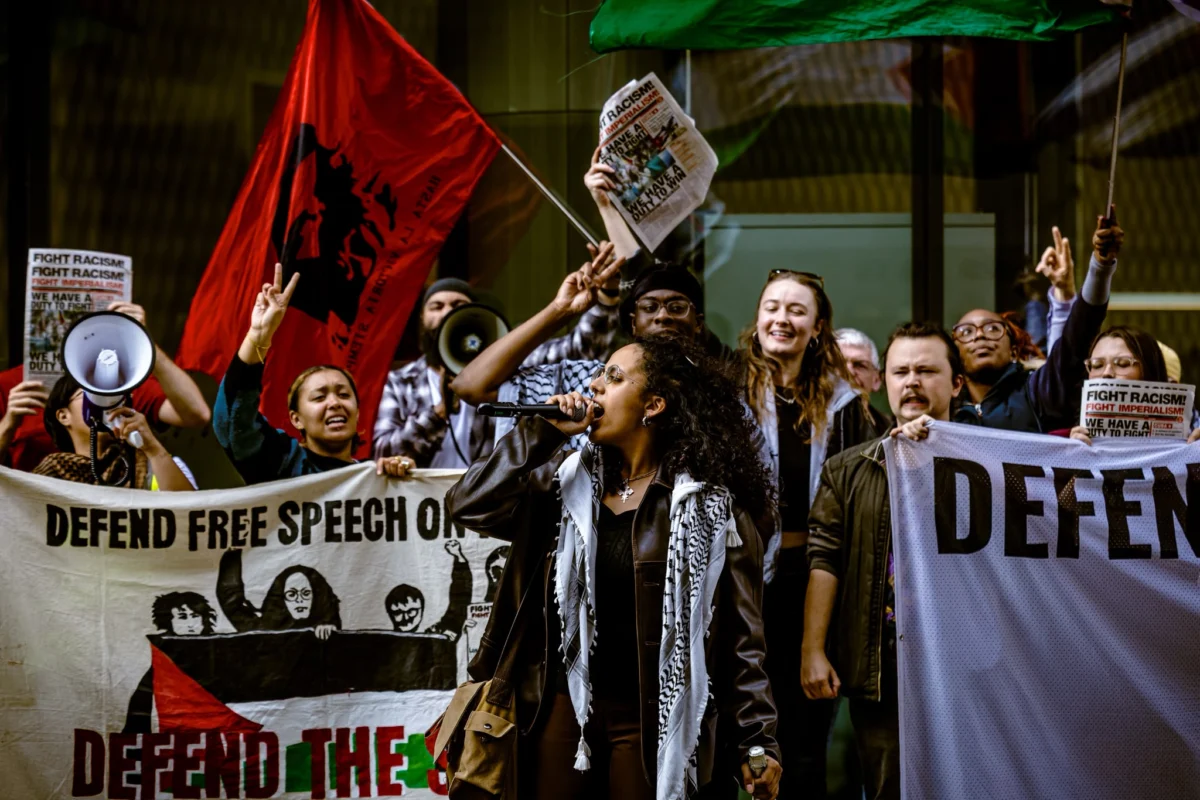
A London jury has found Sarah Cotte, 22, not guilty of expressing support for the Palestinian militant group Hamas during a speech delivered outside her university in October 2023, a ruling that underscores the complexities surrounding free speech, political dissent, and the legal definition of support for proscribed organizations in the United Kingdom. The acquittal came Friday at the Old Bailey, officially known as the Central Criminal Court, after a week-long trial that centered on Cotte’s interpretation of "resistance" versus explicit endorsement of a group designated as terrorist under British law.
The prosecution had argued that Cotte’s words, spoken just two days after Hamas carried out its unprecedented attacks on Israel, constituted support for the organization. Specifically, prosecutors pointed to her expression of "unconditional solidarity" with the Palestinian resistance, suggesting it was a "thinly veiled reference" to Hamas. The court heard that Cotte, a student at the time at the School of Oriental and African Studies (SOAS) in London, maintained her stance that her remarks were directed at supporting the broader Palestinian right to resist occupation, not at endorsing Hamas itself.
Cotte consistently refuted the accusation that her speech amounted to support for Hamas. During her testimony, she firmly stated, "I don’t support Hamas and I have never supported Hamas. I was supporting the right to resist." This distinction between supporting a people’s right to resist and supporting a specific designated group formed the crux of her defense. The jury’s verdict appears to have accepted her nuanced position, differentiating between expressing solidarity with a cause and explicitly backing a proscribed entity.
The case has ignited debate about the boundaries of free expression in the UK, particularly concerning discussions about the Israeli-Palestinian conflict. Hamas, designated as a terrorist organization in its entirety by the UK government in late 2021, faces strict legal repercussions for any public support. Its political wing was banned concurrently, while its military wing, the Qassam Brigades, has been proscribed since 2001. Individuals found guilty of supporting such groups in the UK can face severe penalties, including up to 14 years in prison.
Background of the Charges and Legal Framework
Sarah Cotte was arrested on January 31, 2024, following a speech she delivered on October 9, 2023, just days after the October 7 attacks. The prosecution alleged that her public statements on that day, and subsequently in a WhatsApp group chat, demonstrated support for Hamas. An earlier trial had already found her not guilty of a separate charge related to the WhatsApp messages. The core of the criminal proceedings revolved around interpreting her spoken words and the intent behind them within the framework of the UK’s Terrorism Act.
The Terrorism Act 2000, and subsequent amendments, criminalizes a range of activities, including inviting support for a proscribed organization. The act defines "support" broadly, encompassing anything that could be construed as assisting the organization in its aims. The prosecution sought to prove that Cotte’s "unconditional solidarity" with the Palestinian resistance, in the immediate aftermath of Hamas’s attacks, fell under this definition. However, Cotte’s defense argued that her words were carefully chosen to advocate for the Palestinian people’s right to self-determination and resistance against occupation, a right she believed was distinct from endorsing Hamas’s methods or specific actions.
Cotte’s Defense and Post-Verdict Statements
Throughout the trial, Cotte maintained that her focus was on the broader Palestinian struggle for freedom and human rights, and she sought to distance herself from any direct endorsement of Hamas. She told the jury that while she found the killing of civilians a tragedy, she also stated that the attacks of October 7 were "understandable and could be justified" in the context of ongoing occupation. She clarified that this was not an endorsement of Hamas’s actions but an acknowledgment of the desperation that could lead to such events, a distinction that appeared to resonate with the jury.
"I think saying it is understandable and agreeing with it is two different things," Cotte explained to the jurors. She further elaborated, "I don’t think it’s my role to impose conditions on the Palestinian people and their struggle." This position highlights a common sentiment within some pro-Palestinian advocacy circles, which often distinguish between supporting the Palestinian cause and endorsing specific militant groups. Cotte’s defense strategy aimed to highlight this distinction, arguing that her words were a reflection of solidarity with a people facing occupation, not an endorsement of terrorism.
Speaking to Al Jazeera following the verdict, Cotte framed the acquittal as a significant victory for the broader solidarity movement and a reflection of public sentiment regarding British foreign policy. "This victory will re-energize the whole of the solidarity movement," she stated. She also commented on the broader political implications, suggesting the ruling was "a testament to how people are feeling about British support for Zionism." Cotte emphasized that she used the platform to discuss "the Palestinian struggle, British support for Zionism and our rights as people of conscience," asserting her right to advocate for her beliefs without being criminalized.
Broader Implications and Public Reaction
The acquittal of Sarah Cotte has been met with strong reactions from various advocacy groups and commentators. CAGE International, an organization focused on civil liberties and the impact of counter-terrorism measures, welcomed the verdict. Anas Mustapha, Head of Public Advocacy at CAGE International, stated that the ruling demonstrated that "ordinary people will not accept the criminalization of speech in support of the Palestinian right to resist occupation." He expressed delight for Cotte, her family, and all those who supported her through the protracted legal process.
The case raises critical questions about the balance between national security, the proscription of organizations, and the fundamental right to freedom of expression. Critics of the prosecution argue that such cases can have a chilling effect on legitimate political discourse, making individuals fearful of expressing solidarity with oppressed peoples or criticizing government foreign policy for fear of legal repercussions. The acquittal, in this view, serves as a crucial affirmation that robust debate on contentious political issues, even those involving deeply sensitive topics like the Israeli-Palestinian conflict, should be protected.
Conversely, supporters of the prosecution’s initial stance might argue that the legal framework is necessary to prevent the glorification or encouragement of terrorism. The designation of Hamas as a terrorist organization by the UK government reflects a political and security assessment that the group poses a threat. Any expression of support, even if framed as solidarity with a broader cause, could be seen by some as inadvertently legitimizing or emboldening the group’s activities. The jury’s decision, however, indicates that in this specific instance, the prosecution did not meet the burden of proof required to establish that Cotte’s speech crossed the legal threshold into criminal support for Hamas.
The Context of the Israeli-Palestinian Conflict and Free Speech
The legal proceedings against Cotte occurred against a backdrop of heightened international tension and intense public debate surrounding the Israeli-Palestinian conflict, particularly following the October 7 Hamas attacks and Israel’s subsequent military response in Gaza. Universities, in particular, have become focal points for pro-Palestinian demonstrations and counter-demonstrations, often leading to accusations of antisemitism and Islamophobia, as well as debates about free speech on campus.
This case is emblematic of a broader trend where individuals expressing solidarity with Palestinians have faced scrutiny and, in some cases, legal challenges. The definition of "support" for a proscribed organization is a complex legal area, and jury deliberations often hinge on subtle interpretations of intent and language. The acquittal suggests that the jury carefully considered Cotte’s defense that she was advocating for a right to resist, rather than endorsing Hamas itself, a distinction that remains central to ongoing discussions about political advocacy and legal boundaries.
The outcome of this trial could have implications for future cases involving speech related to political conflicts and proscribed groups. It underscores the importance of precise legal definitions and the jury’s role in interpreting the nuances of language and intent within the context of public discourse. For those advocating for Palestinian rights, the verdict offers a degree of reassurance that expressing solidarity with their cause, while navigating legal restrictions, is possible without automatic criminalization. The case will likely continue to be a point of reference in discussions about free speech, activism, and the legal ramifications of political expression in the United Kingdom.