Diplomatic efforts to reopen the world’s most consequential maritime chokepoint reached a fever pitch Wednesday as officials from Washington and Tehran suggested a breakthrough could be imminent. President Donald Trump told reporters at the White House that a deal to restore traffic through the Strait of Hormuz could be finalized within the next 48 hours, potentially ending a months-long blockade that has paralyzed global energy markets. While the rhetoric from both sides has shifted toward cautious optimism, the specific conditions required to end the standoff remain a subject of intense dispute and private negotiation.
The Strait of Hormuz has been effectively closed to commercial traffic since February 28, a development that has sent global oil and gas prices to historic highs. The closure followed a rapid escalation in regional hostilities, leading to a total halt of a route that previously carried approximately 20 percent of the world’s petroleum liquids and liquefied natural gas. The current push for a Hormuz deal represents the most significant diplomatic movement since a short-lived memorandum of understanding collapsed in late June, leading to renewed military friction in the Persian Gulf.
President Trump’s optimistic outlook was echoed by senior members of his cabinet. Secretary of State Marco Rubio and Treasury Secretary Scott Bessent both issued statements confirming that high-level talks, mediated largely by the Sultanate of Oman, have yielded "measurable progress." The President’s remarks last night underscored the urgency of the situation, noting that "a lot of progress has been made" and that an announcement could arrive "tomorrow or the next day." Despite this, the President emphasized that any agreement must protect American interests and the principle of free navigation in international waters.
The Role of Omani Mediation in the Hormuz Deal
Oman has once again emerged as the primary interlocutor between the United States and the Islamic Republic of Iran. Iranian officials described the ongoing discussions in Muscat as progressing "positively," marking a rare moment of rhetorical alignment between Tehran and Washington. The proposed framework currently under review suggests a bifurcated management system for the narrow waterway. Under one version of the plan, Iran would exercise oversight of vessels entering the Persian Gulf, while Oman would take responsibility for the exit routes.
This proposal aims to address Iran’s long-standing demand for a greater role in regional security and maritime management. However, the plan introduces a controversial "service fee" model. Regional officials familiar with the talks indicate that Iran is seeking to charge transit fees for ships passing through its territorial waters, citing the costs of maintaining maritime safety and environmental protection. This demand has met with stiff resistance from the White House, with President Trump stating unequivocally on Monday, "I’m not going to let them charge. Anybody’s going to charge, we’ll charge."
The disagreement over transit fees highlights the fundamental divide at the heart of the Hormuz deal negotiations. While the U.S. views the strait as an international waterway governed by the UN Convention on the Law of the Sea, Iran increasingly treats it as a sovereign gateway where it can dictate terms. The legal and financial technicalities of these fees remain one of the primary "unclear terms" preventing a final signature.
Economic Consequences of the Prolonged Blockade
The urgency of securing a Hormuz deal is driven by the devastating economic impact of the five-month closure. Since February, the price of Brent crude has remained volatile, causing a ripple effect throughout the global economy. In the United States, gas prices have surged, contributing to persistent inflationary pressures. European and Asian markets, which are more heavily dependent on Middle Eastern energy imports, have faced even more severe disruptions, leading to industrial slowdowns and increased utility costs for millions of households.
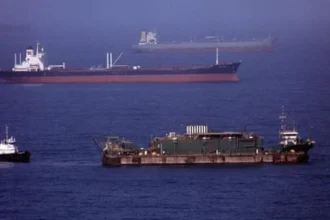
Satellite and drone imagery provided by news agencies show dozens of massive tankers and cargo vessels anchored in the Gulf of Oman, unable to proceed through the strait. These ships represent billions of dollars in stranded assets and decaying commodities. Shipping insurance premiums for the region have skyrocketed to the point of being prohibitive for many smaller operators, effectively creating a secondary economic blockade even in areas where physical passage might be possible.
The maritime industry is watching the current negotiations with a mixture of hope and skepticism. A sudden reopening of the strait would require a massive logistical undertaking to clear the backlog of vessels and ensure that the waterway is free of naval mines or other hazards. Industry analysts warn that even if a Hormuz deal is signed today, it could take weeks for the flow of oil to return to pre-war levels, as crews and shipping companies will remain wary of the fragile security environment.

Political Obstacles and Domestic Pressure
Both the U.S. and Iranian governments are navigating complex domestic political landscapes that complicate the terms of any agreement. For the Trump administration, a deal would represent a significant foreign policy victory and a necessary step to stabilize the domestic economy ahead of upcoming political cycles. However, the administration faces pressure from hawks in Congress who view any concession to Tehran as a sign of weakness. The White House must balance the need for lower energy prices with the requirement to maintain a "maximum pressure" posture against Iranian regional influence.
In Tehran, the government is dealing with the internal fallout of a crippled economy. The U.S. naval blockade of Iranian ports has severely limited the country’s ability to export its own oil, leading to a shortage of foreign currency and essential goods. Iranian state media, including the Islamic Republic of Iran Broadcasting (IRIB), has been careful to manage public expectations. Citing informed sources, IRIB reported that any agreement with Oman regarding vessel traffic "has nothing to do with the immediate opening of the strait."
Tehran’s official position remains that the strait will only open if the United States ceases its "violations" and lifts the naval blockade on Iranian ports. An "informed source" quoted by IRIB stated, "The opening of the Strait of Hormuz depends on a change in behavior and correction of U.S. violations." This indicates that Iran is using the Hormuz deal as leverage to force a broader rollback of U.S. sanctions and military presence in the region.
Security Risks and the Threat of Fresh Hostilities
The memory of the failed June memorandum of understanding looms large over the current talks. That agreement held for less than ten days before fresh hostilities erupted, involving drone strikes and the seizure of commercial vessels. Both nations accused the other of violating the spirit and the letter of the June deal, leading to the current, more restrictive blockade. The lack of trust between Washington and Tehran means that any new Hormuz deal will likely require robust verification mechanisms that are currently missing from the public discourse.
Military analysts suggest that the risk of a tactical miscalculation remains high. The Persian Gulf is currently one of the most densely militarized zones in the world, with U.S. carrier strike groups and Iranian Revolutionary Guard Corps (IRGC) fast-attack boats operating in close proximity. Any incident, whether intentional or accidental, could derail the diplomatic progress in Muscat and lead to a direct kinetic confrontation that would make the reopening of the strait impossible for the foreseeable future.
The proposed involvement of Oman as a "safety guarantor" is seen as a way to create a buffer between the two primary antagonists. By placing an Omani face on the management of the exit route, the deal could allow both the U.S. and Iran to claim a strategic victory without appearing to have surrendered to the other’s demands.
Global Implications of a Successful Hormuz Deal
If a Hormuz deal is successfully implemented, the geopolitical ramifications would extend far beyond the Middle East. It would signal a potential thaw in U.S.-Iran relations, perhaps paving the way for broader negotiations regarding nuclear proliferation and regional proxy conflicts. For global markets, the restoration of the shipping route would provide a much-needed "peace dividend," likely leading to an immediate correction in energy prices and a boost to global trade.
However, the "unclear terms" mentioned by officials suggest that any peace may be temporary. If the agreement does not address the underlying causes of the conflict—including the U.S. sanctions regime and Iran’s regional military posture—the Strait of Hormuz will remain a volatile flashpoint. International observers remain focused on the coming 48 hours, waiting to see if the "optimism" voiced by President Trump translates into a durable and transparent international agreement.
As the sun sets over the Gulf of Oman, the world remains in a state of suspended animation. The dozens of ships visible in drone footage remain stationary, their crews waiting for the word that the most vital artery of the global economy has finally been cleared for passage. Whether that word comes today, tomorrow, or not at all depends on the final, secret deliberations currently taking place behind closed doors in Muscat and Washington.