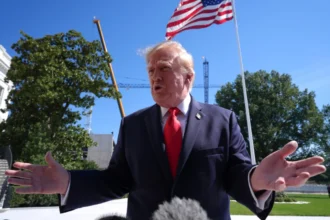
In a significant and potentially destabilizing announcement, U.S. President Donald Trump stated he intends to declare the vital Strait of Hormuz as U.S. territory, a move that could dramatically escalate regional tensions and challenge international maritime law. The declaration, which the President indicated would happen "soon," suggests an assertion of sovereign control over a waterway crucial to global oil shipments and a frequent flashpoint in Middle East politics.
Asserting Control Over a Critical Waterway
The Strait of Hormuz, a narrow chokepoint connecting the Persian Gulf to the open ocean, is one of the world’s most strategically important maritime passages. Approximately one-fifth of the world’s total oil consumption passes through this waterway annually, making its unimpeded flow essential for global energy markets. Iran, situated on the northern side of the strait, has repeatedly threatened to block traffic in response to international pressure or military action.
President Trump’s statement, delivered from the White House, implies a radical shift in U.S. policy, moving beyond ensuring freedom of navigation to claiming outright sovereignty. This assertion directly contradicts the established international legal framework governing straits used for international navigation, which generally recognize the right of transit passage for all vessels, including warships and commercial ships, even if the strait is bordered by one or more states.
Historical Context of the Strait of Hormuz
The geopolitical significance of the Strait of Hormuz is rooted in its strategic location and the immense volume of trade that traverses it. For decades, the United States has maintained a significant naval presence in the Persian Gulf, primarily to ensure the free flow of oil and to deter aggression from regional adversaries. This presence has often involved escorting oil tankers and conducting patrols to safeguard maritime security.
However, the U.S. military’s role has historically been one of protection and enforcement of international norms, not territorial claim. Such a claim by the United States would be unprecedented and would likely face widespread international condemnation and challenge. It could also set a dangerous precedent, potentially encouraging other nations to assert territorial claims over strategically vital waterways.
Escalating Regional Tensions
The announcement comes amid an already fraught geopolitical climate in the Middle East, characterized by heightened tensions between the U.S. and Iran. The two nations have been engaged in a prolonged period of confrontation, marked by sanctions, proxy conflicts, and direct military standoffs. Iran has frequently warned that any move to disrupt its oil exports or its access to the Persian Gulf would be met with a severe response.
The potential implications of the U.S. declaring the Strait of Hormuz its territory are profound. It could be interpreted by Iran as an act of aggression, potentially leading to direct military confrontation. Such a conflict would not only devastate the region but also send shockwaves through the global economy, causing a surge in oil prices and disrupting supply chains worldwide.
International Law and Maritime Sovereignty
Under the United Nations Convention on the Law of the Sea (UNCLOS), of which the United States is not a signatory but generally adheres to customary international law principles, straits used for international navigation are subject to specific legal regimes. The convention distinguishes between territorial seas, contiguous zones, exclusive economic zones, and high seas, each with different rights and responsibilities for coastal states and international maritime traffic.
Declaring the Strait of Hormuz U.S. territory would fundamentally alter its legal status. It would imply that the U.S. has full sovereignty over the waters, seabed, and airspace, allowing it to regulate or even deny passage. This would directly conflict with the principle of transit passage, which allows vessels to pass through international straits without hindrance, provided they adhere to specific regulations for safety and navigation.
Reactions and Diplomatic Fallout
Initial reactions from international observers and allies have been largely one of surprise and concern. While the specifics of the President’s plan remain unclear, the mere suggestion of such a declaration has ignited a firestorm of diplomatic activity. U.S. allies in the region, who rely on the free passage of goods through the strait, are likely to be deeply alarmed by the potential for instability.
Nations that depend heavily on Persian Gulf oil, including major economies in Asia and Europe, will be closely monitoring the situation. Any disruption to the flow of oil could have severe economic consequences, impacting everything from energy prices to industrial production. The potential for a protracted conflict or a significant escalation of hostilities would undoubtedly lead to increased global economic uncertainty.
The U.S. Military’s Role and Capabilities
The U.S. military, particularly the Navy’s Fifth Fleet based in Bahrain, has a long-standing presence in the region and is responsible for maintaining security in the Persian Gulf and the Strait of Hormuz. This presence has been instrumental in deterring attacks on shipping and ensuring freedom of navigation. However, asserting territorial control would require a vastly different operational posture and potentially a significant increase in military resources.
The logistical and political challenges of enforcing such a claim would be immense. It would necessitate a sustained and robust military presence to counter any challenges, whether from Iran or other regional actors. The long-term sustainability and international legitimacy of such a unilateral assertion of sovereignty would be highly questionable.
Economic Ramifications of Strait of Hormuz Disruption
The economic impact of any conflict or closure of the Strait of Hormuz would be catastrophic. Global oil prices would likely skyrocket as supply is severely curtailed. This would lead to inflation across various sectors, impacting transportation costs, manufacturing, and consumer goods. Developing nations, often more vulnerable to energy price shocks, would suffer disproportionately.
The insurance industry, which covers maritime trade, would also face unprecedented challenges. Premiums for shipping in the region would surge, further increasing the cost of goods. Global financial markets would likely react negatively, experiencing volatility and potential downturns.
Future Course and Potential Scenarios
The immediate future will likely see intense diplomatic efforts to clarify President Trump’s intentions and to de-escalate any potential misunderstandings. Allies will be seeking assurances that U.S. policy remains committed to regional stability and the unimpeded flow of global commerce. Iran’s response, whether diplomatic or military, will be a critical factor in shaping the trajectory of events.
One scenario involves the declaration being a rhetorical tactic, aimed at signaling a more assertive stance without a genuine intent to alter the legal status of the strait. However, given President Trump’s history of decisive, often unconventional, policy pronouncements, such a charitable interpretation may prove to be overly optimistic. A more concerning possibility is that the declaration signals a genuine intent to assert U.S. sovereignty, leading to a prolonged period of heightened tension and potential conflict.
The Long Shadow of Hormuz
The Strait of Hormuz has long been a symbol of the delicate balance of power and the volatile nature of Middle East geopolitics. Any attempt to unilaterally alter its status carries profound risks, not only for regional stability but for the global economic order. The declaration, if it proceeds as stated, represents a significant departure from established international norms and could usher in a new era of uncertainty and confrontation in one of the world’s most critical maritime arteries. The coming weeks and months will be crucial in determining whether this declaration leads to a diplomatic resolution or a dangerous escalation of hostilities.