German actor Martin Müller is confronting the profound moral and artistic challenges of portraying Nazi architect Heinrich Himmler in Felix Randau’s new historical drama, I Is Another (Ich Ist ein Anderer). The film, which delves into the complex and often murky narratives surrounding figures connected to the Holocaust, is set to premiere at the 79th edition of the Locarno Film Festival in Switzerland on Friday, August 7, as part of its prestigious Piazza Grande program. Müller’s depiction of one of history’s most reviled figures places him within a lineage of actors who have grappled with the weight of bringing such a character to the screen.
The Historical Weight of Portraying Heinrich Himmler
Heinrich Himmler, as the Reichsführer-SS and chief of the German Police, was a central figure in the Nazi regime, directly responsible for the implementation of the "Final Solution" and the systematic extermination of approximately six million Jews, along with millions of others deemed "undesirable" by the Nazi ideology. His role in establishing and overseeing the vast network of concentration and extermination camps, commanding the SS, and controlling the Gestapo solidified his place as one of the principal architects of the Holocaust. Portraying such a historical figure is not merely an acting assignment but a profound engagement with history, morality, and the representation of evil itself.
Synopsis of I Is Another
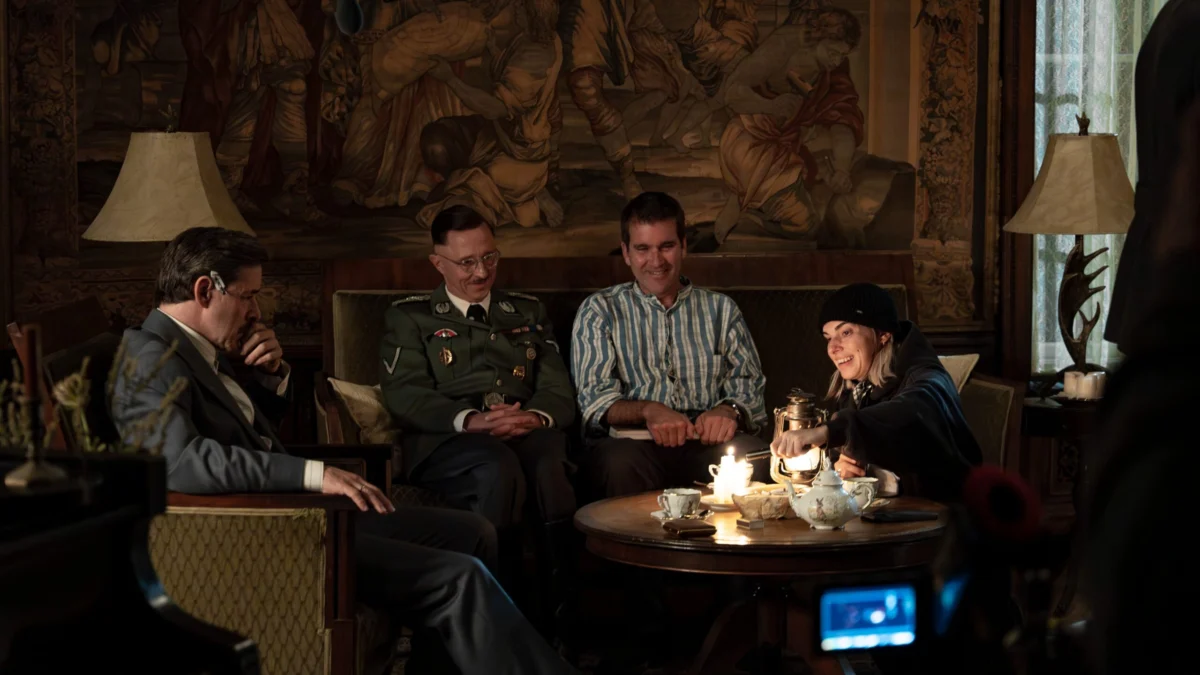
The film I Is Another is set in 1952 and features Claes Bang as Felix Kersten, Himmler’s former massage therapist. Kersten finds himself ambushed by journalist Hedda, played by Valerie Pachner, who questions his claims of having leveraged his influence with Himmler to save thousands of concentration camp prisoners during World War II. Hedda’s skepticism drives the narrative, as she seeks to uncover whether Kersten is a genuine hero or merely fabricating a self-serving myth. The film thus explores themes of truth, memory, and the often-unreliable nature of personal narratives in the shadow of historical atrocities.
The Intense Challenge of Casting Himmler
Director Felix Randau openly discussed the immense difficulties encountered during the casting process for the role of Himmler. Randau told The Hollywood Reporter that finding an actor capable of embodying the character, whom he described as a "weasel kind of guy," proved to be the production’s most significant hurdle. Many actors, when approached, expressed strong reservations, accusing Randau of providing a platform for an inherently evil figure.
Randau vehemently rejected this criticism, arguing that ignoring or neglecting evil allows it to fester and grow in the dark. He drew a stark parallel to contemporary German society, where the rise of far-right political movements underscores his concern. "I think that is really ridiculous and a big mistake because evil is a part of creation. If you ignore or neglect it, it will grow in the dark, and that’s what’s happening here in Germany, as we can all see," Randau stated.
The Resurgence of Far-Right Politics in Germany
Randau’s warning is not an isolated sentiment but reflects growing anxieties within Germany regarding the increasing influence of the far-right Alternative for Germany (AfD) party. This political entity has gained significant traction amid rising anti-immigration sentiments, economic uncertainties, and a palpable weariness with traditional political parties. In the lead-up to Germany’s 2025 federal election, the AfD has emerged as a formidable force, securing second place in national polls and establishing strongholds, particularly in the Eastern states that once comprised the German Democratic Republic (GDR).
The party’s platform, often characterized by nationalist rhetoric and skepticism towards European integration, has raised concerns among many Germans who see echoes of historical extremism. This political backdrop imbues Randau’s film and the casting choices within it with a heightened sense of urgency and relevance, transforming the artistic challenge into a broader societal commentary on vigilance against resurgent ideologies.
Martin Müller: A Stage and TV Veteran Steps Into a Difficult Role
Against the backdrop of these political and artistic challenges, Randau and casting director Suse Marquardt undertook an exhaustive search for their Himmler. Their efforts eventually led them to Martin Müller, an actor primarily recognized for his extensive work in German theater and television. Randau expressed his profound satisfaction with Müller’s casting, praising him for bringing an unexpected depth to the role.
Müller’s connection to the project was facilitated by his longstanding professional relationship with casting director Suse Marquardt. He recounted a straightforward, yet pivotal, casting process that began with an e-casting. After submitting his audition tape, Müller was invited to meet Randau in Munich, where the actor resides. "Felix came to Munich, where I live, instead of me going to Berlin. We just met in a restaurant, and after two hours of talking, I asked him how many people he was meeting. And he said, ‘I’m fine with you. I just wanted to meet you.’ So I was very happy," Müller shared, detailing the unusual simplicity of securing such a demanding role.

Joining a Legacy of Actors Portraying Heinrich Himmler
Müller now joins a distinguished list of actors who have previously taken on the role of Heinrich Himmler in various cinematic and television productions. This roster includes Stephen Graham in the 2017 war drama The Man With the Iron Heart, Eddie Marsan in the 2016 historical drama The Exception, and Matthias Freihof in the 2008 Tom Cruise vehicle Valkyrie. Kenneth Tigar portrayed Himmler in the alternate-history series The Man in the High Castle (2016–2019), while Ulrich Noethen tackled the character in both the Academy Award-nominated Downfall (2004) and My Führer – The Really Truest Truth About Adolf Hitler (2007). The late Ian Holm also notably stepped into Himmler’s shoes for the acclaimed 1978 miniseries Holocaust. Each of these portrayals has contributed to the complex cinematic legacy of representing one of history’s most notorious figures.
The Actor’s Reckoning with a Repugnant Character
For Müller, accepting the role of Himmler initiated a profound personal and professional reckoning. He acknowledged the inherent horror of portraying such a character while also recognizing the magnetic pull such figures often hold for actors. "It’s horrible to take on that role on the one hand, but on the other hand, it’s an interesting person," Müller explained. "He is a horrible person, but people who are a horror are always interesting for an actor."
Crucially, Müller noted that I Is Another does not depict Himmler directly engaged in the atrocities of concentration camps. Instead, the film presents Himmler through the filtered lens of Felix Kersten’s recollections, which are inherently self-serving. Kersten, eager to present himself in a favorable light, selectively recounts his interactions, thus avoiding the full, brutal scope of Himmler’s crimes. "For this part, Himmler isn’t in action in concentration camps or anything like that. So, the film doesn’t show the real horror of Heinrich Himmler because it’s told via Felix Kersten. And he doesn’t tell us about all the horrors because he doesn’t want to be seen in a bad light," Müller clarified.
Psychological Toll and Physical Transformation
Despite the indirect portrayal of Himmler’s worst actions, certain scenes proved emotionally and psychologically taxing for Müller. He recounted a particularly challenging night shoot with co-star Claes Bang. "Claes and I had this scene where we had to discuss how many Jewish people we could save," Müller shared. "We filmed this scene the whole night, and at the end, we said to each other that it was so disgusting to talk about numbers, like people were nothing." This scene powerfully underscored Himmler’s chilling lack of empathy, his cold detachment, and his bureaucratic approach to mass murder. Müller referenced the historical assessment of Himmler as a "mathematician of the Holocaust," a man for whom human lives were mere statistics.
The role also demanded a physical transformation. Director Randau requested that Müller appear "a bit more round in the face." To achieve this, Müller deliberately altered his lifestyle, reducing physical activity and increasing his food intake to gain four to five kilograms. This physical shift became another layer of his immersion into the character.
Shedding the Character and Reflecting on Contemporary Politics
The experience of portraying Himmler lingered with Müller long after filming concluded. The psychological burden of the role proved particularly difficult to shed. "It was really difficult to leave the character," Müller recalled. While he eventually shed the weight gained for the role, the moral and emotional weight of embodying such a figure persisted. "But the other thing was leaving this ugly character. These things just really stick with me," he admitted. The experience prompted him to reflect critically on current political landscapes. "I just kept thinking, ‘what are politicians doing nowadays? Oh my God!’ For me, it’s a horror what the politicians are doing at the moment," he expressed, drawing a subtle but potent connection between historical evils and contemporary political dynamics.
An Unconventional Approach to Researching Heinrich Himmler
Müller adopted an unconventional research strategy, deliberately avoiding previous cinematic portrayals of Himmler. His rationale stemmed from his perception of Himmler as an inherently uninteresting individual outside of his monstrous actions. Müller noted the scarcity of private records or personal anecdotes about Himmler, contrasting this with the more extensively documented private lives of other prominent Nazi figures like Hitler, Goebbels, or Göring.
"There aren’t any films or other [material] with private stuff about him. He was just hiding," Müller observed. He also highlighted the lack of private audio recordings of Himmler, beyond his public speeches, which left a void regarding his natural speaking manner. Given these limitations and the film’s narrative conceit, Müller chose to forge his own interpretation. "So I just didn’t care about that but tried to do it my way," he stated. He emphasized that the film’s Himmler is not a definitive historical representation but rather Himmler as perceived and recounted by Felix Kersten, a perspective that is intentionally ambiguous regarding its veracity. "It’s not the ‘true’ Heinrich Himmler in the film. It’s Heinrich Himmler as [told] by Kersten. And you don’t know what is true or wrong. That’s what the whole film is actually about," Müller concluded, underscoring the film’s central exploration of subjective truth and historical narrative.
The Locarno Premiere and Broader Implications
The world premiere of I Is Another at the Locarno Film Festival is anticipated to spark considerable discussion, not only for its artistic merit but also for its timely engagement with historical memory and the persistent relevance of confronting evil. The film serves as a potent reminder of the responsibility that storytelling bears in navigating the complexities of the past, especially when those complexities hold uncomfortable echoes in the present political climate. Müller’s experience encapsulates the profound challenges and ethical considerations inherent in bringing such a historically significant and morally repugnant character to life on screen.