The USS Gerald R. Ford, the world’s largest and most expensive aircraft carrier, is preparing to depart its current station in the Red Sea to undergo emergency repairs in Crete following a series of internal failures and a damaging onboard fire. The $13 billion vessel, which has been at sea for nearly nine months, has faced a mounting list of mechanical and logistical hurdles that critics say are now jeopardizing the readiness of the U.S. Navy’s premier power-projection platform. While the Pentagon initially downplayed the severity of recent incidents, officials speaking on the condition of anonymity now confirm that the ship’s departure is necessary to address structural damage and persistent infrastructure issues that have plagued the crew during a marathon deployment.
The move to Crete comes in the wake of a significant fire that broke out in the ship’s main laundry room, an incident that has proven far more disruptive than early military reports suggested. According to defense officials, the blaze took several hours to fully extinguish and resulted in the destruction of approximately 100 sailor sleeping berths. The physical toll on the crew was immediate, with nearly 200 sailors requiring medical treatment for smoke inhalation and related respiratory distress. One service member was reportedly in serious enough condition to require an emergency medical evacuation via airlift, though Central Command has since characterized the majority of injuries as non-life-threatening.
Emergency Repairs and the Laundry Room Blaze
The fire damage has significantly complicated life aboard the carrier, which houses more than 4,000 personnel. The loss of 100 beds in an already crowded environment has forced the command to implement emergency berthing shifts, further straining a crew that has been operating at a high tempo in a combat zone. While the Navy maintained in the immediate aftermath of the fire that the ship’s propulsion plant remained unaffected and the vessel was "fully operational," the decision to divert to Crete for repairs suggests that the cumulative damage to the ship’s internal support systems requires industrial-grade intervention that cannot be performed at sea.
Beyond the immediate fire damage, the USS Gerald R. Ford has been grappling with a humiliating and costly failure of its sanitary systems. For years, the ship’s plumbing has been a point of contention and a source of ridicule within the defense community. The carrier utilizes a vacuum-based toilet system similar to those found on commercial airliners, but scaled for thousands of users. This system has proven notoriously unreliable, suffering from frequent and "unexpected" clogs that render entire sections of the ship without functioning restrooms.
Infrastructure Failures: The High Cost of Clogged Toilets
The "clogged toilets" issue is not merely a matter of convenience; it has become a significant financial and operational burden. A 2020 report from the Government Accountability Office (GAO) highlighted that the Ford’s sewage system requires specialized "acid flushes" to clear persistent blockages in the piping. Each of these cleaning procedures costs the American taxpayer roughly $400,000. Despite Navy assertions that leadership addresses these incidents promptly with minimal downtime, sailors on board have reported long lines for functioning facilities and a general sense of frustration regarding the ship’s basic habitability.
These infrastructure failures are compounding the "sinking morale" reported among the crew, who have now spent nearly three-quarters of a year deployed in the volatile waters of the Middle East. The USS Gerald R. Ford was diverted to the Red Sea to support operations against Iranian-aligned forces, a mission that has seen the ship’s air wing participate in thousands of sorties. However, the length of the deployment—extended multiple times to maintain a carrier presence in the region—has pushed both the machinery and the human element to their breaking points.
Personnel Strains Amid a Marathon Deployment
The human cost of the Ford’s extended stay in the Red Sea has drawn sharp rebukes from Capitol Hill. Senator Mark Warner, vice-chair of the Senate Intelligence Committee, recently issued a blistering statement regarding the ship’s status. Warner argued that the crew has been "pushed to the brink" by political and military decisions that prioritized optics over the long-term health of the force. "The Ford and its crew have been paying the price for reckless military decisions," Warner stated, pointing to the strain of nearly a year at sea without a clear timeline for a return to their homeport in Norfolk, Virginia.

The Navy has attempted to frame the situation as a testament to the resilience of its sailors. In official statements, leadership has praised the "immense dedication" of the crew and claimed that maintenance demands have actually decreased as the deployment progressed. However, the reality of the fire damage and the persistent toilet failures suggests a vessel that is struggling to maintain its sophisticated systems under the pressure of continuous combat operations. The Ford is the first of its class, featuring several new technologies—such as the Electromagnetic Aircraft Launch System (EMALS)—that have faced a steep learning curve and frequent breakdowns since the ship was commissioned.
Strategic Vacuums and the Arrival of the USS George HW Bush
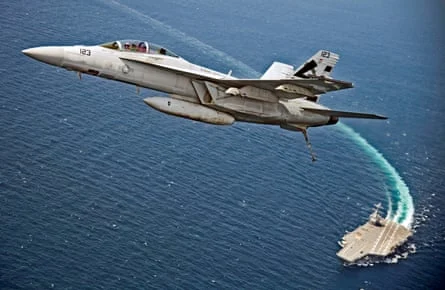
The withdrawal of the USS Gerald R. Ford to Crete for repairs creates a temporary but significant gap in U.S. naval capability in the region. Since February 28, the carrier has been a central hub for strikes against more than 7,000 targets in the conflict with Iran. With more than 75 aircraft on board, including F/A-18 Super Hornets and advanced E-2D Hawkeye radar planes, the Ford provides a level of air superiority and surveillance that is difficult to replicate with land-based assets alone. To fill this void, the Pentagon is reportedly accelerating the deployment of the USS George H.W. Bush, a Nimitz-class carrier, to relieve the Ford.
The transition between these two massive warships comes at a time of heightened regional tension. The U.S. military’s involvement in the Red Sea has been characterized by a constant cycle of interceptions and retaliatory strikes. The Ford’s sophisticated radar systems and air traffic control capabilities have been essential in managing the complex airspace, but the physical wear and tear on the ship’s internal systems have proven to be its Achilles’ heel. The stop in Crete will allow engineers to assess whether the laundry room fire caused any underlying structural weakness to the bulkheads or electrical grids that support the surrounding berthing areas.
The Troubled Legacy of the $13 Billion Supercarrier
The current crisis is the latest chapter in the troubled history of the Ford-class program. Designed to replace the aging Nimitz-class carriers, the Ford was intended to be more efficient, requiring fewer sailors and offering a higher sortie-generation rate. However, the ship was delivered years behind schedule and billions of dollars over budget. Many of its most advanced systems, including the dual-band radar and the advanced arresting gear used to catch landing planes, have faced repeated failures during sea trials and early deployments.
The "clogged toilets" and "fire damage" are seen by many defense analysts as symptoms of a broader issue: a ship that may have been over-engineered with too many unproven technologies. While the Navy remains committed to the Ford-class—with several more ships in various stages of construction—the current deployment has served as a grueling stress test. The fact that a laundry room fire and plumbing issues are forcing a $13 billion warship off the front lines is a point of significant concern for naval planners who rely on these vessels to project American power globally.
Geopolitical Context: From the Caribbean to the Red Sea
Prior to its arrival in the Middle East, the USS Gerald R. Ford had already completed a demanding tour in the Caribbean. During that phase of its deployment, the carrier was used as a platform for counter-narcotics operations, interdicting drug-smuggling vessels and enforcing sanctions against the Venezuelan government. The ship played a role in the high-profile seizure of assets linked to Nicolás Maduro, demonstrating the carrier’s versatility in both low-intensity policing and high-intensity combat roles.
However, the shift from the Caribbean to the Red Sea marked a significant escalation in mission requirements. The transition from seizing tankers to launching strikes against Iranian targets has left the crew with little time for rest or shipboard maintenance. The upcoming stay in Crete is expected to provide the first real opportunity for the crew to decompress and for technical teams to address the "sinking morale" that has become a topic of discussion in both military and political circles.
As the USS Gerald R. Ford sets sail for Crete, the focus remains on how quickly the Navy can restore the ship to full readiness. The repairs to the fire-damaged berths and the persistent issues with the vacuum toilet system are paramount, but the long-term challenge will be managing the exhaustion of the personnel. The Navy has not specified exactly how long the carrier will remain in port, but the arrival of the USS George H.W. Bush will provide the necessary coverage to allow the Ford’s crew the respite they have earned after nine months of historic, yet troubled, service at sea.