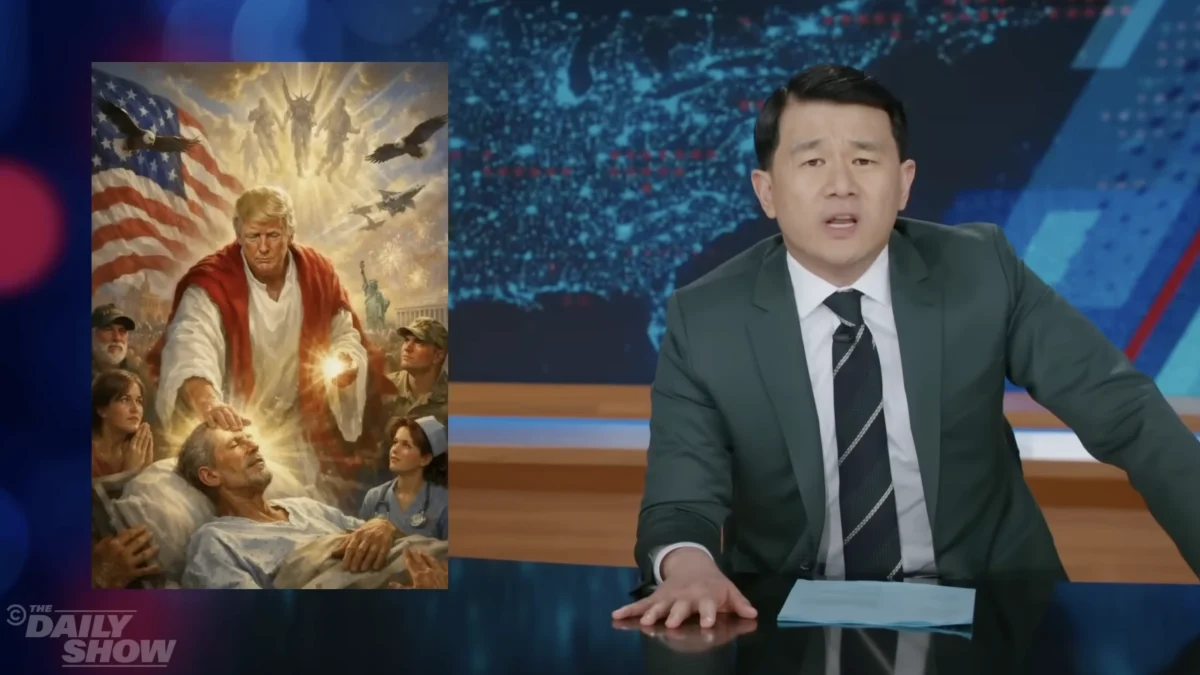
Late-night television host Ronny Chieng used a Tuesday night broadcast to challenge the narrative provided by Republican leadership regarding a controversial social media post involving artificial intelligence and religious iconography. The segment focused on a now-deleted image shared by Donald Trump on his Truth Social platform, which depicted the former president in a manner that many observers identified as a messianic figure. While Vice Presidential candidate JD Vance later characterized the post as a misunderstood attempt at humor, Chieng and political commentators have pointed to conflicting statements from Trump himself as evidence of a disjointed communication strategy.
The controversy began when an AI-generated image appeared on Trump’s social media feed, showing a figure resembling the former president standing in a divine or saint-like light, drawing immediate comparisons to Jesus Christ. The post circulated rapidly across various social media platforms, sparking a debate over the use of religious imagery in political campaigning. Following a wave of criticism from both secular and religious groups, the post was removed from the platform, leading to questions about the intent behind the original upload.
Senator JD Vance, appearing on Fox News to address the backlash, defended the former president by framing the incident as a satirical gesture. Vance argued that the public and the media had failed to grasp the intended humor of the post. According to Vance, the image was never meant to be taken literally, and its deletion was a response to the fact that "a lot of people weren’t understanding his humor." This explanation sought to neutralize the criticism by labeling the detractors as overly sensitive or lacking a sense of irony.
Ronny Chieng Challenges the Satire Defense
During his monologue on The Daily Show, Ronny Chieng rejected the "joke" explanation, suggesting that the defense was an after-the-fact attempt to manage a public relations crisis. Chieng highlighted the irony of the situation, questioning the theological consistency of the messaging. "Where in the Trump Bible does it say you can’t worship false idols?" Chieng asked, referencing the commercial "God Bless the USA Bible" endorsed by the former president earlier in the election cycle.
Chieng’s critique centered on the perceived hypocrisy of the political movement’s relationship with religious values. He mocked the idea that "woke Christians" were attempting to "cancel" the former president for the post. By framing the defense as a battle against political correctness, Chieng argued that the campaign was attempting to distract from the reality that the imagery was designed to appeal to a specific, highly devoted segment of the base that views the former president in quasi-religious terms.
The comedian further lambasted the audience and the broader public for not buying into the "joke" narrative. He pointed out that the defense provided by Vance was directly contradicted by Trump’s own subsequent comments to the press. The disconnect between the vice presidential candidate’s explanation and the former president’s own recollection became a central point of the late-night segment’s analysis.
Conflicting Explanations and the ‘Doctor’ Narrative
The credibility of the "joke" defense was further strained when Donald Trump spoke to reporters regarding the image. Rather than confirming Vance’s assertion that the post was a humorous satire, Trump claimed he had a different interpretation of the AI-generated figure. He told members of the press that he believed the image portrayed him as a medical professional rather than a religious figure.
"I thought it was me as a doctor," Trump reportedly told journalists, making no mention of the post being a joke or a satirical commentary on his public persona. This statement created a significant messaging gap between the top of the ticket and the vice presidential nominee. Chieng seized on this discrepancy, noting that the campaign could not seem to decide on a singular story to explain the post’s origin and intent.
"Is it a doctor or is it a joke, or is it a doctor who is a joke, like a chiropractor?" Chieng quipped, highlighting the absurdity of the conflicting accounts. The lack of a unified explanation has led some political analysts to suggest that the post was not a coordinated campaign effort, but rather an impulsive social media share that required rapid, albeit inconsistent, damage control.
The Role of AI in Political Messaging
The incident underscores the growing influence and potential pitfalls of artificial intelligence in modern political communication. AI-generated imagery allows campaigns and candidates to create hyper-realistic visuals that can evoke powerful emotional responses or reinforce specific narratives. However, the ease with which these images can be produced and shared also increases the risk of messaging blunders and unintended interpretations.

In the 2026 election cycle, the use of AI has become a point of contention among regulators and ethics watchdogs. The ability to place a candidate in any scenario—whether as a religious figure, a medical hero, or a historical icon—blurs the line between reality and digital fabrication. Critics argue that such imagery is designed to bypass rational political discourse and appeal directly to the subconscious biases of the electorate.
Furthermore, the "AI Jesus post" serves as a case study in how digital content can be used to test the boundaries of public acceptability. By sharing an image and then deleting it after a backlash, a campaign can gauge the limits of its supporters’ devotion and the intensity of its opponents’ reactions. The subsequent "it was just a joke" defense is a common tactic in the digital age, often used to dismiss criticism of controversial statements or actions.
Religious Iconography and the Evangelical Vote
The use of messianic imagery is particularly sensitive given the former president’s strong support among evangelical Christians. Throughout his political career, Trump has maintained a complex relationship with the religious right, often positioning himself as a defender of faith-based values. However, the depiction of a political leader in the likeness of a deity or a prophet remains a bridge too far for many traditional religious leaders.
The "Trump Bible" mentioned by Chieng refers to a tangible product that has already sparked debate within religious communities. The $59.99 "God Bless the USA Bible," which includes the U.S. Constitution and the Bill of Rights alongside the scriptures, was marketed as a way to "Make America Pray Again." For critics, the AI-generated image was an extension of this commodification of faith, merging nationalistic sentiment with religious devotion.
The backlash from "woke Christians," as Chieng sarcastically termed them, likely refers to a growing movement of believers who are uncomfortable with the fusion of partisan politics and Christian symbolism. These groups have argued that such imagery borders on blasphemy and undermines the spiritual integrity of the faith. The campaign’s decision to delete the post suggests a recognition that the imagery may have alienated moderate religious voters who are essential for a broad electoral coalition.
The Strategy of JD Vance as a Campaign ‘Translator’
The role of JD Vance in this controversy highlights his position as a key surrogate and "translator" for the former president’s more controversial impulses. Vance, a skilled communicator with a background in media and venture capital, is frequently tasked with refining and explaining Trump’s rhetoric to a more mainstream or skeptical audience.
By framing the AI Jesus post as a joke, Vance attempted to shift the conversation from the content of the image to the perceived humorlessness of the media. This strategy is designed to appeal to voters who are weary of constant political outrage and who view the former president as a transgressive figure who "tells it like it is" or "likes to have fun." However, this approach relies on a level of consistency that was absent in this instance.
When the principal candidate offers a completely different explanation—in this case, the "doctor" narrative—it undermines the surrogate’s efforts to provide a sophisticated defense. The result is a fragmented message that can leave the public confused about the candidate’s actual views and the campaign’s overall competence in managing its digital footprint.
Late-Night Comedy as a Tool for Political Accountability
The segment on The Daily Show reflects the ongoing importance of late-night comedy as a form of political critique and accountability. In an era of fragmented media and echo chambers, satirists like Ronny Chieng often serve as the first line of defense against inconsistent political narratives. By using humor to point out logical fallacies and contradictions, these programs provide a unique form of fact-checking that resonates with a younger, more digitally savvy audience.
Chieng’s refusal to accept the "joke" defense at face value mirrors a broader skepticism among political observers regarding the use of irony as a shield for controversial behavior. As the 2026 campaign progresses, the scrutiny of social media posts, AI-generated content, and the subsequent explanations provided by campaign officials is expected to intensify.
The "AI Jesus post" controversy may eventually fade from the headlines, but it leaves behind a blueprint for how campaigns handle digital missteps. The tension between impulsive social media use and the need for disciplined communication remains a defining characteristic of the current political landscape. Whether the public views these incidents as harmless jokes or as calculated attempts to manipulate religious sentiment will likely depend on the consistency of the messaging and the underlying values of the electorate.