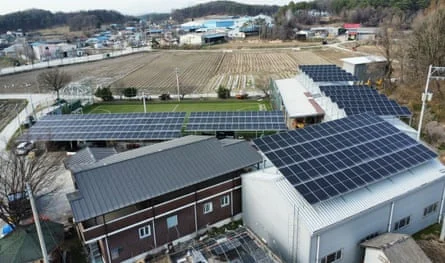
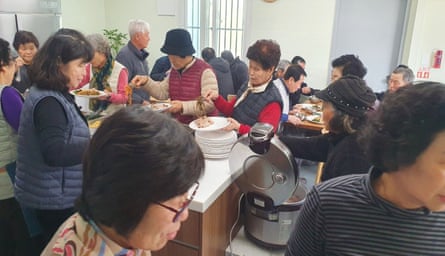
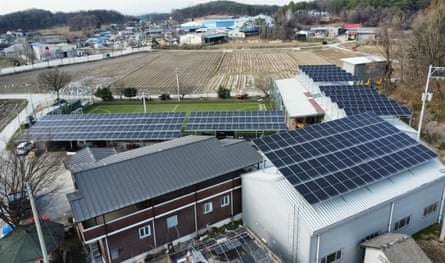
In the rural farming community of Guyang-ri, located roughly 90 minutes southeast of Seoul, the daily rhythm of life is now dictated by the sun and the communal table. This village of 70 households has become the leading edge of a national experiment, utilizing a one-megawatt solar installation to generate approximately 10 million won ($6,800) in monthly net profit. These funds do not go into private pockets; instead, they finance a radical social experiment that provides free communal lunches six days a week for the village’s 130 residents.
The local transformation in Guyang-ri is stark. Prior to the 2022 launch of the solar project, the community lacked basic infrastructure, including restaurants and reliable transportation for its aging population. Today, the revenue generated from the "renewables revolution" funds a "happiness bus" for the elderly, a table-tennis facility, and various cultural activities. Village chief Jeon Joo-young notes that the decision to prioritize welfare over individual dividends has fostered a sense of solidarity that was previously missing.
The Strategic Expansion of the Solar Income Village Model
The success of Guyang-ri is no longer viewed as an isolated local triumph but as the primary prototype for a massive federal undertaking. The South Korean government is rapidly accelerating its "solar income village" program, which aims to integrate 2,500 villages into the renewable energy network by 2030. While the program previously saw modest growth, the target for the current year has been aggressively raised to 700 new villages, a significant jump from the previous annual average of roughly 150.
This acceleration is a cornerstone of President Lee Jae Myung’s broader strategy to pivot the nation away from volatile foreign energy markets. By framing the current Iran crisis as a catalyst for change, the administration is attempting to turn a geopolitical vulnerability into a domestic economic strength. South Korea currently imports more than 90% of its primary energy, with approximately 70% of its crude oil passing through the Strait of Hormuz, a critical chokepoint frequently threatened by Middle Eastern instability.

President Lee has repeatedly characterized this dependency on fossil fuels as a "dangerous vulnerability." In recent addresses to his cabinet, he has stated that the "nation’s fate" is inextricably linked to the success of this energy transition. While many of the current renewable targets were established prior to the recent escalations in the Middle East—including a mandate to generate 20% of electricity from renewables by 2030 and a complete phase-out of coal by 2040—officials acknowledge that the political urgency has reached an unprecedented level.
Funding the Renewables Revolution Amid Global Instability
To support this rapid shift, the South Korean government has introduced a substantial supplementary budget. Approximately 500 billion won has been allocated specifically for energy transition initiatives, focusing on critical grid infrastructure upgrades. This brings the total annual support for renewable energy projects to a record 1.1 trillion won ($670 million). Furthermore, the government has set aside 400 billion won in low-interest loans specifically for the solar village program to ensure that rural communities can overcome the initial capital barriers of installation.
Kim Sung-whan, the Minister of Climate, Energy, and Environment, recently emphasized that the global landscape is forcing South Korea’s hand. He noted that the conflict in the Middle East is driving a worldwide acceleration toward clean energy, suggesting that South Korea must either lead the transition or risk economic obsolescence. The administration is betting that decentralized energy production, exemplified by the solar income villages, will provide a buffer against the price shocks associated with traditional energy imports.
However, the rapid scaling of these programs has exposed significant structural weaknesses in the national power grid. As renewable projects multiply, they are increasingly colliding with capacity limits. Large sectors of the south and southwest regions, where wind and solar conditions are most favorable, are already reaching their maximum grid intake. This has resulted in several gigawatts of renewable projects sitting idle, waiting for connection permits, while some existing capacity is essentially wasted due to a lack of transmission infrastructure.
Structural Hurdles and the Kepco Monopoly
The challenges facing the renewables revolution are not merely technical but deeply institutional. Hong Jong Ho, a prominent energy economist at Seoul National University, argues that the country’s energy crisis predates the current conflict in Iran. He points to the Korea Electric Power Corporation (Kepco), the state-owned utility that maintains a de facto monopoly over the nation’s generation, transmission, and distribution.
Kepco’s dual role as the market operator and a stakeholder in traditional coal and nuclear plants has created what critics call a conflict of interest. By keeping electricity prices artificially low through government subsidies, Kepco has historically discouraged private investment in renewable infrastructure. Hong suggests that decades of cheap, subsidized power have led the South Korean public to view electricity as an abundant public good, making it politically difficult to raise rates to fund the necessary costs of a green transition.
Furthermore, Kepco’s plan to build high-voltage transmission lines to carry power from the renewable-rich south to the industrial hubs of Seoul has met with fierce local resistance. Residents in rural areas often view these projects as exploitative, as they are asked to sacrifice their land and landscape to power the capital without receiving any regional price benefits. Under South Korea’s current uniform national pricing system, a village hosting a massive wind farm pays the same rate for electricity as a high-rise in downtown Seoul.
Supply Chain Dependencies and Market Reality
The push for solar expansion has also highlighted South Korea’s heavy reliance on international supply chains, particularly those originating in China. Currently, Chinese manufacturers provide the vast majority of solar panels installed in South Korea, a result of their dominance in global manufacturing and significantly lower production costs. This dependency has raised concerns about long-term energy sovereignty, mirroring the very fossil fuel dependencies the government is trying to escape.
In response, the Lee administration has introduced domestic module requirements for the solar village program. There are also plans to implement a carbon footprint certification system for imported components, a move designed to level the playing field for domestic manufacturers who face higher regulatory and labor costs. Despite these measures, environmental advocacy groups argue that the government’s overall commitment remains fragmented.
Gahee Han, a representative from the advocacy group Solutions for Our Climate, noted that while President Lee has shown "genuine political intent," the financial allocations tell a more complicated story. While 500 billion won was added to the transition budget, a much larger sum—roughly 5 trillion won—was simultaneously directed toward mitigating fossil fuel price hikes. This includes direct subsidies to oil refineries through a petroleum price cap system intended to shield consumers from the immediate effects of the Iran crisis.
Policy Contradictions and the Path to 2040
Critics argue that these subsidies create a "price signal paradox." By suppressing the market reality of rising oil prices, the government may be inadvertently undermining its own calls for energy conservation. Han suggests that this contradiction reflects a deep-seated institutional mindset that continues to protect fossil fuel incumbents at the expense of transformative change.
The government has also made recent adjustments to its coal and nuclear policies that appear at odds with its long-term goals. Some coal plant closures have been delayed, and several nuclear reactor restarts have been accelerated. Officials defend these moves as temporary measures necessary to maintain grid stability during the Middle East crisis. However, a recent cabinet decision confirmed that "capacity payments"—guaranteed revenue streams—will continue to flow to 21 coal-fired power plants well beyond the 2040 phase-out date, as they will be reclassified as emergency energy reserves.
As the renewables revolution continues to face these headwinds, the success of villages like Guyang-ri remains a vital symbol of what is possible. The transition there has proven that renewable energy can do more than just lower carbon emissions; it can revitalize dying rural communities and provide a new model for social welfare. Whether this micro-level success can be replicated on a national scale remains the central question for South Korea’s energy future.
The window for transformative change is currently open, driven by a mixture of geopolitical fear and economic necessity. For the residents of Guyang-ri, the benefits are already clear. As they gather for their communal lunch, funded by the panels on their roofs, they represent a potential future for a nation trying to decouple its fate from the volatile politics of the Middle East. The coming years will determine if the rest of the country can follow their lead, or if institutional inertia and infrastructure bottlenecks will stall the momentum of the clean energy transition.