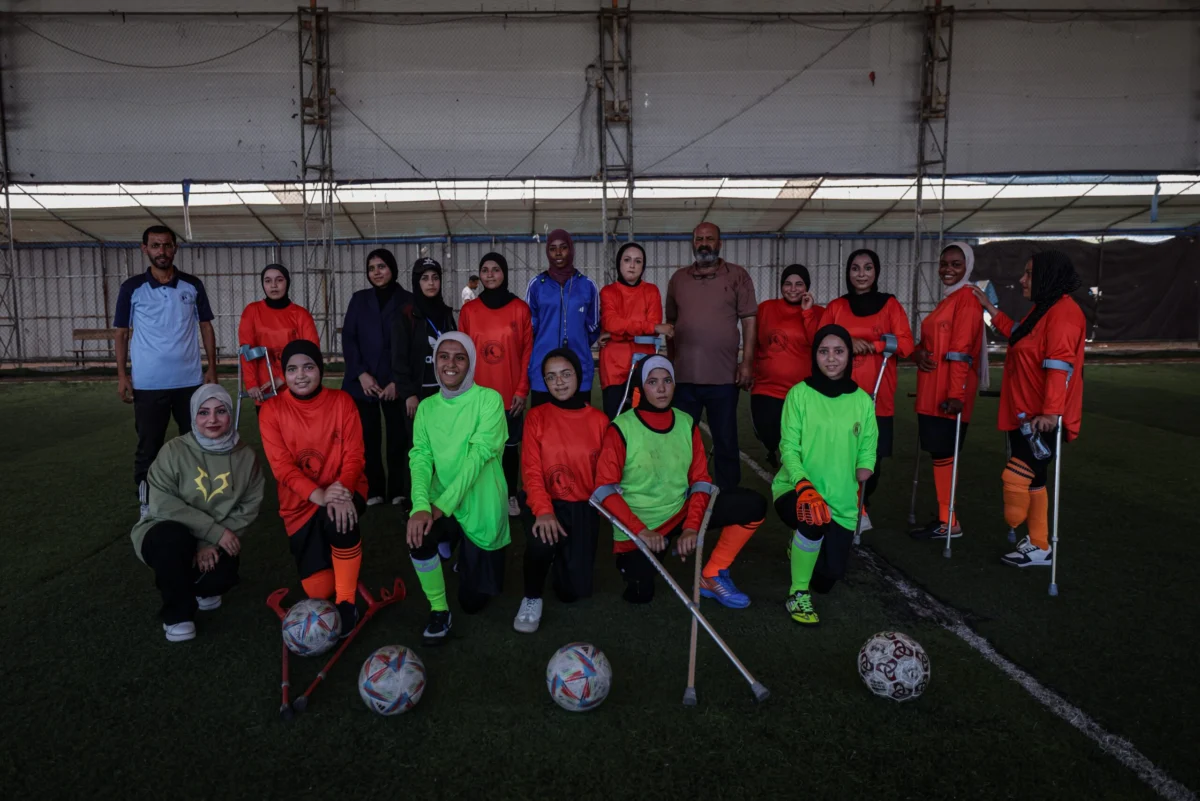
On a modest football pitch in Deir el-Balah, central Gaza, the sounds of cheers and laughter pierce the oppressive quiet that has descended upon the region amid ongoing conflict. Here, a team of young Palestinian women, many of whom are survivors of devastating aerial bombardments and subsequent amputations, are finding a path to recovery and resilience through the sport they love. These athletes, each bearing the physical and emotional scars of war, are using amputee football not just as a sport, but as a vital lifeline for rehabilitation and reclaiming their lives.
The scale of limb loss in Gaza has reached staggering proportions, a grim consequence of the intensified hostilities that began on October 7, 2023. Estimates from the World Health Organization and Palestinian health authorities indicate that over 5,000 individuals have undergone amputations due to Israeli airstrikes and ground operations. This figure represents a tragic testament to the human cost of the conflict, transforming countless lives overnight and leaving a profound impact on the fabric of Gazan society.
The arduous journey toward recovery
For many of these women, the journey from the moment of injury to the football field has been fraught with pain, trauma, and a profound sense of loss. Their stories often begin with the terrifying experience of air strikes, the immediate aftermath of critical injuries, and the agonizing decisions made by medical professionals. The subsequent amputation, while often life-saving, marks the beginning of a challenging and lengthy rehabilitation process, both physically and psychologically.
Farah Abu Qinas, a 23-year-old, embodies this struggle. On the night of June 28, 2024, she was at her grandmother’s home when a nearby explosion rocked the area. The blast inflicted severe injuries on her left leg and caused extensive burns to her right. Despite initial hopes for recovery, the severity of her left leg wounds necessitated a life-altering amputation.

The physical recovery was only the first hurdle. The subsequent period was marked by a crushing sense of isolation and the stark realization that her daily life had been irrevocably altered. Simple movements became monumental tasks, and the slow pace of physical rehabilitation often left her feeling confined within the walls of her home, her world shrinking with each passing day.
A lifeline emerges: The Palestine Amputee Football Association
The turning point for Farah, and many others like her, came through an unexpected connection forged during a physical therapy session. She met Fouad Abu Ghalyon, the president of the Palestine Amputee Football Association. Ghalyon, instrumental in establishing Gaza’s amputee football initiative for women, had assembled a dedicated team of 11 players. This squad comprises nine women with lower-limb amputations and two goalkeepers with upper-limb amputations, showcasing the adaptability and spirit of the participants.
Farah received an invitation to a training session, an offer she hesitantly accepted. The initial adaptation to playing football with a prosthetic limb was challenging, but the unwavering support of teammates who shared similar experiences provided a crucial source of encouragement. On the field, aided by her prosthetic leg, Farah now moves with a newfound confidence, chasing the ball alongside her teammates, Rozan Khaira and Aisha al-Abadla.
Shared experiences, collective strength
The stories of Farah, Rozan, and Aisha, while distinct in their origins, converge on the shared experience of limb loss or significant physical disability. Their search for a sense of purpose, renewed confidence, and a feeling of belonging has found a powerful outlet in the camaraderie and shared challenges of this amputee football team.
Rozan Khaira’s journey is another testament to the resilience fostered by the team. On November 19, 2023, during the height of the conflict, an air strike destroyed a house adjacent to her home, leaving her critically injured. Unable to move her leg, she was taken to a local clinic where doctors informed her that it was attached to her body by only a small section of skin, leaving amputation as the only viable option. Today, Rozan navigates the football pitch with remarkable perseverance, balancing on her crutches as she makes precise passes, a symbol of her unyielding spirit.

“The [Israeli] occupation amputated our bodies, but it could not amputate our dreams or our will to live,” Rozan stated, her words reflecting a defiance that resonates deeply within the team.
Aisha al-Abadla’s story predates the current conflict, highlighting the long-term impact of violence on subsequent generations. Born with an incomplete arm, doctors suspect her condition may be linked to her mother’s exposure to white phosphorus during Israel’s 2008 war on Gaza, while she was pregnant. Despite this congenital disability, Aisha harbors aspirations of becoming the goalkeeper for the Palestinian women’s amputee national football team, a dream fueled by her participation with the Gaza-based squad.
Fouad Ghalyon emphasizes that the team’s purpose extends far beyond the sport itself. It aims to cultivate an environment where women like Aisha can reconnect with themselves and with others, rebuilding social connections that war often severs. Football, in this context, serves as a potent tool for both physical and psychological recovery, helping these women process their trauma and move forward.
Overcoming persistent challenges
Despite the profound impact of amputee football, the team grapples with significant obstacles, including limited resources and insufficient support. Their continued operation relies heavily on community initiatives and strategic partnerships, underscoring the vital role of grassroots efforts in sustaining such programs in challenging environments.
The broader Palestinian athletic community has also suffered immense losses. Reports indicate that 1,009 members of this community have been killed in the ongoing conflict, leading to the near obliteration of sporting infrastructure in Gaza. This devastating loss impacts not only individual athletes but also the nation’s sporting heritage and future potential.

Dr. Khader Abu Shmala, a sports psychologist and coach of the Gaza Hope team, underscores the multifaceted benefits of amputee football. He notes that many survivors initially experience profound isolation and withdrawal. Participation in a team composed of individuals who have endured similar adversies helps them regain self-esteem and reintegrate into society, fostering a sense of shared humanity and mutual support.
A new narrative of resilience
On the football field, Farah and her teammates are no longer defined solely by their experiences as war survivors. They are athletes with aspirations, goals, and a fierce determination to excel. While they may have lost parts of their bodies, they hold fast to what is most important: the unwavering resolve to forge ahead in life.
In Gaza, a land scarred by years of conflict that has left thousands with life-altering injuries and deep psychological wounds, these young women are actively rewriting their narratives. Their story is not one that begins with loss, but with the powerful, courageous decision to embrace life again, one goal, one pass, one victory at a time. Their resilience on the pitch offers a beacon of hope, demonstrating the enduring human spirit’s capacity to triumph over adversity.