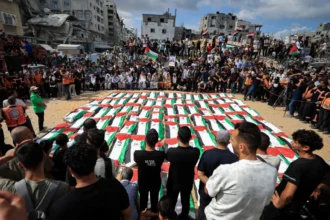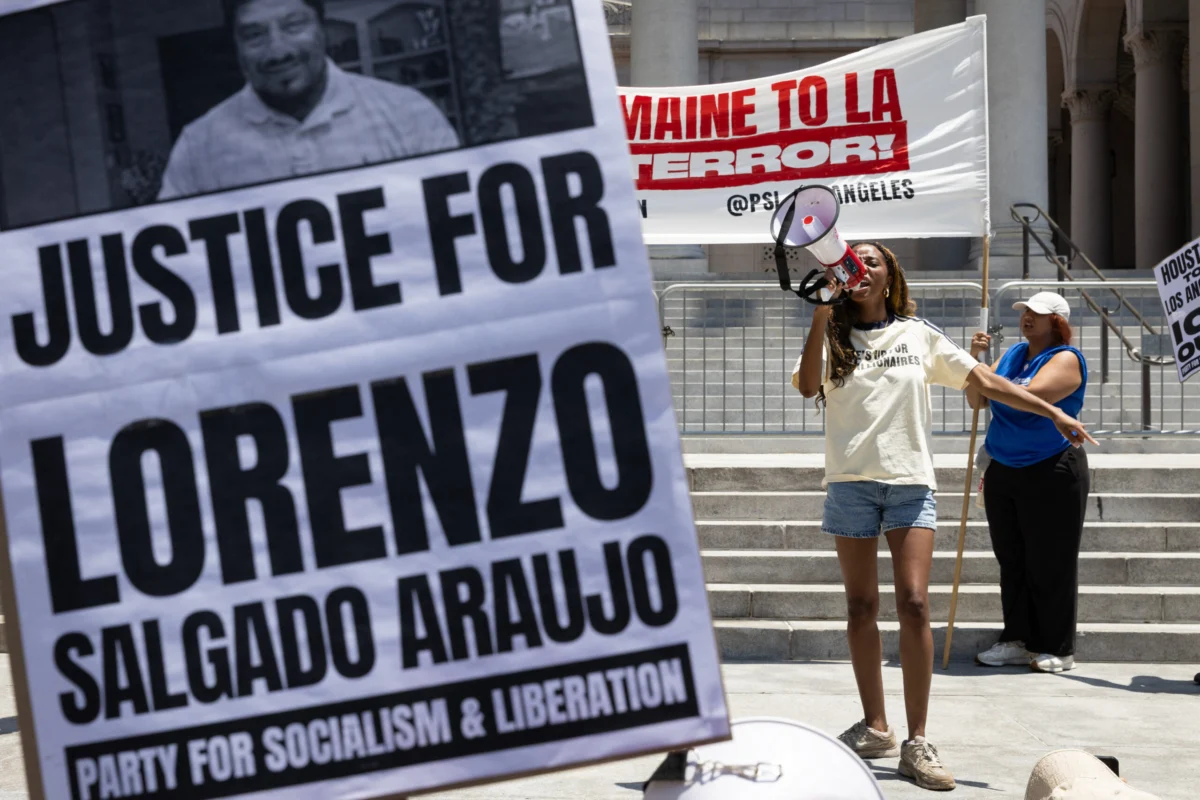
Hundreds of demonstrators took to the streets of Houston this past Sunday, their voices amplified in a chorus demanding justice for Lorenzo Salgado Araujo, a Mexican national fatally shot by an Immigration and Customs Enforcement (ICE) agent earlier this month. The march, which originated at Ervan Chew Park, saw participants briefly halt traffic on a bridge along Dunlavy Street, as documented by local media outlets and shared widely on social media platforms. Protestors carried potent visual statements, including banners emblazoned with the defiant slogans "Abolish ICE" and "Justice for Lorenzo."
Escalating Tensions and the Death of Lorenzo Salgado Araujo
The fatal encounter occurred on July 7, when Salgado Araujo, a 52-year-old Mexican citizen, was reportedly killed by an ICE agent while en route to a construction job site in Houston with his crew. This tragic event has become a focal point for growing discontent with the Trump administration’s aggressive immigration enforcement policies. The protests underscore a broader wave of public scrutiny directed at the federal agency and its practices under the current political climate.
ICE’s official account of the incident claims Salgado Araujo used his vehicle in an attempt to ram an agent, prompting the agent to fire his weapon in self-defense. However, this narrative has been directly challenged by eyewitness accounts, which present a conflicting version of events. Further casting doubt on ICE’s statement, a formal declaration issued by the U.S. Attorney for the Southern District of Texas on Thursday omitted any mention of a collision between Salgado Araujo’s van and a law enforcement vehicle, nor did it explicitly state that the ICE agent perceived an imminent threat to his life.
A Pattern of Fatal Encounters with Immigration Enforcement
The death of Lorenzo Salgado Araujo is not an isolated incident. According to reporting by The Associated Press, interactions with ICE and other immigration enforcement personnel have resulted in at least 10 fatalities since the commencement of President Donald Trump’s second term in January of the previous year. Disturbingly, two of these deaths occurred in the immediate aftermath of Salgado Araujo’s killing, in the states of Maine and Florida, highlighting a disturbing trend of lethal force being employed during immigration enforcement operations.
Calls for Systemic Change and Broader Demonstrations
The urgency felt by the protesters was palpable, with activists articulating a clear demand for more than just accountability in this single case. A video circulating online, shared by the Party for Socialism and Liberation, features an activist at Sunday’s march issuing a direct call for intensified action, advocating for further protests designed to bring the city of Houston to a standstill.
"We need to show ICE, the Trump administration and the entire country that the city of Houston is not to be messed with," the activist declared, her voice resonating with conviction. She continued, articulating the fear and frustration felt by many: "We cannot just sit here and let ICE hunt and murder more of our daughters, our brothers, our uncles. If we want justice, we have to demand it." The activist announced plans for a city-wide "shutdown" of Houston, the nation’s fourth-largest city, scheduled for Friday.
Wider National Protests and Similar Incidents
Sunday’s demonstration in Houston followed a series of similar rallies held across the nation on Saturday. In Portland, Maine, for instance, a protest was organized in response to the July 13 killing of Joan Sebastian Duran Guerrero, a 26-year-old Colombian man who was fatally shot during a traffic stop in nearby Biddeford.
The family of Duran Guerrero, a father to a three-year-old daughter, paid a poignant tribute to him, speaking with Telemundo news network about his unfulfilled aspirations. Their grief underscores the profound human cost of these tragic encounters, extending far beyond the immediate victim.
Scrutiny of ICE Hiring Practices and Agent History
The circumstances surrounding Duran Guerrero’s death have also drawn the attention of Democratic lawmakers, who have called for a thorough investigation into ICE’s hiring protocols. Reports have emerged alleging that the agent involved in Duran Guerrero’s killing possessed a documented history of mental health issues and had a past record of alleged violent and threatening behavior towards his ex-wife.
Congressman Bennie Thompson of Mississippi, the ranking Democrat on the House Committee on Homeland Security, expressed serious concerns to the Associated Press regarding these allegations. He stated that the agent’s alleged violent history "directly call[s] into question the supposed vetting and training ICE does of its recruits," suggesting potential systemic failures in the agency’s recruitment and screening processes.
ICE’s Policy Adjustments and Presidential Stance
In the wake of these high-profile killings, the Trump administration’s top immigration enforcement official, Tom Homan, announced that ICE would implement a "short pause" on traffic stops. Subsequently, on Sunday, he declared that ICE would now mandate the use of body cameras by at least one agent during all vehicle stops. Homan stated his intention was to ensure transparency and allow the public to witness events from the perspective of law enforcement officers.
"I want the American people to see what the officers saw when they took that action," Homan told Fox & Friends Weekend. This policy change, however, stands in stark contrast to President Trump’s public stance. The President has actively encouraged ICE to persist with traffic stops, dismissing concerns about the fatal outcomes.
In a post on his Truth Social platform this past Wednesday, Trump asserted, "We must be strong, tough, and smart, and we CANNOT give up one of I.C.E.’s most important and effective Crime Fighting tools, THE TRAFFIC STOP!" He argued that abandoning this tactic would be playing into the hands of criminals.
Broader Impact of Immigration Crackdown
The human toll of the Trump administration’s intensified immigration enforcement extends beyond these widely reported fatal incidents. Data compiled by The Trace’s Gun Violence Data Hub indicates that at least 13 individuals have sustained injuries since the commencement of the administration’s immigration crackdown. Furthermore, Human Rights Watch reports that a staggering 52 individuals have died while in ICE detention facilities.
These statistics paint a grim picture of the consequences of the administration’s aggressive policies. As of January 2026, ICE had facilitated the deportation of over 540,000 people from the United States, underscoring the vast scale of its operations and the profound impact on individuals and communities.
The Ongoing Struggle for Justice and Accountability
The protests in Houston and across the nation reflect a deep-seated frustration with the federal government’s approach to immigration enforcement. The tragic deaths of Lorenzo Salgado Araujo and Joan Sebastian Duran Guerrero have ignited a powerful movement demanding greater accountability, transparency, and a fundamental re-evaluation of ICE’s operational tactics. Activists are not only seeking justice for individual victims but are also advocating for systemic reforms to prevent future tragedies. The planned "shutdown" of Houston signifies a commitment to sustained pressure, aiming to force a broader societal conversation and compel meaningful change in U.S. immigration policy. The coming days and weeks will likely reveal the extent to which these protests can translate into tangible policy shifts and a more humane approach to immigration enforcement.