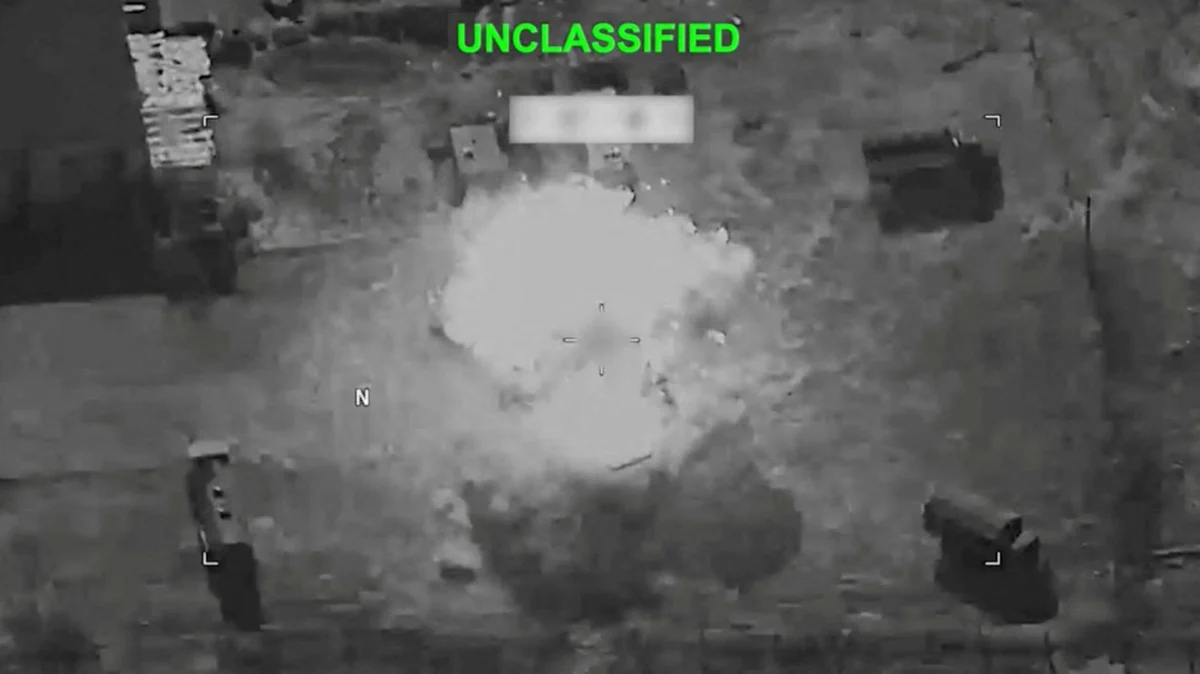
The United States Central Command (CENTCOM) confirmed overnight strikes against dozens of Islamic Revolutionary Guard Corps (IRGC) targets within Iran, escalating a volatile regional conflict that has seen retaliatory actions reach Kuwait and Jordan. The IRGC, in turn, vowed retribution against the "aggressor," indicating a deepening cycle of violence with potentially far-reaching consequences.
US Strikes Target Key Iranian Military Assets
CENTCOM detailed that the coordinated strikes, launched Wednesday night into Thursday, aimed at dismantling critical IRGC infrastructure. Military command centers, missile and drone facilities, coastal surveillance sites, and maritime defense capabilities were all identified as objectives. While specifics on exact locations were not immediately disclosed, the broad scope of the attacks signals a significant US effort to degrade Iran’s offensive and defensive military posture.
The operation followed a direct ballistic missile attack by the IRGC on a US base in Jordan earlier Wednesday, an action that President Donald Trump declared would be met with a severe response. Explosions were reportedly heard across several locations in southern Iran, according to local media, underscoring the widespread nature of the US operations.
Damage and Casualties Emerge from Iranian Provinces
Reports from Iranian news agencies and state broadcasters painted a grim picture of the immediate aftermath of the US strikes. On Qeshm Island, three explosions were reported in the city, with residents indicating a residential area was struck. Tragically, a couple and their child were killed in this incident, according to the semi-official Tasnim news agency.
Further casualties were feared, with state broadcaster IRIB reporting two people trapped under rubble in Qeshm City following a US strike on a residential building in the Chah-Tango neighborhood. Search and rescue operations were underway to free the trapped individuals. Tasnim also reported that power had been restored to Qeshm following a temporary blackout attributed to a missile strike on the electrical grid.
The southwestern Fars province was also reportedly targeted, with US forces striking an area on the outskirts of Kazerun. Explosions were heard on Kish Island in the Gulf, though authorities stated that airport operations and ferry services remained unaffected. In Bushehr province, home to Iran’s sole nuclear power plant, three cities were reportedly targeted overnight, though no casualties were initially reported.
Khuzestan province saw strikes in Abadan and at least seven locations in Ahvaz City, with power outages reported in some parts of the latter. In Hormozgan province, explosions were heard in the port city of Bandar Abbas, with similar sounds reported on the islands of Abu Musa, Kish, and Qeshm. A senior provincial official confirmed that the city of Sirik was not attacked.
Iran’s Retaliatory Actions and Regional Spillover
The IRGC’s pledge of retaliation was swiftly followed by suspected Iranian strikes targeting Kuwait and Jordan early Thursday morning. Kuwait’s Defense Ministry confirmed that one worker was killed in an Iranian attack that struck a building belonging to a Chinese company in the country’s north. The Jordanian Armed Forces announced that their air defense systems had intercepted and downed five missiles launched from Iran targeting the kingdom.
The conflict’s expanding reach is a significant concern. Earlier in the week, Iran launched ballistic missiles at US military installations in Jordan, prompting US and Saudi Arabian retaliatory strikes on Iran-backed groups in Iraq. The Red Sea has also become a flashpoint, with Yemen’s Iran-backed Houthis announcing a blockade and targeting Saudi-flagged ships. Ukraine also reported hitting vessels carrying Iranian-linked military cargo in the Caspian Sea.
Egypt confirmed that a fire damaging two ships at the Mediterranean port of Damietta on Wednesday was caused by a drone attack, though no party has claimed responsibility, and investigations are ongoing.

US Central Command Details Strike Objectives
CENTCOM’s statement outlined the strategic intent behind the US strikes, emphasizing a comprehensive approach to degrading Iran’s military capabilities. The targets included facilities crucial for Iran’s missile and drone programs, which have been a significant source of regional instability. Coastal surveillance and defense sites were also hit, aiming to disrupt Iran’s ability to monitor and respond to maritime threats.
The strikes on maritime capabilities suggest a focus on disrupting Iran’s naval power projection and its capacity to control key waterways, particularly in the Persian Gulf and the Strait of Hormuz. This broad targeting strategy indicates a US effort to impose significant costs on the IRGC and deter future aggressive actions.
IRGC Vows Swift Punishment for "Aggressor"
The IRGC publicly declared its intention to retaliate forcefully. According to Iran’s Fars news agency, the IRGC’s public relations department stated, "With the help of God Almighty, the aggressor will be punished today." This declaration underscored the immediate and severe nature of Iran’s expected response, raising concerns about further escalation and potential civilian impact in the region.
Analysis: A Cycle of Escalation and Broader Implications
The current escalation marks a critical juncture in a long-standing proxy conflict between the United States and Iran, now manifesting in direct military exchanges. The targeting of a US base in Jordan by Iran represents a significant shift, prompting a robust US response. The subsequent Iranian strikes on Kuwait and Jordan highlight the widening regional impact and the potential for collateral damage.
Experts warn that the current situation could devolve into a prolonged period of sustained confrontation. Burcu Ozcelik, a senior research fellow for Middle East security at the Royal United Services Institute (RUSI), noted that the "real danger is that this settles into a prolonged period of sustained confrontation, where regular military exchanges become the norm rather than the exception."
The possibility of a direct attack prompting a collective Gulf military response against Iran, or an escalation by the Houthis in the Bab al-Mandeb strait, remains a significant concern. The complex web of alliances and rivalries in the Middle East means that any miscalculation or overreaction could have devastating consequences for regional stability and global security.
The economic implications are also substantial, with potential disruptions to vital shipping lanes and energy markets. The ongoing conflict further complicates diplomatic efforts to resolve underlying political grievances and de-escalate tensions in a volatile region. The international community is closely watching for signs of de-escalation or further spiraling of the conflict.
Looking Ahead: A Tightrope Walk Between Retaliation and Diplomacy
The immediate future hinges on the response from both the United States and Iran, as well as the diplomatic maneuvering of regional and international powers. While the US has demonstrated its willingness to strike Iranian targets decisively, the IRGC’s vow of retaliation suggests that the cycle of tit-for-tat attacks is far from over.
Analysts suggest that Iran is likely to target US military bases in the region in response to the recent strikes. The ongoing instability in the Red Sea and the Caspian Sea further illustrates the multi-front nature of this escalating conflict.
The engagement of Gulf states in parallel diplomatic efforts is seen as crucial to preventing a wider conflagration. However, the deeply entrenched animosity and the high stakes involved make a swift resolution unlikely. The path forward involves a delicate balance between deterring further aggression and pursuing diplomatic avenues to de-escalate tensions and prevent a catastrophic regional war. The coming days and weeks will be critical in determining the trajectory of this escalating confrontation.