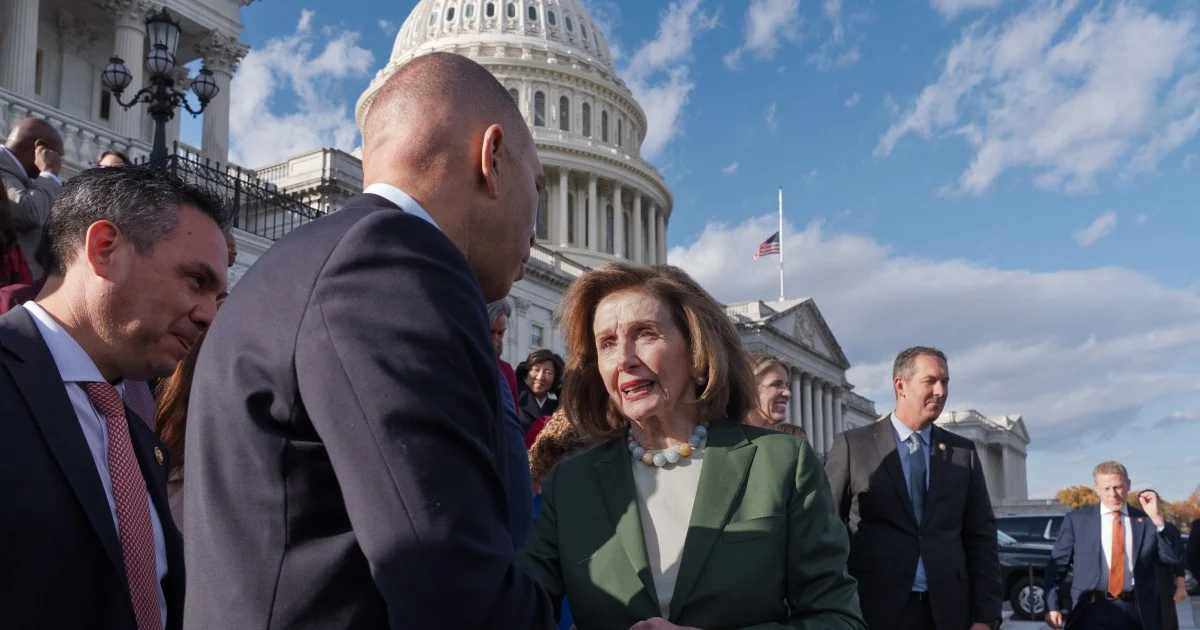
A recent vote in the House of Representatives, where over 100 Democratic lawmakers supported an amendment to halt military aid to Israel, has signaled a seismic shift in American foreign policy, exposing deep fissures in a long-standing bipartisan consensus that has largely shielded Israel from significant congressional scrutiny for decades. While the amendment ultimately failed due to opposition from some Democrats and nearly all Republicans, its considerable support underscored a fundamental change in Washington’s approach to its key Middle Eastern ally.
Erosion of an Unshakeable Alliance
For generations, military assistance to the Israeli armed forces stood as one of Washington’s most sacrosanct foreign policy commitments, upheld by both major political parties, powerful pro-Israel advocacy groups, and a foreign policy establishment that viewed it as a cornerstone of American strategy in the Middle East. This unwavering support, once considered immutable, is now demonstrably fragile.
The vote’s significance is powerfully illustrated by the stance of former House Speaker Nancy Pelosi. A staunch and consistent ally of Israel throughout her extensive career, Pelosi’s decision to join over 100 of her Democratic colleagues in backing a cut-off of military aid reflects a potent political reality that Democratic leadership can no longer disregard. The party’s base has undergone a profound transformation, and traditional assumptions regarding unwavering support for Israel no longer hold automatic sway.
The Gaza War as a Decisive Turning Point
This evolving landscape had been developing for years, but Israel’s war in Gaza served as the decisive catalyst. Even before the current conflict, a growing segment of Democrats expressed unease with the relentless expansion of Israeli settlements in the West Bank, the stalled peace process, and Prime Minister Benjamin Netanyahu’s alliances with far-right factions openly hostile to the prospect of Palestinian statehood. Within the Democratic Party, Israel was increasingly perceived not as an indispensable ally, but as a growing political and moral liability.
The scale of destruction and civilian suffering in Gaza, broadcast in real-time through social media platforms, fundamentally altered the domestic debate. Years of quiet apprehension among many Democrats coalesced into an unmistakable demand for accountability, pushing the issue from the periphery of foreign policy discussions to the forefront of domestic political discourse.
Campus Activism Fuels Generational Revolt
The roots of this transformation are not solely embedded within the halls of Congress; they originated on university campuses across the nation. From the initial weeks of the Gaza conflict, student organizers emerged as the moral and political vanguard, challenging decades of bipartisan orthodoxy regarding the U.S.-Israel relationship.
Encampments, educational forums, and widespread demonstrations, spanning from Columbia University in New York to UCLA in California, rapidly transformed the conflict in Gaza from a distant foreign policy concern into one of the defining domestic political questions for a new generation. This surge in campus activism quickly blossomed into a broader, generational revolt against the Democratic Party’s established approach to Israel.
Establishment Confrontation Alienates Younger Voters
Rather than acknowledging the profound depth of this generational shift, many within the Democratic establishment opted for confrontation over dialogue. Numerous party leaders defended aggressive crackdowns on student protests, with images of peaceful demonstrators being arrested, suspended, and forcibly removed circulating widely. These actions convinced many younger voters that their party leaders were more invested in preserving an outdated foreign policy consensus than in heeding the concerns of their own base.
The political repercussions of this approach have been substantial. While the crackdowns may have dispersed sit-ins, they failed to mend party unity. Instead, they accelerated the estrangement of younger and progressive voters, diminishing enthusiasm within crucial Democratic constituencies.
Electoral Consequences and Internal Reckoning
The 2024 election cycle starkly illuminated this growing disconnect. The Democratic Party not only faced a presidential defeat but also lost several congressional seats, including control of the Senate. While the Gaza conflict was not the sole factor, it served as a potent example of the consequences when a party establishment underestimates a profound generational shift. The attempt to suppress the movement, rather than extinguish it, inadvertently accelerated the Democratic Party’s internal reckoning over its policy toward Israel.
This year’s primary elections have reinforced this lesson. Progressive candidates have successfully unseated incumbents by openly rejecting unconditional military aid to Israel and refusing campaign contributions from influential pro-Israel organizations. These electoral victories demonstrate that criticizing Israeli government policy is no longer an electoral liability in many Democratic primaries; it has demonstrably become a political advantage.
A Shift Towards Conditional Aid and Accountability
Across both state and federal levels, Democratic lawmakers are increasingly articulating a need for conditions, accountability, adherence to international law, and a strategic recalibration of U.S. support for Israel. These concepts, once relegated to the fringes of political debate, are now central to mainstream discussions. The central question is no longer whether Israel should receive American support, but under what conditions that support should be provided, and whether Israel should continue to be exempt from standards applied to other U.S. allies.
The Dawn of a New Era in U.S.-Israel Relations
The result is the most significant political realignment concerning Israel in a generation. While Congress still possesses the legislative capacity to maintain military assistance, it has lost the bipartisan consensus that once rendered such support politically automatic and virtually unassailable. The true importance of the recent House vote lies not in its immediate legislative outcome, but in its revelation of the future trajectory of American politics.
The implications for Israel are potentially historic. For decades, successive Israeli governments have built their national security strategy on the bedrock assumption of consistently bipartisan and largely unconditional American military assistance and diplomatic backing. The billions of dollars in U.S. military aid have been instrumental in financing advanced fighter aircraft, sophisticated missile-defense systems, precision-guided munitions, and joint military research that underpins Israel’s qualitative military edge.
If the erosion of the bipartisan consensus continues, this foundational assumption may no longer hold true. Future Democratic administrations or Democratic-controlled Congresses might not entirely eliminate military assistance, but they are increasingly likely to condition it on Israel’s adherence to principles such as civilian protection, curbing illegal settlements, ensuring humanitarian access, and compliance with international law.
This shift would mean Israel would lose not only the certainty that has underpinned its long-term military planning but also the political guarantee of automatic U.S. protection from mounting international pressure. Israeli governments would increasingly be compelled to weigh the political ramifications of their actions alongside their military calculations.
In this context, the diminishing bipartisan American support represents one of the most consequential strategic challenges Israel has faced in decades. This is not because the alliance is necessarily ending, but because it is fundamentally transitioning from an unconditional partnership to one that is increasingly conditional. Whether Israeli leaders fully recognize it or not, the political landscape underpinning the U.S.-Israel relationship has irrevocably shifted, and political foundations, once they begin to erode, can crumble far more rapidly than they were initially constructed.