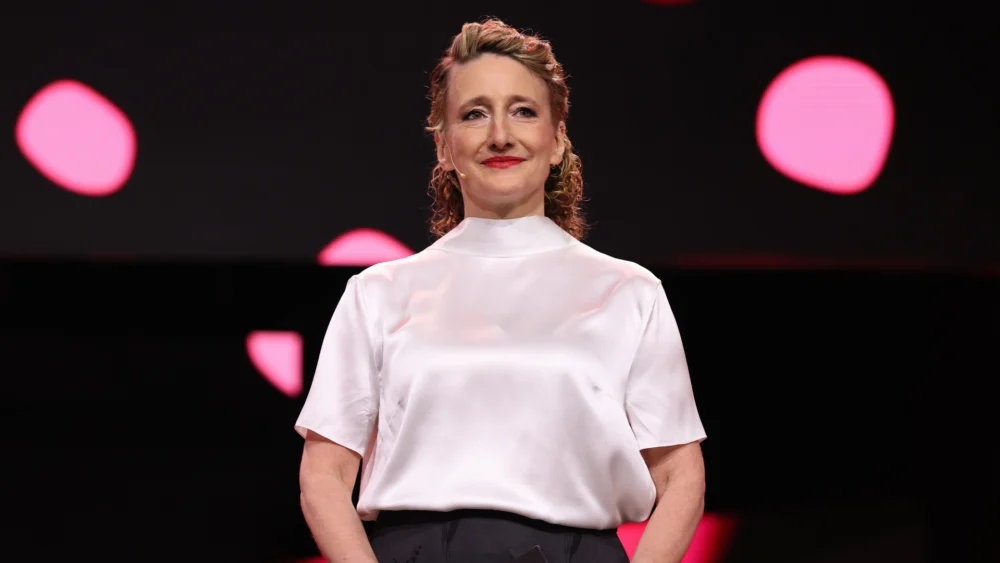
Tricia Tuttle, the current head of the prestigious Berlin International Film Festival, known as the Berlinale, is reportedly set to retain her leadership role but will be required to operate under new stringent conditions, including the establishment of an advisory board and the implementation of an "Antisemitism Code of Conduct" applicable to all festival participants. This development follows a period of intense public scrutiny and political pressure on the festival’s management in the wake of controversial pro-Palestinian statements made during its recent awards ceremony.
The German Culture Ministry, a key financial backer of the Berlinale, appears to have reached an agreement with Tuttle after initially exploring options for her early departure. Conservative German tabloid Bild, which has been a vocal critic of Tuttle and advocated for her removal, first reported that a separation deal could not be finalized, primarily due to Tuttle having three years remaining on her five-year contract. Instead, unnamed government sources cited by Bild indicate that Tuttle will continue as Berlinale director, having agreed to the new oversight and the mandatory code of conduct.
The Genesis of the Berlinale Controversy
The catalyst for these sweeping changes can be traced back to the Berlinale awards ceremony on February 21st, 2024. During the event, several filmmakers used their platform to express strong pro-Palestinian sentiments, sparking immediate outrage within Germany’s political establishment and conservative media. Syrian-Palestinian director Abdallah Al-Khatib, who received the top prize in the festival’s Perspectives section for his film Chronicles From the Siege, notably used his acceptance speech to accuse the German government of "being partners in the genocide in Gaza by Israel." This direct condemnation prompted German Federal Environment Minister Carsten Schneider to walk out of the ceremony in protest, underscoring the gravity of the political fallout.
Beyond the awards stage, Tuttle herself became a target of criticism, particularly from right-wing German media outlets. A premiere photo taken on February 15th, depicting Tuttle alongside the crew of Chronicles From the Siege, fueled the backlash. The image showed filmmakers wearing keffiyehs and holding Palestinian flags, symbols that have become highly contentious in the context of the Israel-Gaza conflict, particularly in Germany where discussions surrounding the conflict are often charged with historical sensitivities related to the Holocaust and the nation’s steadfast support for Israel.
Political Pressure and the Call for an Antisemitism Code of Conduct
The incidents at the Berlinale ignited a fierce debate within German political circles, with the German Culture Ministry expressing significant alarm. Culture Minister Wolfram Weimer, in an interview with the Rheinischen Post newspaper, vehemently condemned the events, using terms such as "hate speech," "activist attacks," and "Israel hate" to characterize the expressions from the festival stage. Weimer stressed the critical importance of a new code of conduct to prevent such incidents from recurring, signaling the government’s resolve to exert greater control over the festival’s public discourse. Given that the German government provides approximately 40 percent of the Berlinale’s budget, its influence over the festival’s operational and ethical guidelines is substantial.
The proposed "Antisemitism Code of Conduct" is expected to include a "taboo against antisemitism that applies to all participants," as reported by Bild. This measure is intended to codify behavioral expectations and ensure that the festival adheres to Germany’s official stance against antisemitism, which is a deeply sensitive and legally protected area in the country. The precise language and scope of this code, and how it will be enforced, remain subjects of considerable discussion and potential contention.
Navigating Free Speech and Artistic Expression
The imposition of a mandatory code of conduct raises significant questions regarding artistic freedom and free speech, fundamental principles often championed by international film festivals. Critics point out that the statements made by Al-Khatib and the display of keffiyehs and Palestinian flags, while politically charged and controversial, are not inherently illegal under German law. This creates a complex tension between the government’s desire to prevent expressions deemed antisemitic or supportive of groups critical of Israel, and the constitutional protections for freedom of expression.
How the new Berlinale code of conduct will be reconciled with Germany’s existing free speech laws is an open question, and its implementation could set a precedent for other publicly funded cultural institutions. The concern among some cultural observers is that such a code, if interpreted broadly, could lead to self-censorship among filmmakers and artists, potentially stifling critical commentary on global political issues. The Culture Ministry’s additional reported desire for Tuttle to "attract more Hollywood [stars] to Berlin" further complicates this dynamic, as potential restrictions on political expression might deter international talent seeking platforms for diverse perspectives.
Political Divides and Industry Solidarity
The controversy surrounding Tuttle and the Berlinale has exposed deep divisions within Germany’s political landscape. Calls for a "fundamental overhaul" of Germany’s most important film festival, and specifically for Tuttle’s replacement, originated primarily from the conservative Christian Democratic Union (CDU) party, a leading force in Germany’s ruling coalition. CDU parliamentarian Ellen Demuth, a member of the parliamentary committee on culture and media, publicly stated that discussions "must ultimately lead to the replacement of Tricia Tuttle as director of the Berlinale," reflecting a strong conservative push for change.
Conversely, Tuttle found significant support from other political factions and the international film community. Sven Lehmann, a member of the Green Party and chairman of the culture and media committee, voiced his "absolute delight that Tricia Tuttle wants to stay" as head of the festival. Lehmann lauded Tuttle’s "remarkable strength and deep commitment to the Berlinale and the art of film" in the face of what he described as a "campaign waged against her." He also directly criticized Culture Minister Weimer, stating that the minister had "lost a great deal of trust through his actions" and now bore the responsibility to restore that trust with Tuttle, the Berlinale team, and the wider German and international cultural scene. Lehmann emphasized that the Berlinale should "remain a place of free culture and exchange, not a place of intimidation," highlighting the ideological clash over the festival’s future direction.
Internationally, the film industry rallied strongly behind Tuttle. Hundreds of prominent actors, directors, and film professionals, including acclaimed figures like Sean Baker, Tilda Swinton, Vicky Krieps, and Wim Wenders, publicly expressed their support. This widespread solidarity culminated in an open letter published by 32 global film festival directors, including Cannes’ Thierry Frémaux, Sundance’s Eugene Hernandez, and TIFF’s Cameron Bailey. The letter unequivocally supported "Tricia Tuttle’s wish to continue as Berlinale Festival Director," underscoring the concern within the global film community about political interference in artistic programming and leadership.
Future Implications for the Berlinale
The implementation of an "Antisemitism Code of Conduct" and the establishment of a new advisory board mark a significant turning point for the Berlinale. These measures reflect the German government’s heightened sensitivity to geopolitical issues, particularly the Israel-Gaza conflict, and its determination to ensure that publicly funded cultural institutions align with national foreign policy and historical responsibilities.
The challenge for Tuttle and the Berlinale management will be to navigate this new landscape while preserving the festival’s reputation as a platform for diverse artistic voices and critical discourse. The details of how the advisory board will function, its composition, and its precise powers will be crucial in determining its impact on the festival’s independence. Similarly, the specific language and enforcement mechanisms of the "Antisemitism Code of Conduct" will shape the boundaries of permissible expression, potentially influencing everything from film selection to panel discussions and audience engagement. The Berlinale now stands at a critical juncture, tasked with balancing its artistic mission with increasing political oversight, a predicament that will be closely watched by the international cultural community.