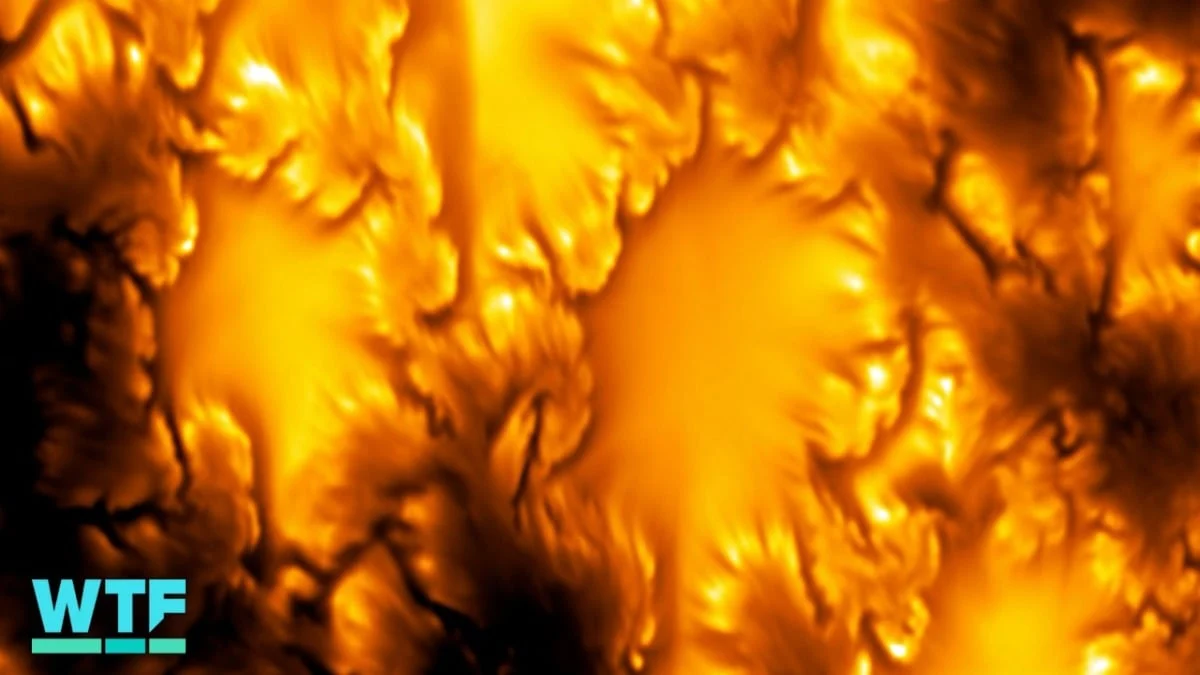
The National Science Foundation’s Daniel K. Inouye Solar Telescope has released unprecedented footage revealing the turbulent surface of the Sun in detail never before seen by human eyes. This highest-resolution video of the Sun ever captured showcases solar granules—churning cells of plasma—each roughly the size of the state of Texas, providing a window into the violent processes that power our solar system.
Located on the summit of Haleakalā, Maui, the Inouye Solar Telescope utilized its four-meter mirror to bypass the atmospheric interference that has historically limited ground-based solar observations. The resulting imagery depicts the solar photosphere, the visible "surface" of the Sun, as a mosaic of gold-hued, cell-like structures. These cells represent the top of convection columns where hot plasma rises from the interior, cools, and then sinks back down in dark lanes.
This milestone in heliophysics marks a significant leap in the ability of scientists to monitor and understand solar activity. By capturing features as small as 18 miles across, the telescope provides the granular data necessary to map the Sun’s magnetic fields. These magnetic structures are the primary drivers of solar storms that can impact Earth’s technological infrastructure.
Technical Breakthroughs in Solar Observation
The achievement of the highest-resolution video of the Sun ever captured required a total reimagining of telescope thermal management. Because the telescope’s primary mirror focuses a massive amount of solar energy onto a single point, temperatures at the focal point can reach levels high enough to melt metal. Engineers implemented more than seven miles of piping to circulate coolant throughout the observatory, effectively dissipating the heat generated by the concentrated sunlight.
In addition to the cooling system, the telescope employs advanced adaptive optics. This technology uses a deformable mirror that adjusts its shape hundreds of times per second to compensate for the blurring effects of Earth’s atmosphere. This allows the Inouye Solar Telescope to achieve a level of clarity that rivals or exceeds space-based observatories, which are limited by the physical size of the mirrors that can be launched into orbit.
The data processing requirements for such high-resolution imagery are equally immense. The observatory generates approximately nine terabytes of data daily, necessitating a robust cyberinfrastructure to store, process, and distribute the findings to the global scientific community. This data pipeline ensures that researchers worldwide can analyze the fluid dynamics and magnetic shifts occurring in real-time on the solar surface.
Understanding Solar Granulation and Plasma Dynamics
The "honeycomb" pattern seen in the highest-resolution video of the Sun ever captured is the result of convection, the same process seen in a boiling pot of water. In the Sun’s case, the "water" is a superheated, electrically charged gas known as plasma. The bright centers of the granules are the locations where hot plasma is erupting from the depths of the Sun.
As the plasma reaches the surface, it spreads out, cools, and becomes denser. This cooler, heavier plasma then descends back into the Sun through the dark channels visible between the bright granules. These dark lanes are of particular interest to physicists because they are often the sites of intense magnetic activity.
By studying these convection cells, scientists hope to solve one of the greatest mysteries in solar physics: why the Sun’s outer atmosphere, or corona, is millions of degrees hotter than its surface. The high-resolution video provides clues as to how magnetic energy is transported from the interior to the outer layers, potentially explaining the mechanism behind this extreme heating.
The Role of Magnetic Fields in Space Weather
The primary mission behind capturing the highest-resolution video of the Sun ever captured is to improve our understanding of space weather. The Sun’s magnetic fields are constantly twisting and snapping, a process that can trigger massive explosions known as solar flares and coronal mass ejections (CMEs). These events send clouds of charged particles hurtling through the solar system at millions of miles per hour.
When these particles reach Earth, they interact with the planet’s magnetic field, creating geomagnetic storms. While these storms produce the beautiful auroras seen at the poles, they also pose a significant threat to modern civilization. A major solar event has the potential to disable satellite communications, disrupt GPS navigation, and cause widespread failures in the electrical power grid.
The Inouye Solar Telescope’s ability to resolve small-scale magnetic structures allows researchers to see the "seeds" of these solar storms before they erupt. Current predictive models for space weather are often limited by a lack of high-fidelity data. With the new imagery, scientists aim to increase the warning time for solar events from approximately 48 minutes to 48 hours, giving utility companies and satellite operators more time to protect their assets.
Protecting Global Infrastructure from Solar Threats
The economic implications of a severe solar storm are staggering. A 2013 report by Lloyd’s of London estimated that a solar event on the scale of the 1859 Carrington Event could cause between $600 billion and $2.6 trillion in damages to the U.S. power grid alone. Such an event would destroy high-voltage transformers, leading to blackouts that could last months or even years in some regions.
The highest-resolution video of the Sun ever captured serves as a critical tool in the global strategy to mitigate these risks. By providing a detailed look at the solar "weather patterns," the telescope enables a more proactive approach to grid management. Power companies can utilize the data to adjust loads and isolate vulnerable components when a solar storm is detected.
Furthermore, the aviation industry relies heavily on solar data. During periods of high solar activity, radiation levels at high altitudes can increase, and radio communications used for trans-oceanic flights can be disrupted. Improved forecasting through high-resolution solar monitoring allows airlines to reroute flights away from polar regions and ensure the safety of passengers and crew.
A New Era of Multi-Messenger Heliophysics
The Inouye Solar Telescope does not work in isolation; it is part of a broader international effort to study the Sun from multiple vantage points. It works in tandem with NASA’s Parker Solar Probe, which is currently "touching" the Sun by flying through the outer corona, and the European Space Agency’s Solar Orbiter, which is capturing the first images of the Sun’s polar regions.
The combination of ground-based observations from the highest-resolution video of the Sun ever captured and in-situ measurements from space probes provides a "multi-messenger" view of solar physics. While the Parker Solar Probe measures the environment directly, the Inouye Telescope provides the context by showing what is happening on the surface at the base of the solar wind.
This collaborative approach is essential for building a comprehensive model of the solar-terrestrial environment. As the Sun enters the more active phase of its 11-year solar cycle, known as solar maximum, the frequency of flares and CMEs is expected to increase. The synchronized data from these various instruments will be vital for monitoring the Sun’s behavior during this period of heightened activity.
Future Implications for Science and Society
The release of the highest-resolution video of the Sun ever captured is only the beginning of a planned 50-year mission for the Inouye Solar Telescope. As the instrument continues to collect data, it will likely lead to the revision of long-standing theories regarding stellar evolution and plasma physics. The Sun is the only star close enough for humans to study in such detail, making it a laboratory for understanding the billions of other stars in the universe.
Beyond the scientific community, the imagery has a profound public impact. It serves as a reminder of the dynamic and often violent nature of the star that sustains life on Earth. The visualization of solar granules provides a tangible sense of the scale and power involved in stellar processes, fostering a greater public interest in STEM fields and space exploration.
The continued operation of the telescope also highlights the importance of international cooperation in science. While funded by the U.S. National Science Foundation, the data is shared with researchers across the globe, reflecting the universal nature of the threat posed by space weather. As society becomes increasingly dependent on satellite technology and interconnected power grids, the need for precise solar monitoring has never been more critical.
Advancing the Frontiers of Solar Research
The Inouye Solar Telescope represents the pinnacle of current optical engineering and solar science. By providing the highest-resolution video of the Sun ever captured, the National Science Foundation has opened a new frontier in our quest to understand the nearest star. The level of detail achieved—seeing features the size of a small city on a sphere 93 million miles away—was considered impossible just a few decades ago.
As researchers delve deeper into the petabytes of data produced by the observatory, the focus will shift toward long-term trends in solar magnetism. Understanding how the Sun’s magnetic field is generated in the interior and how it emerges through the surface will be the key to unlocking the secrets of the solar cycle. This knowledge is not just academic; it is a fundamental requirement for the long-term survival of a technologically advanced civilization.
The ongoing observations from Maui will continue to refine our view of the Sun, transforming it from a distant, glowing orb into a complex, ever-changing landscape of plasma and magnetism. The highest-resolution video of the Sun ever captured is a testament to human ingenuity and a vital shield against the unpredictable nature of our solar system.